

 Online Reporter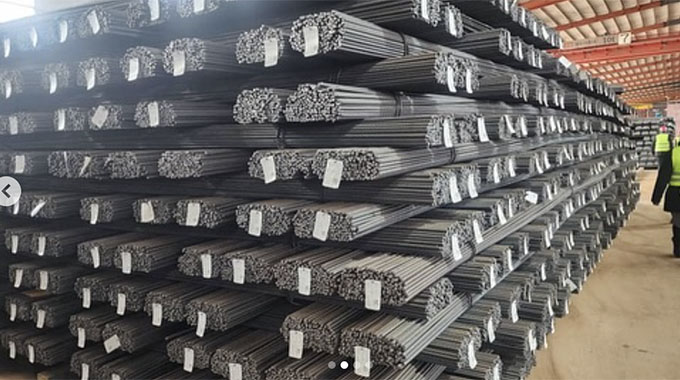
THE manufacture of steel and a growing range of products, such as bars and now piping, by Dinson Iron and Steel Company in Mvuma is having a major beneficial effect on Zimbabwean development.
For a start and for all practical purposes, all construction material is now produced in Zimbabwe: cement, bricks, reinforcing steel and tiles.
The largest construction project in the country, the dam wall at the confluence of the Gwayi and Shangani Rivers in Matabeleland North, is now being accelerated and the upper levels of the wall will be solidly Zimbabwean.
From the beginning, Zimbabwean cement along with the sand and aggregate were local, but until last month imported steel had to be used for the reinforcing. But last month Dinson started delivering the local steel bars and has assured the contractor that it can handle the large orders needed under the present accelerated building programme.
So the Government-appointed contractor is now using Dinson reinforcing steel, presumably after checking it out and ensuring that it met the demanding standards for a dam wall that has to last centuries. Dam walls have these sort of expected lifespans even with very variable pressures as the levels of the impounded lakes rise and fall from almost empty to totally full.
The Government is now determined to finish the dam wall before year end, so that the next season can start filling the impounded lake, and has promised an adequate cash flow to the contractor so that work can be continuous, 24 hours a day.
The arrival of the Zimbabwean construction steel will also benefit investors and developers throughout the construction industry, who now have a reliable supplier “round the corner” instead of having to wait for railway or truck deliveries of well over 1 000km.
There is the problem that outside supplies needed to fit in Zimbabwean orders with what their own local customers wanted.
Before Dinson were able to supply there were reports that potential regional steel shortages were looming. Considering that steel is a very heavy product, shorter transport routes automatically cut transport costs significantly and to this can be added the fact that with Dinson, owner and investor Tsingshan Group of China fitted the latest technology to produce a highly competitive product. Every dollar that can be saved in a construction project means that it becomes more viable.
Dinson are also pretty sanguine that they will be able to supply the large 1,8m diameter pipes needed for the pipeline from the dam to Bulawayo, ending the perennial water shortage in Zimbabwe’s second city and allowing it to accelerate the rebuilding and expansion of its heavy industrial base . . . something that is ever more vital as Dinson and others build up the supply of heavy industrial raw materials.
Dinson is scheduled to go beyond ingots, bars and now pipes and finally produce what has never been produced before in Zimbabwe, steel sheet in a range of grades and formulations.
That will be an essential raw material for many industries that want to manufacture products.
Dinson has already started exporting steel and considering they are looking in the short term of producing 600 000 tonnes a year, it will be some time before local demand might slow exports.
Hopefully, Dinson will be building up exports of value added products, such as bar, piping and sheet steel, rather than just ingots so that the exports become more valuable.
Zimbabwean industry is strong in agro-processing and there is a wide range of smaller concerns involved in other manufacturing, but we have been weak in the heavy industrial base. Too much of industry, outside the agro-industries and cement and one or two others, has been reliant on processing imported raw materials.
This was an industrial strategy initiated when it became necessary to look at import substitution for local markets under a very tight supply of foreign currency, when every potential saving was a help. But it will not build the industrial giants, we need to make goods that sell throughout Africa under the African Continental Free Trade Area.
As we build up our manufacturing industry, and this is not just Government policy, but what every economist continually recommends, we need to have the big background of a large heavy industrial base. Dinson now provide that with steel, and investment plans go beyond increasing the range of ordinary steel products such as bar, pipes and sheet, but include the Tsingshan specialties of stainless steels.
Already, Tsingshan are a major force in the chrome processing industry and have interests in nickel, the two major raw materials after the iron and coke in stainless steel. This should be exciting potential investors, local and foreign, in manufacturing. Having the required raw materials on tap nearby at competitive prices is always useful.
One reason Tsingshan must have had in mind when deciding on their major investment in Zimbabwe with more to come, must have been besides the pro-investment corruption free environment, the ready access to almost all the raw materials needed for a major modern steel company.
Although their investment has had to include other significant investment into electricity generation and transmission, the fundamentals ensured that the additions were acceptable.



