Online Reporter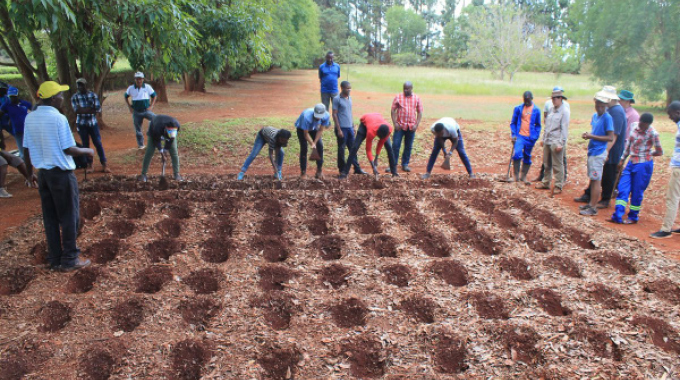
WITH lower rainfall forecast across Zimbabwe and Southern Africa in general as a result of the super El Nino building up in the Pacific Ocean, an improved drought mitigation plan has been drafted and approved by Cabinet to minimise the effects and ensure adequate food supplies.
The Government has drawn on the lessons of the 2024-2025 season, which saw the worst drought since independence, yet was managed effectively with no one starving, reasonable harvests in some areas, and perhaps most remarkably a low livestock mortality, with far fewer cattle dying than had died in previous less severe droughts.
This time we will do even better.
Even with drought, better farming using climate resilient methods, more irrigation and other interventions, the grain harvest is still expected to reach 1,6 million tonnes.
Of this around 600 000 tonnes is likely to be sold by farmers after they have met their own on-farm requirements and will be available in the strategic grain reserve, along with carry overs from last season, for the essential programmes such as ensuring that families who had bad harvests receive grain.
This is the number one priority, to make sure no one goes hungry. Excellent systems were put in place using community knowledge to find those who would need help and then making sure they received that help.
There will almost certainly be a national grain deficit, despite the continually improving farming, of anything between 266 881 tonnes and 541 881 tonnes.
Following what worked so well last time, the private sector millers will import some or most of their requirements, allowing the reserves to be used for relief programmes.
Individual households will also be allowed to import, although these personal imports are likely to be modest.
Climate-proofing farming techniques are being pushed hard.
In the small-scale sector this means using Pfumvudza/Intwasa with all the lessons learned as fully as possible.
Already farmers have been asked to make sure all planting holes are dug, or redug, to the recommended depths, thus trapping more of the rain that does fall.
In addition, full mulching with as much manuring as possible is being pressed; mulches not only help build up soils but reduce evaporation considerably, so retaining more of that trapped rainwater longer.
By preventing that hard-baked surface that can arise in just a few days, mulches again help ensure more of the rain that falls is absorbed by the soils.
They also limit erosion.
Larger-scale farmers use similar techniques, although done in different ways.
Decent rains last season has almost certainly increased the amount of suitable and accessible mulch materials for most farmers.
The research has been continuing, and it is now known that degraded soils are more common and more strongly acidic than once thought.
The solution is obvious, more lime. But once again that solution has been refined to using liquid lime, which is easier to transport around a small farm and easier to apply.
Practical research does look at the farmer using that research, and tries to ensure that recommendations are easy to implement.
Since the last drought, thousands of additional boreholes have been drilled in the national programme with the creation of community-managed village business units following.
This will not only help ensure reasonable supplies of fresh food to go with the grain, but increases the number of livestock watering points, a critical factor in minimising livestock mortality.
Obviously there will be need for some careful management of the water from these boreholes, and sensible allocations for all needs. But that is the advantage of community management, each village being able to do what works best in its area.
Better pasture management and other techniques, which are implemented in good years as well as drought years, also add to the resilience of livestock farming.
One longer-term trend that the frequent fluctuations in seasonal cycles is seeing the growing popularity of the cattle breeds indigenous to Zimbabwe, animals that over centuries have evolved to being able to cope a lot better with hot and dry conditions than exotic breeds.
They also tend to have better resistance to some animal diseases and generally are better adapted to local conditions.
Pure-bred strains have been developed over decades by enthusiasts, and are either farmed as pure-breeds or are cross-bred to include other desirable characteristics on top of the local higher survivability.
The Government programme has obviously been continually updated since the last drought, so this time we do it better, one of the marks of the Second Republic.
We came through the 2024-2025 drought rather well and this time we should be able to do quite a lot better than “rather well” as we know more of what works and what does not.