admin
admin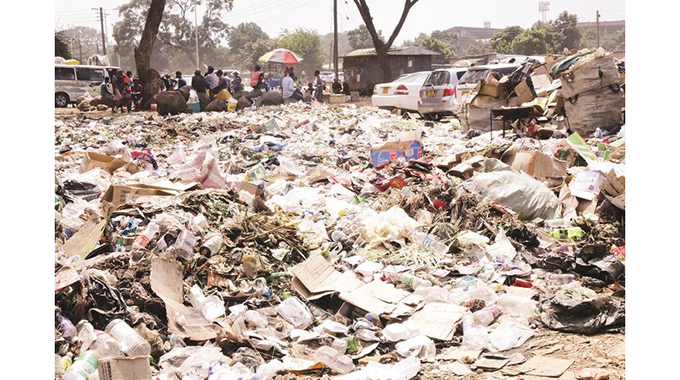
Harare Metropolitan has fast been overtaken by the accumulating uncollected rubbish dumped in the open on any vacant land and left to moulder and rot and create serious health hazards.
The problem has arisen from the inability of the four councils to cope, with the two largest, Harare and Chitungwiza municipalities being the worst, as well as the largest. Now the Environmental Management Agency is moving in to take over, using the staff and equipment of the councils already assigned to garbage removal as it co-ordinates the process, but also able to access other council resources as well as resources from the National Civil Protection Fund.
This required President Mnangagwa to declare a state of disaster in Harare Metropolitan over waste removal and then bring in the EMA as the lead Government agency to fix the problem.
The declaration trumped the independence the two municipalities and two local area boards had when it came to services such as waste removal. These are supposed to be done by local authorities and in general the central Government does not interfere and especially in the cases of municipalities it cannot interfere, unless there is a declared state of disaster.
The need for the declaration and the temporary assignment of the EMA to organise waste removal, both the day to day operations to stop further accumulation and the special operation to clean up the illegal dumps and clogged streams and wetlands, was obvious.
There is the regular services, largely collecting garbage from houses and business premises and ensuring that there are public bins where needed so people do not throw litter into the streets.
This sound simple and in fact was one of the first functions of the old Salisbury Sanitary Board set up in the early 1890s, and carried on by the municipal council that replaced this bard in the late 1890s.
For over a century the board and council managed to collect the garbage regularly, empty the binds and generally keep the city clean. Even the continual battle against little was fought, with public bins put in place and designs sought to prevent vandalism.
The state of disaster arose when the efforts required were simply not being met. We have, just as one example, Harare City Council stating that only 18 of the required 36 garbage trucks are working.
We do not hear what is being done to fix those that can be repaired, nor when the new ones arrive. The only other contribution from the council is the regular demand on the rates bill for refuse removal charges, and often this like the water bill is for a service that we have to pay for but do not get.
Hand-ringing by the mayor is not going to improve matters. It needs a more determined effort.
The breakdown in regular weekly collections are every residential house and flat, and the more frequent services at business premises, and owners of those are charged higher rates to cover this sort of thing, has regrettably led to some taking illegal action.
So we have people sneaking out at night with a sack of garbage and quietly dumping it on an illegal dump that has grown in their area nearby, or going down to the nearest stream or wetland and throwing the waste there.
This might get the rotting rubbish out of their own premises, but it does not help the community or the need to have a safe and hygienic city.
The EMA has a hard task ahead of it, and will require the backing of everyone, including the four councils and their staff, so that a proper job is done. More resources need to be mobilised just to stop the garbage problem getting worse, that is getting household and business rubbish collected regularly according to the timetables that have been paid down.
At the same time the EMA and the councils need to start getting those public bins in place.
Every now and again in Harare city centre and at some suburban shopping centres there is a major effort involving businesses sponsoring public bins.
This works for a short while, although those bins need to be emptied daily and sometimes more frequently, and then the effort eases off and we find metal rusting and other materials breaking up.
The net result is the growing litter in the streets, as so few seem to care. There might be grounds for the EMA to use the bylaws all councils have on littering, plus its own powers when it comes to those who dump rubbish, to wage an enforceable campaign against litter, trying for the educational progress first but then starting to fine the litterbugs who simply do not listen.
Besides getting “normal services restored” though there is a lot of legacy work for the EMA to do, removing those huge informal dumps and starting to clean up public open spaces where rubbish has been dumped. Here the extra resources will be needed.
At the same time the EMA needs to look at why the largest of these informal dumps are formed.
It almost certainly goes beyond the decline in collection services from the councils, and part of it will be the growing volume of rubbish, sometimes because of new business or different business, and sometimes from the change in packaging.
In former times there was a lot more biodegradable packaging. A paper bag rots long before a plastic bag even starts, and a lot more households used fresh fruit and vegetables and converted the waste from these into compost, so bins were not nearly so full.
The EMA might want to involve garden experts and the like to see what households can do about recycling some of their rubbish into compost. It could even try to get better recycling moving in any case. In some parts of the world households have to split up their rubbish into several categories, and one of the reasons that so many agree to do this is that in those cities the garbage removal charges fall, and after a while can be abolished.
The city earns more money from selling off large portions of carefully separated garbage than it needs to buy and run the collection trucks. Zimbabweans might not like having to use five different coloured bags, but if this cuts their monthly bills and cleans up their city they might be persuaded to start, at least in one suburb as a pilot scheme.
The EMA has a major opportunity in this spell of overseeing all the garbage removal in Hare Metropolitan and managing a large part of the services.
It can put into practice a lot of what it has learned, and the knowledge of what needs to be done, and start creating something a lot better that can be handed back to the local authorities when the temporary arrangement has succeeded.


 leeroy