


 admin
admin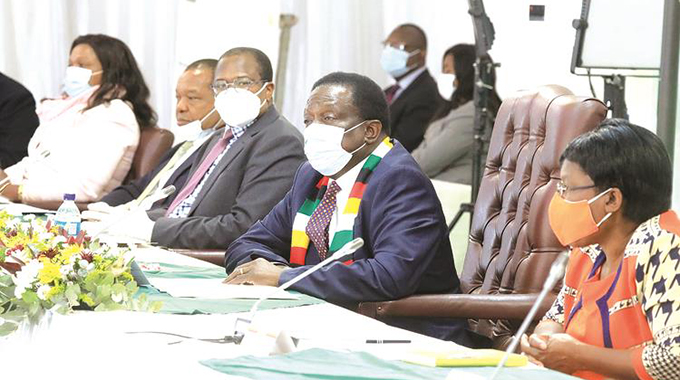
The land issue has always been an emotive one, with vicious resistance having been demonstrated throughout the redistribution phase.
However, the Second Republic has been vehement in its quest to bring the issue to rest once and for all.
This has culminated in the signing of the Global Compensation Deed on July 29, 2020.
However, instead of getting a standing ovation for staying true to its promise, Government has been vilified, with the opposition going into the overdrive attacking the move, particularly on social media.
It is most unfortunate that the opposition and a certain section of Zimbabweans have developed a destructive penchant of attacking and opposing every move by Government without fully appreciating the intended objective and meaning of it all.
They have, in the process, exposed themselves as either ignorant or just bent on fomenting chaos at every turn to suit the masters’ whims.
However, the earlier they realise that there is more to be gained by being positive and progressive, the better for this country.
Zimbabwe is in an economic regeneration mode and it would certainly be beneficial if we got all hands on deck instead of attention-seeking geriatrics bent on side-tracking current efforts.
We are in no way suggesting that Zimbabweans should all become “yes-men” but instead, informed interjections and constructive criticism should be proffered as opposed to merely opposing for the sake of it.
Government has come out clear that only those farmers under the Bilateral Investment Promotion and Protection Agreements (BIPPAs) and the Bilateral Investment Treaties are getting their land back while some black indigenous farmers who had lost their land are also set to benefit.
The Government meets its end of the bargain prescribed by the Constitution.
This plausible exercise demonstrates the Second Republic’s desire to mend relations with the international community while also creating a conducive environment to attract Foreign Direct Investment (FDI).
What is also pleasantly surprising is that those that strongly opposed the fast-track Land Reform Programme previously, have suddenly repented and are now screaming the loudest that there should be no reversal.
This is simply an admission that it was not a bad idea after all.
They criticised the Land Reform Programme no end and yet in their hearts of hearts they saw it as a viable empowerment strategy, hence the tears and fears that the process was about to be “reversed”.
Addressing members of the Political Actors Dialogue (Polad) on Friday, President Mnangagwa did not mince his words.
“Let me restate that the Land Reform Programme is irreversible. To this end, there is no vacillation. The current processes with regards to land issues entail the implementation of provisions of our national Constitution, in particular, Section 295 as it relates to black indigenous Zimbabweans. I urge all farmers to remain focused on preparing for a successful 2020-2021 season,” he said.
It is stated in the Transitional Stabilisation (TSP) programme that:
“The New Dispensation has taken the decision to finalise compensation to all former farmers affected by the Land Reform Programme, in accordance with the country’s Constitution and Zimbabwe’s obligations under bilateral agreements.
“Work towards this is being expedited through a Working Group comprising Government officials and representatives of former farm owners,” reads the document.
This is precisely what the Government is doing.
Indeed, Zimbabwe is working towards achieving food self-sufficiency and to return to its status as the region’s breadbasket.
Strategies have been put in place and more is being done to ensure that this is achieved.
A resurgence in agriculture has a significant effect on the economy as a whole and should be supported by all.
Africa’s blueprint and master plan for transforming the continent into the global powerhouse of the future has also identified agriculture as key to the continent’s prosperity.
The Comprehensive African Agricultural Development Programme (CAADP) is one of the continental frameworks under Agenda 2063 and it aims to help African countries eliminate hunger and reduce poverty by raising economic growth through agriculture-led development as well as promoting increased national budget provision to the agriculture sector.
Through CAADP, African governments are expected to increase investment level in agriculture by allocating at least 10 percent of national budgets to agriculture and rural development, and to achieve agricultural growth rates of at least 6 percent per annum.
CAADP also sets targets for reducing poverty and malnutrition, for increasing productivity and farm incomes, and for improvements in the sustainability of agricultural production and use of natural resources.
This dovetails with what the Government is doing as it implements such strategies as the Pfumvudza programme.
Giving back land to the 37 farmers is also a strategy to bring stability in the sector hence increased productivity.
Such efforts are fast changing the narrative in agriculture and the economy at large.
We implore the Government and its private sector partners to persist on this trajectory.


 Online Reporter