dyton mupawaenda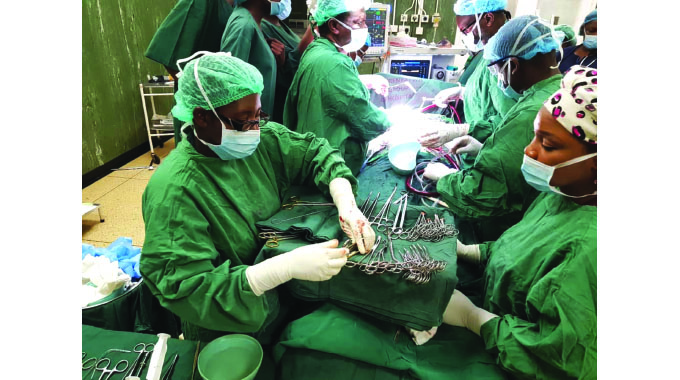
The announcement that 60 free open-heart operations will be performed at Parirenyatwa Hospital this year is both a significant leap forward in Zimbabwe’s health facilities, especially the public sector, and a sign that what was almost experimental surgery a couple of years ago is now moving into the routine, although demanding teams of very high-end professionals.
Improvements in what Zimbabwe can do in the medical world must be based on this double, of more and better equipment in hospitals, and of more medical professionals, both the specialists and the support teams they require. Advances come through when all these pieces are in place.
Zimbabwe has for decades had very good training for nurses, technicians and doctors, and has been able to train specialist medical staff without much problem. Keeping them in Zimbabwe has been harder. Of course, in a normal course of events, many young professionals given the opportunity may well want to spend a few years at another hospital in another country to gain further skills and experience, and then return to their own country to use them.
So it has not so much been our young medical professionals leaving the country, as perhaps far too few coming back and instead settling where they went. That is their right, but it has meant a large drain on our medical manpower.
Reforms throughout the system under the Second Republic have helped to ease the brain drain, and these reforms are many. Obviously the transfer of all medical staff to the new Health Services Commission and an upgrade of the old board for health services, has helped to concentrate efforts in the staff lines in public service.
The open heart surgery team needs three specialist surgeons, so that two are available for every operation, plus the anaesthetist, plus the trained surgical nursing staff, and a range of technicians who are operating and maintaining the complex equipment. The retention levels and return levels of such staff are now high enough to assemble such teams.
And we are fortunate that the leaders of the medical profession see it as part of their duty to be available for public work as well as private practice and that they see teaching the next generation of doctors and specialists to be something they have to do, although universities do not overpay their part-time teaching staff who do so much of the hard work of mentoring the next generation in their post-graduate specialist qualifications.
But we have also seen a major upgrade of the public health facilities, the hospitals and clinics, and the access to equipment, consumables and medicines. A few years ago even the most dedicated doctors were almost at the end of their tether because the bare essentials to do their work were simply not there. Some decisive action did make a large difference and then we have been seeing a steady improvement in equipment.
The private health sector, which does tend to grow rapidly in times when there are problems in the public sector, has tended to confirm the upgrade in the public sector. It has remained fairly stable over the last few years as more people are prepared to use public facilities and more top professionals are able to work in them.
We need to remember that some of the most advanced medical work done in Zimbabwe is done in the large referral hospitals and that is where the top specialist teams of doctors, nurses and technicians tend to be based. The separation of conjoined twins, which can now be done in Zimbabwe, was done in a Government hospital as is this fairly large number of free open-heart operations.
Some of the major improvements in the public health sector have been backed by the general private sector and by development partners. A lot of this came through during the Covid-19 pandemic when it was obvious that a lot of work needed to be done on hospitals and clinics, in creating intensive care and isolation units and the like. In other words a major upgrade of facilities.
That was done with everyone working together and with the Ministry of Health and Child Care able to specify exactly what was needed and able to account in detail for everything they received from the Treasury and what they received from donors. Such efficiency encouraged others to come in.
While Covid-19 retreated, those upgraded, repaired and new facilities are still there, and are being put to very good use for all the other medical problems that routinely arise. There are hundreds of medical problems that might end up in intensive care and if the right equipment and trained staff are there, thanks to Covid-19, then they are there for whatever follows.
We can see other signs of high levels of efficiency being routine. When this new polio variant, which everyone thought was extinct, suddenly emerged in central and east Africa, an urgent vaccination programme was organised. WHO and Unicef might well have supplied Zimbabwe’s ration of the new vaccine stocks, knowing they would be put to proper use.
It was interesting to note that the two vaccination doses were each given to more than four million children in just one week each. But when you think about it, what was passed off as a normal operation must have required a lot of work, to make sure that the staff were where they were supposed to be, that they were bringing in the children and that the logistics of getting the vaccine to each point worked.
This upgrade of the public health system, right from the community health workers to the top-end of health professionals, must be maintained with progress every month and every year while what has been done already is properly maintained and continued.


 Online Reporter