

 admin
admin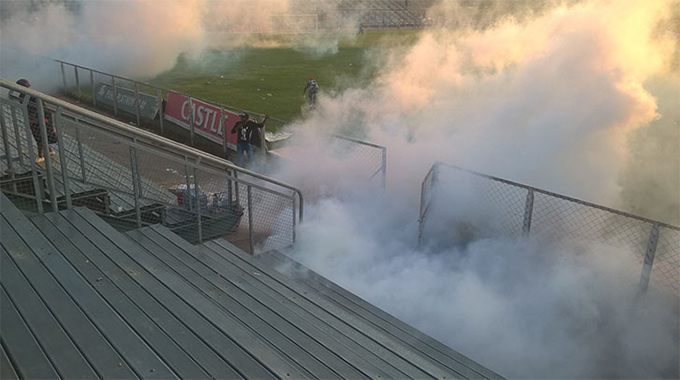
Incidents of violence that have marred domestic Premiership football in the last few days should be a huge cause for concern.
Recently, the Zimbabwe Republic Police (ZRP) arrested 15 people in connection with disturbances that led to the abandonment of a league game between FC Platinum and Highlanders at Mandava.
The supporters apparently took the law into their hands after the referee had given a penalty decision, which they did not agree with.
The police memo on the incident indicated that a section of supporters clad in Highlanders colours “reacted to the penalty decision by throwing missiles in the form of water bottles and stones onto the pitch toward players, match officials and the police that had formed a barricade, forcing the match officials to stop the match.”
The match had to be abandoned with 84 minutes played, while the teams were tied on 1-1.
It was a sad ending to what have been interesting duels between these two teams over the years.
Hooliganism has always been a huge challenge, not only in Zimbabwe but worldwide. But it always gets us worrying when the scourge hits close to home.
Football is all about friendship and fair play.
The pitch is reserved for players and match officials on duty. Fans have no business scaling the fence and invading the pitch to make their voice heard.
Sometimes referees do err just because they are human.
One of the most basic tenets of football, which is understood by all, is that the referee’s decision is final.
If an error is made there are always remedies available to the affected parties to seek redress. It is not for the fans to manhandle the referee and try to force him to change the decision.
That is the highest level of indiscipline and criminality which should not be tolerated in our sports at all. It is always worrying when football grounds are turned into war zones.
The hooligans even disregarded the pleas from their own club officials, including Highlanders captain Ariel Sibanda who literally begged them to return to the terraces as they advanced threateningly towards the match officials.
It is always difficult to understand what will be going on in the minds of such bad-mannered characters.
Imagine the damage to property that always comes as a result of these skirmishes and the potential injuries to players, officials and fans, and even loss of life.
We are told the commotion continued into the central business district of Zvishavane, where innocent people could have been caught up in the disturbances.
A few days before the violence at Mandava, we had already witnessed some red flags in the Independence Day Cup final between Dynamos and Highlanders at Barbourfields.
Supporters rained missiles onto the pitch on different occasions to protest the referees’ decisions during that match.
While it is almost unanimously agreed that the refereeing standards have gone down, there is no justification whatsoever for supporters to invade the pitch and engage in violent confrontations.
Clubs should take a leading role in educating their supporters about the dangers of hooliganism.
It is these clubs that stand to suffer huge losses if this problem is not solved.
Apart from the potential loss to life and the widespread damage to property, hooliganism is a bad advertisement for football.
It discourages well-meaning fans from attending matches, and the clubs lose potential revenue in terms of gate takings.
Worse still, these unfortunate incidents come at a time the league authorities are struggling to attract people back to the stadium in the aftermath of the Covid-19 disruptions.
Sponsors and the corporate world are also not keen to be associated with such a despicable product, if hooliganism goes unchecked.
As a result, clubs suffer because of lack of corporate buy-in.
Police, to their credit, managed to track some of the culprits and 15 people were arrested for “disorderly conduct as defined in section 41 of the Criminal Law (Codification and Reform] Chapter 9.23. ZRP Zvishavane 1049/22-1063/22 refers.”
Hooliganism is a criminal offence.
All the stakeholders should play their part to make the football stadium a safe environment.
Hooligans out to make the beautiful game look ugly should be sniffed out of football.



 Online Reporter