dyton mupawaenda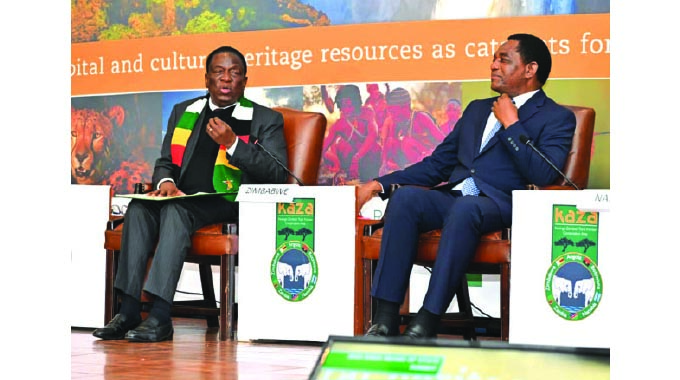
The growing overpopulation of elephants in particular, but also some other African wildlife species, in Southern African threatens a major ecological collapse across a swathe of SADC, and especially in the Kavango-Zambezi Conservation Area where the cooperation of five countries is being upgraded.
But the countries are being penalised for looking after their wildlife, especially the elephant, by the way the international conservation movement tries to micromanage conservation everywhere, as President Mnangagwa noted last week at the KAZA Summit in Livingstone.
Yet, as the President also noted, a lot of the countries that want to tell KAZA countries, and for that matter the rest of Southern Africa, how to look after their game have fairly bad records over looking after their own wildlife.
The extinctions and near extinctions of megafauna over much of Europe and North America in the last few thousand years has been severe, for example.
Southern Africa, and Southern African communities, see wildlife as a resource, not as something separated from the population and the economies and put in a very large open-air zoo.
The whole point of the KAZA conservation area is to treat the wildlife and farming zones within its range as a single unit to prevent fragmentation of wildlife ranges and to have people and wildlife in the same area.
As part of the measures that allow people and wildlife to live together is controlled hunting, and in some cases this may even have to be extended to culling.
This happens to be natural, at least in Africa, where the hominid family evolved and has been in various forms a predator for several million years.
The Southern African countries have also built up stockpiles of ivory from natural deaths, problem animals and seizures from the few poachers who still try their luck with the courts that jail them also seizing their ivory.
There is an estimated US$1 billion worth of ivory in these stockpiles, which could pay for a lot of conservation work, but which cannot be tapped.
All elephants in the world have been placed in the first appendix of the CITES treaties, meaning that there can be no trade in elephant products and no hunting of elephant.
This was done because of the severe poaching pressure in most of the rest of Africa and in Asia, that had led to all three species of elephant becoming endangered across most of their range.
But while the three living species are listed as endangered in the case of the African bush elephant and the Asian elephant, and critically endangered for the African forest elephant, much of Southern Africa has done the hard work of preserving and taking care of the bush elephants found in the region, to the extent that Botswana has the largest national herd, followed closely by Zimbabwe.
And the easily biggest threat to the elephant in these two countries is the collapse of their environment. This has happened before.
Most Zimbabwean wildlife experts have heard first hand or through their mentors about the Sebungwe Disaster in what is now the Binga, Gokwe North, Gokwe South, Hurungwe and Kariba districts.
This huge area was largely shot out in a tsetse control measure in the early 1900s and then just left. The wildlife rebounded, but without any hunting or other controls, and sixty years later was eating itself out of house and home. More trees were being destroyed by elephant than were rooting and the area was moving towards a desert.
That disaster, and the suffering and losses of wildlife, led to changes in how wildlife was managed and for a couple of decades the elephant populations in the huge northwest game areas were kept under control through controlled hunting and culling.
The controlled hunting led to the Campfire concept, a remarkable programme that allowed the communities who lived with wildlife to benefit from the wildlife, partly through the sale of hunting rights.
This allowed income to flow into these areas, and poaching decreased sharply, as communities saw it as high-end theft.
Poaching in Southern Africa, except for the extremely valuable rhinoceros, was largely contained and the poachers pushed back. Even the rhino are slowly moving out of total danger, although no one is even thinking about relaxing the guard.
It is now possible, with genetic analysis and other scientific tests, to determine where a particular piece of ivory comes from, so it is now theoretically possible to be able to have strictly controlled trade in Southern African ivory and strictly controlled Southern African elephant hunting without allowing criminals to launder poached ivory and trophies from the endangered populations.
Cites and the global conservation community do not even want to have these possibilities raised, let alone properly discussed in a dispassionate and rational forum.
Meanwhile, we in Southern Africa are going to at some stage have to find dramatic solutions to the overpopulation problem as the elephant herds continue to grow and the dangers of a major five-nation ecological collapse draw nearer.



 Online Reporter