admin
admin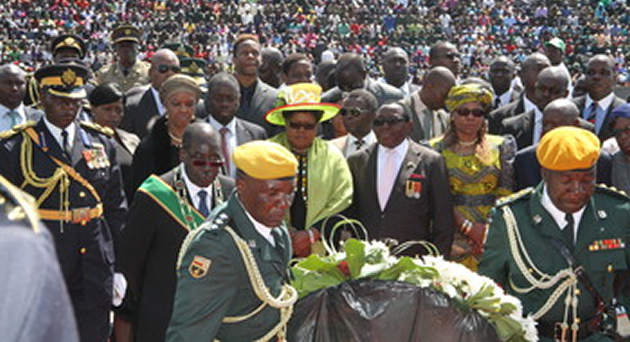
 On Monday, Zimbabwe marks Heroes Day. On this day every year, Zimbabweans honour the sacrifices that were made by thousands of cadres who took up arms against white colonial domination during the First and Second Chimurenga/Umvukela.
This is a very important moment for the country which must be celebrated by all regardless of political affiliation, age, tribe, skin colour or regional background. It is a moment for us all.
Tens of thousands of Zimbabweans, tired of being ruled my foreigners, rose in the First Chimurenga/Umvukela in 1896. They had the commitment to rid their land of foreign domination but commitment alone without advanced weapons failed to win them the war. Whites mercilessly crushed the black resistance at that point.
The settlers intensified their systematic segregation of blacks in basically every facet of life — in education, on the job market, in business opportunities, in land ownership, political representation and involvement and so on.
Blacks attended the most inferior schools and their syllabi were meant to perpetuate their servant status. Whites had access to better education facilities and the quality of their education was superior.
Blacks got poor jobs and the most successful ones secured the jobs of teachers, clerks, drivers and nurses while whites were the lawyers, medical doctors, engineers, accountants and so on. Blacks were forcibly removed from fertile lands they had occupied for centuries and dumped on rocky badlands where they barely grew anything. Whites took their place in the fertile soils in high-rainfall areas where agriculture was always viable. In fact, blacks lived in so-called tribal trust lands where they were allowed to rear only a prescribed number of animals. Unjust laws were unleashed on blacks for the injustices to continue “legally.”
In regard to political representation, blacks did not have the right to vote and never had a chance to be voted for. Whites, who constituted the privileged class, voted and could be voted into political office.
The net effect of such systematic marginalisation was that blacks were reduced to the level of wild animals, only useful when they served white interests. It was revolting for any self-respecting black person to live under such conditions.
They rose in the earliest independence wars, led by Mbuya Nehanda, Sekuru Kaguvi, Lobengula and other luminaries but were wiped out. In the 1940s, as more blacks received even that modest education and as awareness improved, they started mobilising around labour grievances and forming political parties that demanded the right to vote. Still they were brutally suppressed.
They soon realised that demonstrations and talks were never going to liberate them, so in the 1950s, more robust parties came up, into the early 1960s when Zapu, and later Zanu came on the stage with a more militant tone.
The Second Chimurenga/Umvukela then erupted in 1966. Zanu and Zapu, the most dominant pro-people political parties at that time, now had fully fledged and equipped military wings, Zanla and Zipra respectively. Its cadres were formally trained in many countries including Zambia, Angola, Tanzania, China, former Yugoslavia, former Soviet Union and Mozambique. These countries also helped with military hardware.
The likes of President Robert Mugabe, the late Vice-President Joshua Nkomo, Joseph Msika, Simon Muzenda, Josiah Tongogara, Jason Moyo, Alfred Nikita Mangena and Lookout Masuku led that war. With the level of organisation that the popular movement had acquired, and the modern weapons as well as better tactics, Ian Smith’s Rhodesian Army had no chance.
As the guns blazed in the countryside, Smith had to agree to talk at a number of venues but it was the Lancaster House Conference of 1979 that ended the war. The first democratic elections were held early 1980, and Independence then came on 18 April 1980.
It is this heroic, protracted struggle that claimed thousands of lives and injured as many that Zimbabweans will mark on Monday. We look forward to a big commemoration, thousands of people congregating at various centres countrywide.


 Online Reporter