

 dyton mupawaenda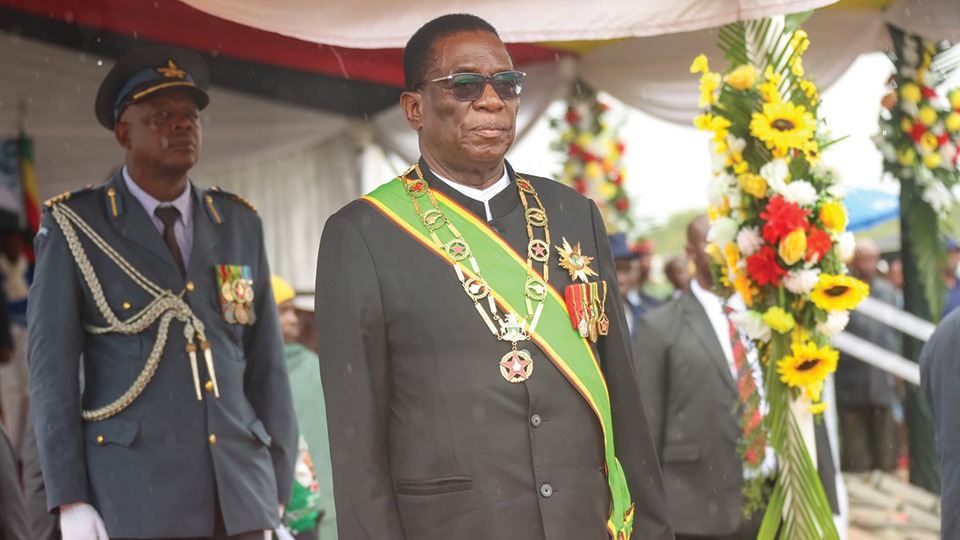
PRESIDENT Mnangagwa was clear and forthright in his Independence speech in Gokwe yesterday – let’s keep focused towards the attainment of Vision 2030 without letting our detractors side track us.
He was also unequivocal about the need to maintain national cohesion and unity, exhorting Zimbabweans to prioritise peace and stability so that national programmes and processes can proceed unhindered.
Zimbabweans are honest, hard working people, the President said, and there is nothing that can stand in their way towards the attainment of shared goals.
Thus he called for the consolidation of the progress made since Independence while building towards a better, prosperous future.
In the years after independence there was real progress in making sure educational opportunities long denied so many people were opened to all. There was also a concerted effort to ensure that all Zimbabweans could access at least the basic health facilities practically, as well as opening doors to economic advancement.
Efforts were made to empower the communal areas with both proper local government and with the start of better farming opportunities, at the very least stripping away the laws that limited their competitiveness. With the dumping of the old racial and land tenure laws it became possible for a lot of people to realise the fruits of their hard work and live better.
After around 20 years the promise of land reform was made real in the sense that Zimbabwe took control of its farming land and started allocating this land on the basis of ability and need, although it soon became obvious that the major benefits of land reform would need further programmes to allow the landholders to realise their potential and to give them security so they could develop their farms.
But whatever we do there is still more than needs to be done since we cannot just draw a line and say we now have a perfect country, a perfect society and a perfect economy.
The Second Republic under President Mnangagwa has in more than six years been accelerating the development of the economy, of communities, families and individuals, realising ever more the potential of the resources Zimbabwe has been blessed with and making sure that everyone shares in this potential, with no area and no person left behind.
This double requirement, of growth that includes all, is summarised in the theme for the independence celebrations this year: “Zimbabwe at 45: Devolve and develop together towards Vision 2030.” We need the development, but we need to make sure that this is devolved, so we all benefit, and no one is left behind.
In his address to the nation to mark the 45th anniversary, President Mnangagwa returned to the practical business of building Zimbabwe. It cannot happen instantaneously, but it must happen as he noted, a brick a time. Vision 2030 is largely a goal so that we know what we are building in practical terms, and to make sure that all Government and private policies are heading in the same direction. In his address the President explored the brickworks that we are using to get those bricks to build the country. Farmers, commercial on the larger A2 farms and small-scale on the communal lands and A1 farms, are now able to access a range of programmes to grow more crops and, increase and upgrade livestock.
These practical programmes not only bring in the results of research to cope with climate change and other problems, and not only make sure that any genuine farmer can access inputs through a range of schemes, but also close the door on those who want to cheat with some very simple checks and conditions shutting the door on corruption.
Other programmes are closing the rural-urban divides, such as the borehole drilling that is bringing a borehole to every village and every school, and the rural solar programme that will provide a basic power supply to every house. These add value to life far in excess of the modest increase in economic value, making life a lot easier for a lot of people. Not all programmes have to be economically justified.
At the same time the Government is now moving ahead on offering security to all genuine farmers with a title-deed scheme, with a similar scheme in progress in urban areas to regularise those settlements that can be regularised and where people have commendably been building decent housing. At the same time as sorting out the urban mess caused by deficient local government, the Government wants the proper rules enforced so that we can accelerate the provision of housing without cleaning up future errors.
The universal right to education and skills training is being made far more effective, partly by ensuring that those from vulnerable families can go to school, partly through curriculum changes that stress that pupils and students must learn how to apply the knowledge learned in classrooms, but also with a huge expansion in vocational training so that practical skills are learned and far more people can earn a good living.
In the end it is what people can do and what they do that matter and here a practical Government is opening doors for practical people, and increasing the backing for those prepared to apply their skills and work hard.
Devolution has had some very practical benefits already, with a significant chunk of the capital budget now being applied through local authorities and communities. The basis for this is that people living on the spot almost always have a far better idea of what they need and what they are missing than a theoretical expert, and are normally willing to ensure far more value comes from the devolved funds through their own inputs.
Good government also requires being able to deal with emergencies, and here the President brought up the fact that Zimbabwe is now largely able to cope with its own resources when faced with emergencies like Covid-19 or that terrible drought that hit us last year. We also learn from this coping, not just in overcoming the potential disaster but also putting place policies so that next time we have less of a problem.
The President was also stressing the need for national unity, which does not mean we all agree all the time but does mean we are all ready to pull our weight and push forward to build the Zimbabwe we want and which our children deserve. There might be debate and disagreement over priorities and policies, but there is remarkably little disagreement over what sort of society we want and what sort of country we all want.
Independence Day is a good time for us all to remember that far more unites us than splits us up and that we have and can work together. We first did that to win our independence, and now we must continue doing this to turn that independence into the sort of country and society we all want.


 Online Reporter