admin
admin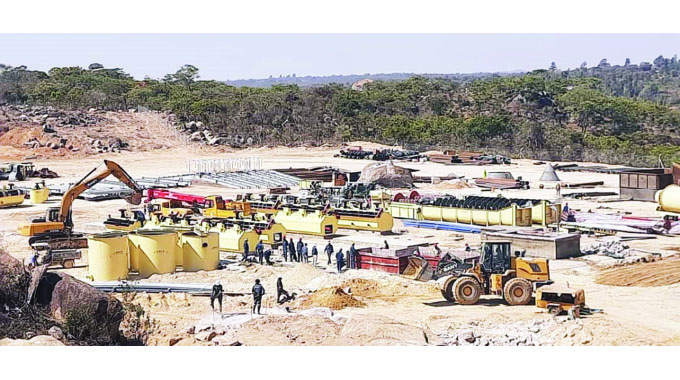
The opening of a lithium carbonate processing plant in Goromonzi in about two months, the result of a major US$40 million investment by Chinese investor Shengxiang Investments ties together a lot of Government policies that benefit Zimbabwe, the investor and the local community.
There is a strong Government policy that all mineral ores should be processed in Zimbabwe to the highest commercial level before export.
In the world of lithium this is lithium carbonate or lithium hydroxide. Lithium metal is produced in tiny quantities for specialist purposes. Lithium is a soft extremely reactive metal that will burst into flames in the presence of water, and this can include damp storage.
Those who need the actual metal keep it in an oil-filled container and no one uses the metal as a bulk commodity.
The glass and ceramic industry, the original major user of lithium, and now the manufacturers of lithium-ion batteries for everything from tiny electronic appliances to electric cars and trucks, want a stable and storable salt and in global markets most lithium is sold as lithium carbonate, although there is modest trade in lithium hydroxide, an extreme alkaline salt similar to caustic soda, the similar sodium salt.
But the tradable commodity is an extremely pure carbonate salt, better than 99 percent pure, and that at the moment is selling at around US$30 000 a tonne, down from its peak in November last year, but likely to start increasing soon. That price is obviously a lot higher than the raw ores, and makes the processing plant a worthwhile investment.
Shegxiang are looking at a maximum capacity of 2 000 tonnes of lithium carbonate a day, which translates to US$60 million a day at present prices, and that is exceptionally serious money.
Obviously the plant is planned for future mining output, but still even if it goes at just half throttle that comes to around US$4 billion a year on a five-day week.
Going flat out on multiple shifts we can possibly see US$10 billion output a year, so there is plenty of room for expanded mining by the growing number of mining companies. These sort of numbers show the huge potential lithium has to transform Zimbabwe, and the sort of extra value that a country obtains when it processes the raw ores to the product that can be delivered straight to a factory gate anywhere in the world, or which can be traded in mineral markets and on mineral exchanges, or which can even be safely stored until used.
Several lithium mines have been opened or are being developed in Zimbabwe, so there is enough ore for the new processing plant to handle. We do not see any problem for these mining companies to prefer local processing.
For a start, while Zimbabwe has the sort of mining and investment laws and the basic peace and security a decent mining sector needs to develop rapidly, its geographical location can add a lot of cost to exports in the form of transport.
Obviously a miner would like to make exports exceptionally high value and the lowest possible bulk to minimise transport costs, so here the Government and the miners are on the same wavelength, the Government wanting to push the value and the miners both pushing value and cutting bulk.
With this processing to the main global standard as an industrial raw material, Zimbabwe could also be on its way to going further and start making the end products, that is the factories.
There has been talk of battery factories, since a lot of the raw materials would now be available, the pure lithium salts, the nickel, and some of the other minerals.
Cobalt has not, unfortunately, yet been found in Zimbabwe, and it is an important part of battery manufacture, but our good neighbour Zambia is a cobalt miner, processor and exporter, so a truck of ingots would not have to travel far if we became a Zambian customer.
The one major lack is a fairly immature chemical industry, but here the fertiliser companies and others are starting to build that basic sector, so the necessary extensions required by battery makers would at least rest on a reasonable foundation. The bigger and more diversified your chemical industry the easier it is to add the extra plant. This looking for manufactured products is what will turn Zimbabwe from the 2030 vision of an upper middle-income country to the next levels.
At the moment we export most out minerals as either final products, such as gold bars or soon as drums of lithium carbonate, or as the next level down, a partially processed form that at least has a lot of local value addition.
Where we are weak is turning that mineral wealth into commercial products. We are seeing progress, with the expansion of the cement industry, which uses 100 percent Zimbabwean raw materials, and very soon with the return to the steel industry, and this time with a range of steels.
But even with steel rolling mills and the like we still need the next level of industrialists to make things from steel sheet, rather than just export bars and sheets.
There have been complaints in some media that lithium mining and processing in some countries can have a serious environmental impact. Some of this was to try and block the global switch to electric cars, but some was based on less than rigorous environmental checking.
Fortunately, the Zimbabwe Environmental Agency is alert to this sort of thing and has been monitoring and licensing the development both at the mines and at the Goromonzi plant.
It correctly was doing this at the start, so that the work could proceed rapidly and no expensive remedial work was needed. When you get it right on the drawing board everyone is a lot happier.
Usually getting it right costs just as much as getting it wrong, and then you save on not having to clean up the mess later.
So the community is happy. For a start there will be minimal environmental damage, but secondly there will be up to 400 new jobs in the early stages and in a small centre like Goromonzi that is a major development.
Since we are talking about long-term investment here we are talking about real long-term and permanent jobs, the best sort.
This is why the Goromonzi plant is such a boon for everyone. The lithium miners and processors can get full value for their work and investment, the local community can get a major industry with hundreds of decent jobs, and Zimbabwe gets a huge boost to the value of its exports. We all win.


 Online Reporter