MECHANISATION is critical, as President Mnangagwa reminded us this week, to ensuring that small-scale farmers, no less than the holders of larger farms, can increase the value of what they produce and build up the value of their annual harvests in the journey to respectable prosperity.
There is nothing inherently odd about small farms being mechanised.
The average sized farm in the European Union is still only around 17ha, despite the continuing gradual drift of rural families into non-farm businesses or urban employment. Yet these farms are generally highly mechanised, allowing a single family to cope, perhaps just hiring seasonal labour such as students or townies wanting a paid holiday at critical periods.
The Second Republic and the President are doing a lot more than just talking about mechanisation of smaller farms.
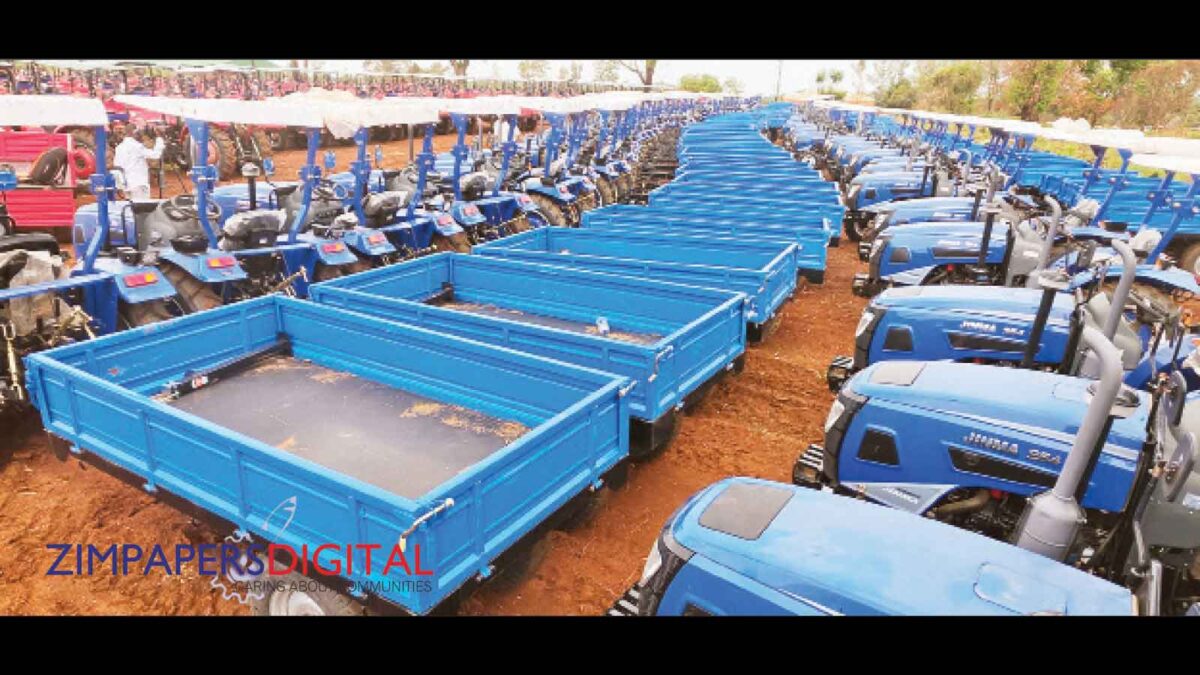
As usual the President has been demanding something a lot more practical. He was, after all, talking about spreading mechanisation to the small-scale sectors at the launch of the Expanded Farmer Mechanisation Facility, with long rows of equipment already assigned and on display.
A group of banks has come forward to put up the required financial schemes.
Some small-scale farmers, usually among those in the “tobacco belt” are already earning the sort of annual income, with decent business records to show a bank, that allows them to start upgrading to tractors and matching implements and tractor drawn trailers.
These will be, as yet, in a small minority even for the 18,5kW tractors on display at the launch.
But in time they will become typical.
But there was also less expensive mechanised equipment available, allowing a farmer to start somewhere and multiply their own manual labour several fold. Farmers work hard, but mechanisation is not so much reducing that hard work but rather increasing the value of every hour.
Even hand-held mechanical cultivators would be a starting point for many Pfumvudza/Intwasa farmers, allowing a planting hole to be dug with less effort in less time.
One modest stumbling block to expanding mechanisation, the paucity of rural service stations selling fuel, is already being addressed with a practical container-hosted station that can be placed almost anywhere and allow some innovative rural business person to start selling without huge investments.
The general growth of practical skills, another priority of the Second Republic, should ensure a respectable living for smart young mechanics wanting to set up shop near their rural family home.
Mechanisation creates a new set of service businesses. In developed countries the majority of the rural population are not farmers or farm workers.
The majority run service businesses, provide professional and technical services, own processing concerns and other add-ons.
So while the farmers create the first rungs of the value chain, there are many opportunities for others to add their bit in the general increase in prosperity.
One very practical suggestion made at the facility launch was to see suitable village business units, including those run under schemes for youths and war veterans, taking the lead in mechanisation.
There was the caveat, that the units investing in mechanical equipment and presumably providing a service to members for a viable fee, would have to have transparent bookkeeping, sound management and be able to meet the standards of strict mechanical maintenance.
But some of these units have already reached this stage, and have also built up experience in how to properly cost-share resources and have created the necessary culture to get all those benefiting to pay the required fees, usually on a fee-for-service basis, from the extra income they earn.
Adding mechanical equipment is a simple extension of what is already done, including solar panel and pump maintenance, rather than a leap into the dark.
Such co-operative or small business ownership has additional advantages. When a farmer might need only one tractor some of the time, there is always that problem when the tractor has to undergo repairs, and is out of action at a critical moment.
A village business unit can have a larger fleet and so be able to cope with routine maintenance and emergencies.
There is nothing odd about farmers sharing equipment. Even the largest farmers hire combine harvesters when bringing in their wheat crop.
That is how even the expanded national fleet of 486 can cope with so many farms. The farmer knows when the combine will be needed and for how many days, and makes the appropriate booking, rather than investing vast amounts of capital into something needed for a week at the very most each year.