admin
admin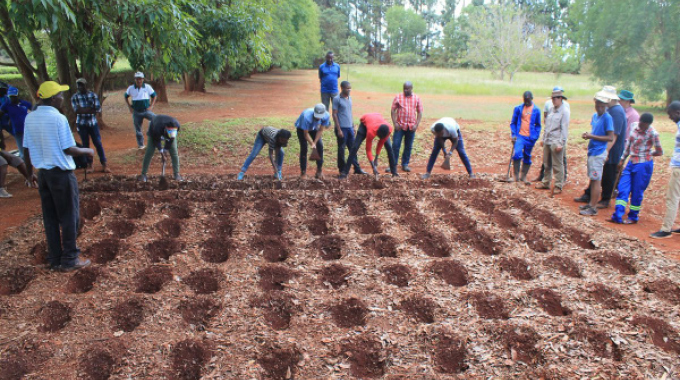
SINCE coming into office, the Second Republic has provided the essential framework for all farmers to have access to inputs and advice, along with guaranteed markets for almost anything they want to sell.
This has been reflected in first the restoration of agriculture and now in the record harvests for many crops.
A lot of thought went into the systems, both technical in terms of farming methods, and financial to make sure farmers were backed but in ways that ensured they would not abuse inputs or finance. A few people were caught diverting inputs and charged and jailed, and that along with the checks has prevented widespread abuse.
The small-scale farmers, with their Pfumvudza/Intwasa schemes, epitomised the progress with an almost foolproof system put in place. These farmers receive free inputs of seed and fertiliser, up to a modest limit and for the crops deemed most suitable for their area.
They cannot even start entering the allocation process until they have been on a brief local course. They also should have dug or cleaned up previously dug holes in approved plots and collected at least part of the mulch their modern agriculture methods demand. The local agricultural extension officer has to check them off, and all this also automatically guarantees that the farmer has some sort of land right in a communal or resettlement area.
After planting is supposed to have been done, the routine visits by the extension officers act as a further check that the seed was planted and the fertiliser used, although these visits are intended for the far nobler purpose of helping farmers overcome any problems.
But the officers will notice if someone’s plot that was supposed to be sprouting a particular crop is barren, implying seed was diverted. Similarly if the crop is some spindly near a useless set of plants, compared to the lusher growth on neighbouring farms, this would imply that the fertiliser was diverted. In an area of smallholder farmers, neighbours will also automatically see what their compatriots are doing.
But there have arisen some interesting schemes among some of the farmers with larger farms, who have access to loans through Government-guaranteed schemes and access to physical inputs through an ARDA contract arrangement. Some have gone for both, so getting a crop from the physical inputs and having money in addition, and then trying to welsh on repayments.
In normal farm loans, repayment is almost automatic via the same sort of stop-order that works so well in the tobacco trade.
In this case, when the farmer delivers the crop to the contractor or the Grain Marketing Board or other approved buyer, the loan is deducted. But when the crop can go to one contractor who provided physical inputs, the money may not be noticed.
This has a double detrimental effect. First, there are the honest farmers, who might well complain almost continually in the nature of farmers, but still operate properly within the systems, fulfil their contract requirements and repay loans.
These farmers might find it harder to get inputs or loans if contractors and bankers feel that farmers in general are too high a risk. These farmers need a simple path they can race along and get what they need.
The second detrimental effect is that the fund that is supposed to be increasing each year as farmers pay back loans and new funds are granted instead is decreasing, as loans just disappear.
There is not enough new money to keep resupplying the fund in its entirety and the whole business relies on a high level of repayment so the fund is growing.
The Ministry of Lands, Agriculture, Fisheries, Water and Rural Development has, in conjunction with other authorities, found a solution using modern technology.
Farmers and their dealing go into a data base, so all relevant information is available to anyone authorised to look at it, and the farmer gets a smart card that can be used to collect inputs.
The level of their credit will largely be determined by the value of the farm if the farmer already has title deeds or if they can be helped to obtain these under the new programme now being implemented.
This allows a return to the old system where borrowing farmers left their title deeds with their banker.
The problem, in the unlikely event that the farm needs to be sold, that someone will start re-accumulating the huge estates that were broken up during land reform, can easily be solved by simply enforcing the maximum farm sizes already laid down, and making it clear that some people are simply not allowed to bid for land being sold.
The Ministry is keen on seeing this system extend to the Pfumvudza farmers, and this is correct.
For a start, we do not need to have a dual system of separate sets of farmers, rather than just having farmers all of whom are now expected to have a commercial orientation, regardless of farm size.
The pure Pfumvudza input scheme operates up to a limit, and we should now be seeing some of the more productive and go-ahead Pfumvudza families wanting to increase their cropping, meaning they have to move into the more commercial programmes. This needs to be encouraged and it needs to be simple for a farmer to operate when they upgrade and expand.
This already is assumed to be the norm in the important tobacco cropping and trade, where all farmers are basically equal, regardless of whether they grow half a hectare or a couple of hundred hectares.
We need to see ever more of such equality, and a continuum of farmers, rather than distinct groups that do not overlap.
By using smart technology, the costs of enforcing schemes that speed up progress for the honest farmers, cut out cheating and remove some of the grey areas that some exploit, are very low.
So the savings are not chewed up in administrative costs.
Instead life becomes easier for the hardworkers who do not try and fiddle, and the fiddling largely becomes impossible.



 Online Reporter