

 admin
admin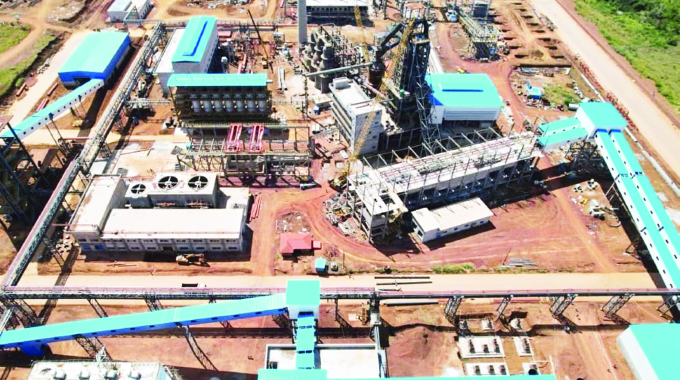
Zimbabwe looks set to become a major heavy industrial economy and probably Africa’s leading steel maker, with another centre of coal mining, a coking plant, a power station, ferrochrome smelting and eventually stainless steel production being established in Beitbridge district.
There is already the Tsingshan investment through its Zimbabwe subsidiaries, led by Dinson Iron and Steel Company now in production at Manhize, but including a coking plant and coal thermal power station at Hwange and investments into nickel and ferrochrome.
It will also expand to include a range of steel sheet and bar products plus stainless steel manufacture.
Now a second Chinese investor, Palm River Energy, has been building up the energy and industrial park about 20km west of Beitbridge town.
One major development is the expansion of operations at the recently opened Tuli coalfield, which straddles the Limpopo border and with mining companies working on both sides.
This coalfield, at the opposite end of the country from Hwange, is the second to be opened for mining, spreading the load, with the main function being to supply the coking plant and a power station being built by Palm River Energy.
The concentration of the operations in the 51 square kilometre zone should make it easier to cope with the environmental safeguards needed for higher-ash and higher-sulphur coal, by concentrating operations.
The power station is starting with a 50MW unit with another coming in promptly, but eventually Palm River Energy want a 1 200MW station.
One reason Palm River, like Tsingshan through Dinson, is willing to build a power station is that the heavy industrial processing requires a lot of energy.
Palm River will be starting with a ferrochrome smelter, and these are major users of electricity. Zesa has already noted that investors are building their own power plant so that the beneficiation can be done without straining its generating capacity and is more than willing to buy any surplus generated to feed into the grid.
Palm River in fact seems to be planning to eventually generate a significant surplus as part of its investment into both heavy metal processing and energy generation.
While other independent power producers are largely looking at solar power, Zimbabwe does have a need for investors into base load, and with the extreme fluctuations in Zambezi River flows in recent years, this does mean coal for reliable supplies, at least until the Muzarabani natural gas supplies can be exploited.
The development in Beitbridge is not something in some vague future, but is happening now.
Already 400 people are employed at the site, and the first phase will see 2 000 jobs created. Most of these will be technical jobs, and here is the other natural resource Zimbabwe has, besides minerals, and that is a fast growing pool of technically-educated people.
This is important for investors, in that all raw materials as it were, are on site, human and mineral, along with good investment laws.
Both of these giant private Chinese investments, by Tsingshan and Palm River, were cemented by President Mnangagwa, who is eager to meet serious major investors and address their concerns.
He wants to see his vision of an upper middle-income country by 2030, and that means that a lot of Zimbabweans need to be in good jobs while the country is a major industrial as well as mining and agricultural hub.
We need that heavy industrial base. Here the Presidential intervention has been critical. Many of the downstream investments will come almost automatically from Zimbabwean as well as foreign businesses once the heavy-lifting of the base industries has been done.
The President has also assured investors not only of the friendly pro-business and pro-investment climate, but has also made it clear that corruption is not a debatable issue.
There must be none and he wants to hear of anyone trying to put the bite on an investor.
Zimbabwe did lose some opportunities in the past over poor investment policies and attempts by some unpleasant and nefarious people who volunteered to steer through a deal in return for a cut.
This does not mean that Zimbabwe has no conditions. For a start we have labour laws. We want both employer and employees to be happy and protected.
We have environmental regulations, streamlined but effective. Much of our environmental law is built around identifying potential problems in advance and then working out solutions, again in advance when this is fairly cheap, to minimise the dangers.
We do not seek to ban anything in the general industrial line, but seek to have solutions worked out and set out.
One huge advantage of the green-field investment we are seeing at Manhize and Beitbridge is that we and our investors can plan properly in advance, without having to convert old-fashioned technology.
Doing it right at the beginning allows the best technical solutions to be applied, thus moderating costs significantly.
While special economic zone status is obviously granted to major investment, this is just at the start-up stages of the investment.
Eventually they will be paying normal taxes, and in any case the very large workforces will be taxed on their incomes from the beginning, and along with the investing companies, will be paying VAT on personal and many commercial purchases.
Zimbabwe does not need to worry about over investment into heavy industry. Much of the output of this sector will be for export, and investors appear to be choosing the right products for Zimbabwe. The country has an edge in stainless steel manufacture.
We have the essential ingredients of coal, iron ore and limestone, with the iron ore and limestone often next to each other and the coal nearby for steel-making.
But to get that extra value, reasonable quantities of chrome and nickel are essential ingredients, and we mine those.
There are often some very small quantities of other metals needed, and here while the odd truckload will not be a major import, there is a good chance that wide-awake prospectors might well find deposits of say molybdenum and vanadium. They should be around considering our geology.
Exporting highly processed products rather than the base ores or metals means that we get full value from our resources, as well as a lot of extra quality jobs in many technical fields.
Here our membership of the Africa Continental Free Trade Area is an extra advantage, since investment and manufacture inside AfCFTA allows the products to trade freely.
Rules of origin relate to geography, not the owner of the processing plants. So Zimbabwean minerals converted to advanced products in Zimbabwe with almost 100 percent local content, go right to the top of the list.
This allows investors to benefit from the free trade area.



 Online Reporter