admin
admin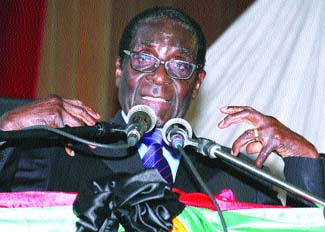
Naturally, we rejoice that this important gathering takes place when our land is in the hands of its rightful owners, thanks to our successful land reform programme. But this is a celebration which should always remind us of the challenge to fully utilise the resource, focusing more on matters of productivity than acquisition.
I therefore call upon all traditional chiefs to play a central role in motivating our people to aim for optimal productivity on the farms. It is important that our traditional leadership should also help those of our people who cannot think of successfully working the land they occupy unless a white man is part of the enterprise.
To assist our people in realising our land objectives, government has put in place a number of comprehensive agriculture programmes, which enable our rural communities to get necessary agricultural inputs, mainly seed and fertilizer.
Sadly some of our senior people who managed the process tend to selfishly appropriate these inputs to themselves and then we have the ministry of finance which gives less than adequate support to the agricultural sector, the mainstay of our economy. Such brazen failure to support our agriculture has tended to negatively impact on the performance of the sector by preventing the farmers from achieving maximum production. The problem is often exacerbated by erratic rainfall.
I am pleased to say that in times of drought Government has remained committed to providing various social programmes that cushion our communities against calamities as hunger and starvation, mainly through the Social Dimensions Fund.
This is the fund which disburses such forms of assistance as grain or money to the needy households identified through the Vulnerability Assessment Exercises. To complement such welfare programmes, Government has introduced the Grain Loan Scheme spearheaded by the Ministry of Agriculture, Mechanisation and Irrigation Development and coordinated by the Ministry of Local Government, Rural and Urban Development.
The scheme allocates to each household a fifty kilogramme bag of maize per month which the beneficiaries are expected to pay back after a rewarding harvest. All chiefs are expected to play a pivotal role in the implementation of the programme.
As you are aware, with the community share ownership schemes at Zimplats in Mashonaland West, and Mimosa and Murowa mine in the Midlands, the indigenisation and empowerment initiative has gathered momentum, bearing testimony to our unwavering commitment to improve the lives of all our people, especially those who were historically subjugated by colonialism.
Community share ownership schemes thrust our traditional leaders, the custodians of our cultural and natural resource heritage at the helm of community empowerment and development.
As the western nations seek to decimate our virtuous values by imposing deplorable alien principles and practices and in the manner of homosexuality, lesbianism, and
bestiality, among others, our moral fabric stands endangered.
These vices are anathema to African values and morals, and we will never embrace them. It is a shame that some African leaders and even some from amongst us are condoning such appalling acts under the guise of democracy. In fact some African leaders are upholding such dehumanising practices as a precondition for receiving donor monies!
One notes with deep concern the moral decadence of the west which is influencing some amongst us to seek to relegate our values in order to please their western sponsors.
Ladies and gentlemen we should always remain vigilant against imperialist machinations. Recent events in the North Africa, where legitimate governments were toppled by so- called rebels under the guise of democracy, underline this very need for vigilance. Western economies desperately need our resources as they seek to make their sagging economies rebound. We thus need to sensitise and mobilise our communities to remain resolute and ready to defend our birthright.
The Constitution making process is moving too slowly, quite contrary to the provisions of the Global Political Agreement (GPA). Some elements among us are now tactically delaying the process so as to frustrate the holding of General Elections in 2012. But we cannot afford to postpone them again.
We just have to proceed towards elections this year, with or without a new constitution.
In an attempt to restore the traditional leaders’ authority and standing, virtually stripped from them by the colonial system, I am pleased to learn that the Emplacement of Resettlement Land under the authority of traditional leaders has gathered momentum. Boundary disputes which might hamper progress in this regard should find themselves resolved.
It is, however, disheartening to notice that the wanton destruction of the flora and fauna in community areas seems to continue unabated. The natural habitat and grazing land are extensively damaged by veld fires each year, causing danger to both people and livestock, and ultimately ruining the environment we solely rely on for our sustenance.
Accordingly, I would like to implore you, our traditional leadership, to inculcate the spirit of ownership amongst our people so that the protection of the environment becomes a collective responsibility of our communities. I also make clarion call to tobacco farmers to develop sufficient woodlots for tobacco curing and their use as alternative sources of energy.
In conclusion, I would like to take this opportunity to thank the Ministry of Local Government, Rural and Urban Development and all your co-operation partners, for organising this occasion, making it grand by, for the first time in history, having our chiefs attend the conference in the esteemed company of their spouses; quite an ingenious way of saying thank you to women on this, the International Fay for women.
I thank the traditional leadership for being exemplary an especially for remaining resolute on matters of sovereignty and self-determination.
It is now my pleasure to declare the 2012 edition of the Annual chiefs Conference officially open.
I thank you.


 Online Reporter