admin
admin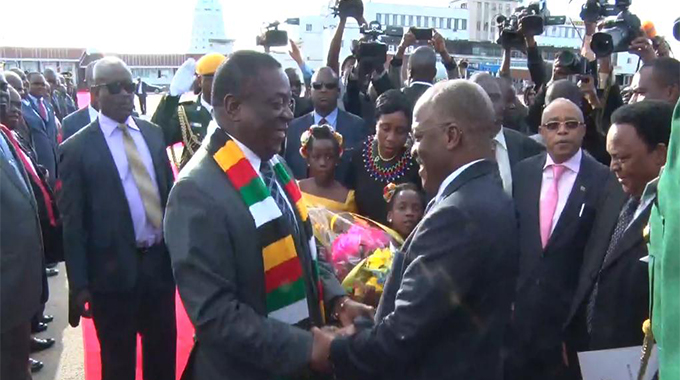
Tanzania President, John Magufuli arrived in Harare yesterday for a two-day official visit that will further strengthen the fraternal relations between the two countries.
This is his first visit to Zimbabwe as Tanzania president, a position he assumed in November 2015. He makes the visit 11 months after President Mnangagwa paid a two-day visit to Tanzania.
President Mnangagwa had, seven months earlier, taken over the leadership of the country and was on a regional tour to introduce himself to leaders in Sadc.
While in Zimbabwe, President Magufuli and his team are at home and must be happy. Zimbabwe and Tanzania share a long history and their relations have been always strong.
Many will remember the strong support that Tanzania, under founding President Julius Nyerere, rendered to liberation fighters from here in the 1960s into the 1970s.
Thousands of them were trained there. Tanzania’s leadership gave much moral support to our freedom fighters. The Sadc country had attained independence in 1961 and was a source of inspiration for liberation fighters from here.
“If Tanzania has done it, why can’t we?” they asked themselves as they underwent military training at Morogoro, Bagamoyo and Mgagao camps. Actually, President Mnangagwa spent time at Bagamoyo during the liberation struggle.
Tanzania, too, was one of the biggest logistical bases for our liberation struggle. The Organisation of African Unity (OAU) Liberation Committee was hosted in Dar es Salaam, the Tanzania capital.
The task of the committee, whose formation was decided on at the inaugural meeting of the OAU, held in Addis Ababa, Ethiopia, in May, 1963 was to help the African liberation movements to achieve freedom from colonialism.
A Tanzanian general, Hashim Mbita, was the head of that committee. Tanzania was also a member of the Frontline States that supported the independence struggles of many Sadc countries.
After independence, the political relations between Zimbabwe and Tanzania remained strong.
Zanu-PF and Chama Cha Mapinduzi, Tanzania’s ruling party, are comrades who liberated their respective countries and are members of the Sadc framework for liberation parties that seeks to foster strong ties between them.
Being members of Sadc, both countries cooperate a lot on matters of regional and country level interest.
It is good that the countries have a formidable shared history. That history must now be a basis for greater economic co-operation.
Speaking at the end of President Mnangagwa’s visit to Tanzania in June last year, President Magufuli said trade and investment ties between Harare and Dar es Salaam were weak.
In 2017, trade between the two countries was at Tanzanian shillings 21.1 billion (about US$9.25 million) up from Tanzanian shillings 18.3 billion in 2016. This trade volume is not enough, he said then, thus “we need to take efforts to increase the trade volume.”
On investments, President Magufuli said Zimbabwe has 25 companies operating in Tanzania worth US$32 million and he invited more Zimbabweans to invest in his country.
Inevitably, the subject of economic relations came up for discussion yesterday when President Mnangagwa met his guest earlier in the day.
President Magufuli, speaking at a banquet hosted for him by his host at State House in Harare last night, said he has high hopes that Zimbabwe will rise.
He said already, the economy is showing positive signs since President Mnangagwa came in in November 2017. However, for the recovery to be sustainable, the West must lift their illegal sanctions on Zimbabwe, said the Tanzania leader.
“I am delighted that this afternoon,” President Magufuli said, “President Mnangagwa and myself held discussions about enhancing further these relations. Among the things we discussed and agreed to do better in advancing economic relations. This is because for far too long our relations has been dominated by political issues with little attention being given to economic matters. Our two countries have therefore agreed to consolidate our economic cooperation in order to give practical meaning to our political cooperation. To this end we have agreed to increase trade and promote investment flow between us. We have also agreed to share experiences and best practices in the management and utilisation of our natural resources.”
These are good observations that must get the two governments and their private sectors to focus their attention on business, business and more business. The foundation — the longstanding political co-operation between the two countries – is already there.
The challenge is now to build the superstructure, which is greater, mutual bi-lateral trade and investment. It is our hope that the visit by President Magufuli, and President Mnangagwa’s last June, will give impetus for that economic co-operation to bloom.


 Online Reporter