admin
admin
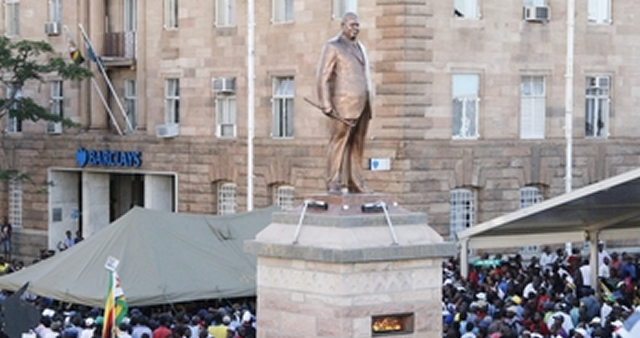 Plans to erect a statue of Father Zimbabwe, the late Dr Joshua Nkomo, in Bulawayo had been unfolding for a long time. It was a matter of the date. The refurbishment of Bulawayo Airport has also been going on. It was a matter of time. As it turned out, Transport and Infrastructure Development Minister Dr Obert Mpofu decided to raise the national profile of these projects by having them completed and commissioned on the same day.
Not only that; this was done on Unity Day — on December 22 — to give them added national significance.
The whole nation had its eyes on Bulawayo as President Mugabe officially opened the renamed Joshua Mqabuko International Airport, unveiled Dr Nkomo’s statue in Bulawayo’s city centre and renamed Main Street to Joshua Mqabuko Nkomo Street.
While all this is a fitting tribute to the memory of the late national hero, it is always unfortunate that we can never pay enough homage to those who sacrificed their lives for the national good.
The living can only make such gestures.
President Mugabe observed that: “Both the statue and the renamed street commemorate and are a tribute to Dr Nkomo for his leadership, his dedication and his ability to translate the aspirations of Zimbabweans.”
He said the two projects were the “real story of Zimbabwe and Zimbabweans, our struggles and aspirations as a people”.
It is easy these days to talk disparagingly and derisively about our national heroes.
But the events in Bulawayo remind us all what heroes such as the late Vice President and thousands of others wanted to achieve.
President Mugabe, Dr Nkomo and other nationalist leaders took a deliberate decision to forsake the privileges which came with their education to fight for a free Zimbabwe.
This freedom went beyond a national flag and a national anthem. It meant control of our natural resources and Dr Nkomo made a point of always reminding us that land was a major driving force of the armed struggle.
We have no doubt that he rests better at the National Heroes Acre knowing Zimbabweans are fighting to regain their land and their minerals — in short, their economy.
This is a process and it is bound to be long and painful, and it is this pain which often gives rise to opportunistic political formations and external “messiahs” prescribing short-term solutions as a way of delaying or completely subverting the revolution.
Part of going beyond gestures and symbolism in the form of names and statues is to meet people’s daily needs. President Mugabe was fully aware of this when he stressed that Bulawayo should be revived as an industrial hub.
These are some of the short-term goals envisaged under the Zim-Asset. It is important to keep up the momentum on this issue.
The water situation has been a long outstanding project which is often raised by some politicians around election time.
It is therefore easy for people to assume a cynical attitude when such projects are mentioned, instead of keeping the political leadership and Government constantly on their toes over implementation.
We believe that the events of this week in Bulawayo took on a national tenor so that they are taken with the seriousness they deserve. It is well-known that there are people who carry the baggage of grievances from what happened prior to the Unity Accord.
As results of the July elections suggest, many people in Matabeleland North and South have decided to move on and make the best of what the nation has to offer.
Programmes such as land reform, indigenisation and economic empowerment should benefit all, except those who exclude themselves because of what their political parties say.
We don’t believe that Nkomo would have sacrificed his life so that in the end our peace and harmonious relations amount to no more than whites retaining what they acquired by dint of their race while blacks retreat to the former Tribal Trust Lands.
In that case his struggles and our aspirations would all have been in vain.
We therefore believe we should be doing Dr Nkomo much honour if, in seeing his name on the street, the airport and his statue in the centre of Bulawayo, all those symbols constantly reminded us of what nation he would have wanted Zimbabwe to become.


 Online Reporter