admin
admin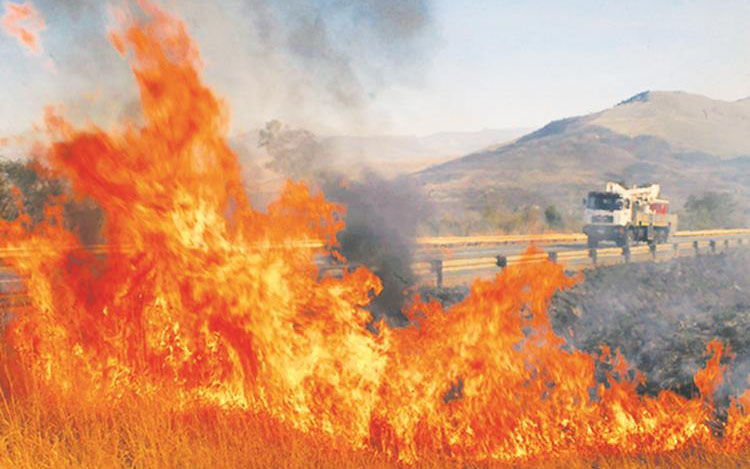
We are now in that time of year when veld fires break out and large areas of grazing, forest and natural veld can be destroyed.
Last year almost 400 000ha were burned over by veld fires, more than double the 172 000ha of the year before. Some of the extra might well have been with almost all farmers actively using their land, more fires were reported, as the law requires, although absentee farmers in the past might well have not even noticed.
But whatever the reason, 4 000 square kilometres is a lot of land. We need to remember that last year the rains ended late, balancing in actual rainfall the long dry spell in the middle of the rainy season.
That meant that there was a reasonable amount of biomass, since the grass kept growing in the late restart of the rains, but that a lot of this would have less dry than usual and so might have only been fuel for a bad fire a bit later.
This year we had good rains across the summer, and so a lot of grass and shrubs and trees were able to grow, and the rains ended at the normal time with little rain from April onwards.
So there is a lot of fuel for fires, and that fuel is rapidly drying if it is not already dry. The double of plenty of biomass and dry biomass makes the Environmental Management Agency very nervous, and it should be making farmers very nervous as well.
While steps can be taken to prevent fires, there are far too many careless people. We see people throw cigarettes out of car windows, instead of using their ashtrays; we see people burning garbage instead of burying it; we see some farmers clearing land with a fire that gets out of control. There are many other causes.
With more farmers growing more crops where the residues have to be destroyed to keep pests at bay, crops such as tobacco and cotton, there might well be need to burn the residues, but those fires can be controlled and done when there is no wind and with as much of the residue piled in heaps far from the grass next to the fields.
Other residues seem ideal for mulches, and with conservation farming compulsory in some sectors and encouraged in all, residues have to be used intelligently rather than just destroyed because it is convenient to set fire to maize stalks.
We need to maintain the pressure on the whole population not to start or cause fires, or to be very careful if they have a legal and legitimate reason to light a fire, but we also have to take precautions to protect land, and to put in place the systems that are needed to control and fight fires to minimise their damage.
The Ministry of Lands, Agriculture, Fisheries, Water and Rural Development uses its vast and dense network of agriculture extension officers to pass on the practical measures, urging people to take them and also to practice safety as they create firebreaks and make sure the firebreaks are wide enough.
Where farmers have tractors and ploughs, simply ploughing around the end of fields provides a respectable break. At least it gives a line where a fire can be fought.
The medium and larger commercial farmers will obviously want to protect their fields of winter wheat and their winter grazing using this method.
But sometimes you cannot plough, no matter how many tractors you have, since a kopje cannot cope with a tractor or plough. Yet there is often enough soil on that kopje to support grass and trees and shrubs, fuel for a fire. We have all seen burned-over kopjes.
So all farmers, on all sizes of farm, need to look at slashing grass or even, where conditions are right burning a protective strip, although that is an extreme way of doing the job. The break-up of large estates means there are a lot more roads and tracks across farmland.
Many of these are not smooth finished roads, and quite often have a centre strip of tall grass, but with a bit of slashing and other means of vegetation removal can serve as an effective firebreak with a lot less effort than clearing a strip of virgin bush.
Where farmers put in fire guards in past years, they can usually clear these this year with far less effort. In fact maintenance of fire guards seems like one of those perennial farm chores that pay huge dividends and, if done regularly, require very little work.
The other area that must be addressed is the community pressures, efforts and organisation. One dud farmer in a community can create a huge fire hazard, and the community must explain why this is a bad idea, and if necessary call in the authorities. There are laws that allow neighbours to make the guards if the land holder refuses.
Communities also need to be organised to deal with fires that do break out. If they have already pushed hard for proper fire guards the fire fighting will be a lot easier.
Neighbours are supposed to rally round a farmer dealing with a fire, and where possible need to have equipment ready to be mobilised.
Of course care must be taken. People die when they rush in to fight a fire sweeping across a large area of grass. This is one reason why fire guards are so important, since they provide the lines where a fire can be fought far more safely and effectively.
But a lot of manpower is still needed even away from the advancing front of a fire to deal with those trickles of flame that always seem to creep across most guards.
The EMA has also made a point of recommending that farmers harvest their grass before it burns.
Thatching grass is always needed, and mature grass can be cut and baled as hay before it dries out and the stalks die.
Both those crops add value to grass. Livestock farmers normally have fairly short grass, since their cattle eat the plants and a proper rotation of fields means that there are no large areas of high dry grass free of much nutrition but fuel for a serious fire.
Veld fires, or at least the bad ones, are the result of carelessness, bad farming practices, improper use of land and a host of other factors that can be fixed for the advantage of everyone.
We can never stop the odd modest field being burned over, but we can stop those fires spreading and wiping out the grazing of whole communities, and we need to get organised and take the recommended steps.


 Online Reporter