admin
admin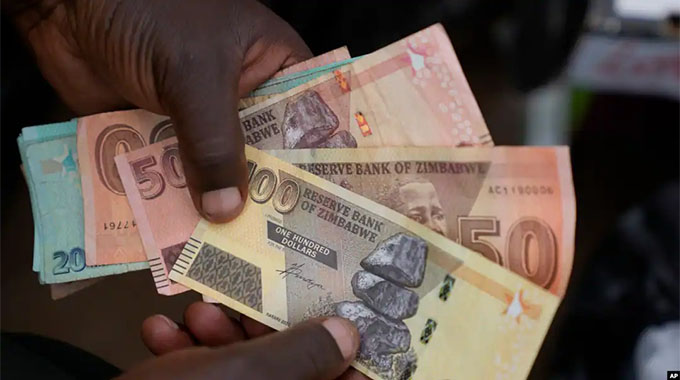
Amid the rush by civil servants to banks, it has been found that there is not very much in the way of local Zimbabwe dollar banknotes held by banks, and no one is able to withdraw any of their pay in local cash.
This can be expected after the recent exchange rate volatility, but even before the rapid rise in the price of a US dollar, and its 34 percent fall over the past four and bit weeks, there was not much in the way of local banknotes in the ATMs.
The Second Republic has been careful not to balance any books by printing money, and in any case prefers seeing the growth of electronic transfer for a wide range of reasons.
At the moment most $50 and $100 notes are kept in folded wads of $1 500, which by general agreement of the conductors of buses and kombis, drivers of mushikashika and their passengers is the equivalent of US$0,50, the fare on many routes, or is in the same folded wad of the same size used by street vendors and their customers as US$0,50.
Each night around half the regular passengers on 50c routes have such a folded wad, their change from US$1, and the other half do not. The next day the groups switch, with those with the wads providing the change for those who have paid US$1. It works, just but as notes become worn and torn it will be harder to maintain.
What little is left over tends to be in tills where businesses accept US dollars to be used as small change, and if there is anything left at closing time it is a tiny float for the next day and so does not have to be banked.
In practice there are not enough Zimbabwe banknotes to even attempt to cope with change in US dollar purchases in the average supermarket, and customers usually have to accept samples from a range of small chocolate bars.
Some Spar supermarkets pass out printed tokens for a few cents in US currency that regular shoppers can then use when they come back.
This is not always accepted by the customers, and they are back to the chocs.
The cost of printing more of these banknotes looks higher than their worth. Even with an exchange rate of $4 000:US$1, a $100 note is the equivalent of 2,5USc, with the $50 note being the equivalent of half that. It is likely with the cost of the superior paper, the intaglio inks and the materials for the metallic strips that it will cost more than $100 to print a $100 note.
One solution would be a range of new notes, say $500, $1 000 and $2 000. The transport sector and many vendors would like the $2 000 note as half a US$1. There would be other problems. Street dealers would somehow get a large proportion of these notes and sell them as a premium, as has happened in the past.
While it cannot be ruled out that relatives at banks help the dealers, there is also the problem that they empanel their own relatives and friends to queue at ATMs and then pay them a trivial sum to take over the notes.
There would be a second problem, of perception. Even if the printing and issue of new banknotes was tightly controlled and audited, with the banks having to put up the local currency when taking stocks of banknotes for their customers, and this being in locked accounts and only accessible when the banks return worn and torn notes, there would still be a lot of Zimbabweans, who remember the horrors of hyperinflation and who would suspect the authorities of printing money to pay bills.
Mobile money could be a solution, especially as one platform, the largest, now offers US dollar accounts. The transport sector needs a significant proportion of their fares in US dollars since for all practical purposes it is impossible to buy fuel and spare parts in local currency.
This might change with the present changes we are seeing and the likelihood that more businesses will be able to buy foreign currency from their banks, but we are not there yet.
One problem with mobile money, when standing in a bus, is that identifying each passenger is hard and the process is hardly instantaneous with users now having to go through even more buttons to make a transfer. Using it to send change to passengers is again theoretically possible, but time consuming.
During the peak of the Covid-19 lockdowns, many large buses were unable to ply intercity routes and came under Zupco control on urban routes. Tap cards became common. These were issued by NMB, one of the larger banks in the middle range of Zimbabwean banks, and were backed by card readers connected to NMB bank accounts held by bus companies.
The buses were able to tap Government stocks of fuel and so buy their fuel in local currency, so it worked. They have now died.
Only one bank issued the cards and the readers, and many bus operators who had a reader said later that it was “broken”. This may have been accurate, but could have just been an excuse to insist on cash.
But the concept was good and solved a lot of problems and delays in making very small payments. It could be reintroduced with two improvements.
First all banks would have to be involved, along with the mobile money platforms.
Everyone in Zimbabwe, or almost everyone, has an account with one of these, usually these days two accounts, one for local currency and one for US dollars.
Secondly there would probably have to be two types of card, one for local currency and one for US dollars, and these being easy to recharge. If the authorities were worried about new sources of money laundering and black market dealings outside the chance of detection, they could quite easily limit the use for cards for very small sums.
No one needs cash or equivalent these days when buying anything in the formal sector in local currency. Everyone has swipe machines, or mobile money business accounts, or some other way of accepting an electronic transfer.
The need for cash comes with the little stuff, the equivalent of US$1 or less, and usually in the informal or semi-formal sectors where a rapid transfer is needed without any problem of sorting out who paid what.
The present stock of Zimbabwean notes is just coping with demand, with some strange agreements over its value, but as we move forward we need something else.
Now is possibly a good time to start the debates and if necessary put in place an acceptable alternative so it can be introduced properly.



 Online Reporter