Chronicle Editor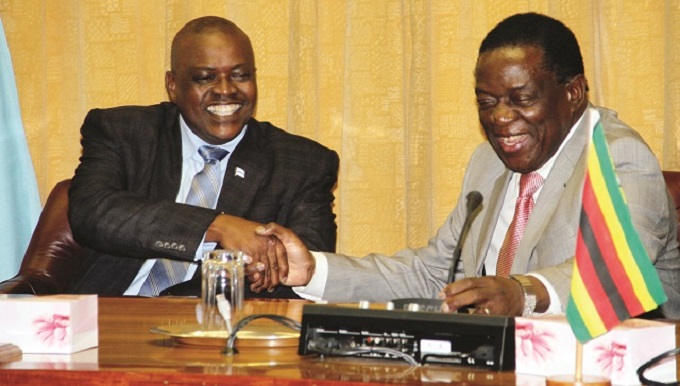
Zimbabwe and Botswana held a very successful Bi-National Commission (BNC) Summit in Harare this week that has taken their bilateral relations to another level.
The summit, the first such high-level conference between the neighbours, saw six memoranda of understanding (MoUs) being signed. The agreements signed are on diplomatic consultations, mining, geology and metallurgy, cooperation in energy sector, science and technology, rules and procedures governing the meeting of the BNC as well as an extradition treaty.
Trade and investment was also high on the agenda at the historic summit with Botswana pledging to make available one billion Botswana pula to support Zimbabwe’s private sector. To further enhance the economic ties, President Mnangagwa and his guest, President Mokgweetsi Masisi agreed that a business forum be held next month on the sidelines of the Zimbabwe International Trade Fair in Bulawayo. In addition, President Masisi also handed over health assistance donation worth P2,1 million to the Government of Zimbabwe.
Speaking at the end of the event President Mnangagwa said: “I am pleased that at this inaugural session, we witnessed the signing of six agreements which set the legal framework for broad cooperation in the agreed areas. Through our collective efforts, may the conclusion of these agreements not be an end in itself, but the beginning of greater bilateral cooperation for the benefit of our people and future generations. History has shown us that where people and nations get used to working together, they grow to share the same vision and aspirations.
“I am confident that Zimbabwe and Botswana have set themselves along this path.”
President Masisi was similarly happy with the inaugural session of the BNC, adding that more work must be done for companies and citizens of both nations to come up with concrete initiatives that build on the foundation laid at government-to-government level.
“Today’s meeting is the beginning of a strong and long journey which is ahead of us,” he said. “More work still needs to be done especially to open our private sector business people and private citizens to play a meaningful role in our efforts to further strengthen our bilateral relations. There is no doubt that our success in implementing the commitments we make today will go a long way in ensuring a conducive environment for our people and businesses to increase their interaction.”
It was a resoundingly successful four-day session that lays a strong basis for greater co-operation between Harare and Gaborone for mutual benefit.
The P1 billion credit facility, almost equivalent to US$94, 5 million, is a decent sum of money that will be helpful to the local private sector that has been struggling for financial support over the past 19 years of Western sanctions that have prevented them from accessing such support from international markets.
We therefore encourage local companies to, as fast as they can, start to apply for loans under the facility.
We are positive that Botswana appreciates the challenges that the business sector in our country is facing, particularly the manufacturing sector. It will be good if requirements for companies to borrow under the fund are not made too tight to such an extent that they put the facility out of their reach.
In saying this, however, we are not overlooking the need for the requirements to be structured in a way that is not too lax. Local companies need affordable credit, that is long term to enable them to retool and finance operations, enabling them to recover over a long period and be able to turn around. Short term credit will be of no use really given the low base that many local companies have been forced to sink because of two decades of no external finance.
It is good that Presidents Mnangagwa and Masisi directed the senior officials to expedite the conclusion of outstanding agreements and MoUs before the midterm review to be held in November this year. By ordering a mid-term review, the leaders are creating conditions for tangible benchmarks and deliverables to be made. Also, this encourages faster implementation of agreed positions instead of having to wait for the next BNC in Gaborone in February next year to review progress and chart the course for the next 12 months.
Talks are ongoing, as Minister of Industry and Commerce, Mangaliso Ndlovu says elsewhere on these pages today, for a bigger package, of US$600 million from Botswana to support industry here. It is appreciated that this is a huge sum of money which cannot be made available overnight. There has to be thorough negotiations, typically over an extended period of time until both governments satisfy themselves with the terms of the package. If an agreement is reached on this bigger facility, local industry will celebrate.
Another important outcome of the Harare summit is the two countries’ position against Western sanctions. According to the communiqué issued at the conclusion of the indaba yesterday, the countries not only denounced the embargo, but also called for it to be lifted unconditionally.
President Masisi has gone public against the ruinous measures about thrice since January this year. Zimbabwe will continue to count on such support, optimistic that consistent, high-profile denunciation of the sanctions and calls for their removal will, over time, influence the US and Europe to yield.


 Online Reporter