


 Chronicle Editor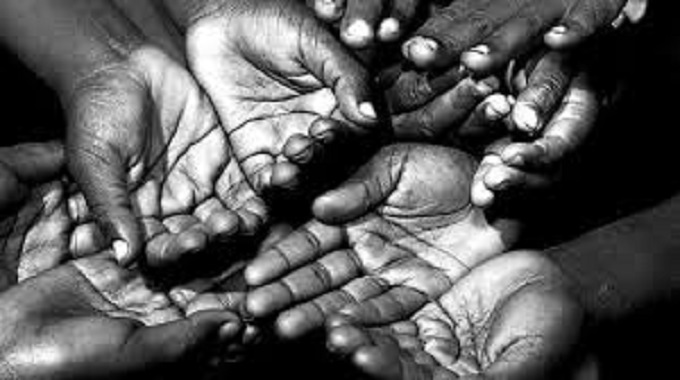
Kudzai Chikiwa, Features Reporter
WHILE other Grade One kids of her age are hopping and jumping as they rhythmically recite the Mathematics number line, the abacus and week days, poor seven-year-old Jane Dube* is sitting by the corner of Jason Moyo St and 9th Avenue in Bulawayo begging for alms from Good Samaritans.
Unlike her colleagues who are recalling their last Math lesson, she is reciting the beggars’ anthem “Sicel’ uncedo/Tokumbira rubatsiro’’ (We beg for help). It does not even cross her mind that she should be at school, all she knows is that the world has warm hearted people who drop coins in her tin or often give her some goodies.
It has become a norm that in the morning she and her visually impaired mother sit by the street corner, during lunch time they go to a food outlet and in the evening they go city supermarkets that close late to get the few pennies from people who will be shopping to go home.
“This is how we get money for food. My mother told me that I cannot go to school since I am the only one available to lead her as you see she is visually impaired. Every day we come in town to beg for money. My visually-impaired father moves around with my big brother. They play a guitar and get money as well,” she said with a deep thought.
Speaking while counting the brown coins she had collected, Jane says none of her siblings goes to school as begging has become their daily norm.
“We don’t go to school, we are always helping our parents get something from well-wishers,” she said.
Asked on what she wishes to be in life, she confidently said she wanted to be a teacher and build a big house for her parents.
“When I grow up I want to be a teacher. I will have many cars and build a big house for my mother. I don’t want her to be moving around the streets anymore. I will take them to a far land,” she said with a grin of excitement evidently oblivious of the missed opportunity that will enable her to achieve her dreams.
Jane mirrors the sad life of most children whose parents are living with disabilities in the country. They are deprived of their right to education and other needs just because they are born to parents with various disabilities.
And to her and unfortunate others, the constitutional provision that every child has a right to education does not mean anything. It remains engraved in the pages of the supreme law of the land while she grows out of school going age in circumstantial ignorance.
Her constitutional right to education is being violated as education remains a distant dream to her with no effort being put in place to ensure such rights are not contravened. Society has also forgotten them.
They look at them with dismissive tolerance and seem to have accepted that the only education they are entitled to is to learn how to persuade well-wishers to hear their plight.
These children find themselves pushing their parents’ wheelchair, leading their visually impaired parents as they maneuver traffic in the streets while their age mates are shaping their future at school.
They carry in their innocent ignorance, strong visions of becoming great people in life but all become illusions — a mirage because of lack of education.
In Zimbabwe, it has become a norm to see children as young as six asking for alms from Good Samaritans while their parents will be singing gospel songs to entertain and draw sympathy from well-wishers. Some of these small children have resorted to getting into supermarkets and beg by the till points. It has become more of a norm to see them following potential well-wishers to get alms although children organisations say it is a gross form of child abuse.
There is no doubt that education is one of the most important social service that a country should provide its citizens with and countries that fail to deliver that service are bound to fail. The importance of education can therefore never be overemphasized.
Primary and Secondary Education Minister Paul Mavima said recently that his ministry’s main objective was to take Zimbabwean education to the 21st century standards where there has to be an educational transformation and full implementation of the competence-based curriculum.
The question now is, when other children are made competent and are equipped for the future, what will become of these kids who haven’t been in a classroom? Some are prowled on by sex perverts who take advantage of the desperation of their situation.
When the parent passes on, is the child going to understand that there is life beyond begging? How are they going to try other avenues of life when they never sung the grade one vowel song but only knows their common street anthem siceluncedo/tokumbira rubatsiro.
Unicef in its 2018 reported noted that, “Education is more than just a fundamental right; it helps pave the way to a successful and productive future”. This may be translated to mean that there is no bright future without education in any normal societal set up. There is no proper profession in Zimbabwe which does not require education. Even the new curriculum has adopted a practical way of teaching where pupils learn life skills at school.
While the media, NGOs and other stakeholders have continued to lobby for the inclusion of people living with disabilities in various projects, their children remain a forgotten constituency that requires special attention.
Disability lawyers appealed to Government and non-governmental organisations (NGOs) to fund training of parents with disabilities.
A lawyer from the Lawyers with Disabilities Association Zimbabwe Trust, Advocate Bekithemba Mlauzi said the increasing number of child beggars whose parents were living with disabilities was worrisome indicating that they were ignorant of their children’s rights.
“It is an indication that their parents are not fully educated on their children’s rights, they prioritise begging,” he said.
Adv Mlauzi said lawyers were prepared to provide legal education and advocate for children’s rights but they lack funding. He condemned turning children into beggars as a criminal offense that violates the children’s rights.
“This is a serious violation of children’s rights but you will find that people with disabilities may be forced by circumstances to engage their children into begging. This is why we advocate for their education to help them understand that no disability override a child’s right,” he said.
Bulawayo Provincial Affairs Minister Cde Judith Ncube bemoaned the increase of child beggars in the city centre saying children’s rights were being violated.
“We need to engage the Social Welfare and find out what can be done to solve the issue of child beggars’ increase in Bulawayo. What’s touching is that they are of school going age and many are girls.
“The girl child life is fragile and should not be exposed to begging, they end up being abused for the sake of saving their desperate parents. These parents need to be assisted financially and be trained on children’s rights before they ruin their children’s lives and make them perpetual street dwellers,” said Cde Ncube.
The Deputy Minister of Public Service, Labour and Social Welfare, Cde Lovemore Matuke condemned child begging saying a parent’s condition should not deprive a child from her basic rights like education.
He said Government was ready to help the vulnerable children since they have an allocation set aside for them.
Protecting children whose parents have disabilities remains a collective responsibility which needs to see both Government and society assisting the children to go to school. Their parents need to be taught not to prioritise begging over education.
One writer once said, “The moral test of government is how that government treats those who are in the dawn of life, the children, those who are in the twilight of life, the elderly, and those who are in the shadows of life, sick, the needy and those living with disabilities.”
@tamary98


 Online Reporter