Online Reporter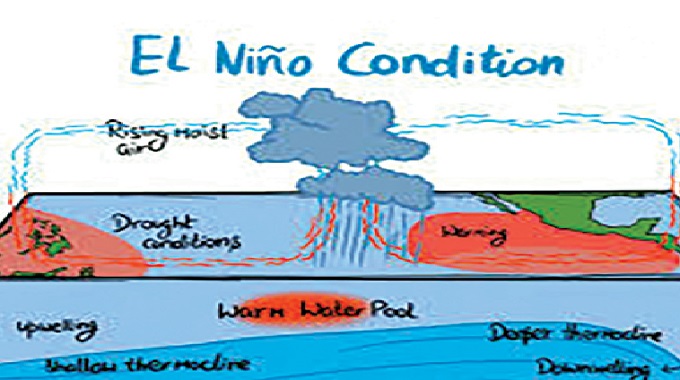
Obert Chifamba
Agri-Insight
A SEASON is not ruined just because climate scientists have forecast a possible El Niño event.
What changes is risk — where stress is more likely, and when adjustments are obligatory.
And justifiably, the forecast of El Niño weather should be treated as a prompt for action to assess vulnerability, adjust planting timing, improve water control, and align monitoring for pests and diseases with the most likely stressors.
This analysis frames El Niño as a call to act: assess susceptibility, fine-tune planting timing, reinforce irrigation and drainage, and align pest and disease monitoring with expected weather stressors.
And coming on the backdrop of the recent forecast of a possible El Niño phenomenon visiting Southern Africa’s shores in the 2026/27 farming season, this line of argument seeks to assert that farmers’ management techniques will play a pivotal role in shaping the outcome of the season regardless of the predetermined outcome resulting from the interplay of many natural factors.
The predicted El Niño for the 2026/27 rainy season (roughly Oct 2026–Mar 2027 for much of southern Africa) will inevitably cause a shift in rainfall pattern — most importantly by increasing the chances of below normal rainfall and drought risk in some parts of southern Africa.
It is, however, not a guarantee of failure everywhere.
In practical terms, when there is an El Niño, the country or region experiences less total seasonal rainfall, more frequent dry spells (periods with no rain inside the season), higher heat and evaporation, which can worsen crop water stress that threatens the viability of both crop and animal husbandry.
The impact of El Niño varies by region and farm with stress linked to the phenomenon typically translating into reduced yields or even none in some cases.
This happens when rains that fall during that season are insufficient or arrive late to save planted crops.
Sometimes the El Niño impact is felt when the season is quite advanced with crops caught at the flowering and grain filling stages when water stress becomes very damaging.
When predictions of hostile seasons are issued, farmers therefore need to treat them seriously and act accordingly to mitigate the potentially disastrous effects that come with bad weather.
One way of reducing the scale of damage is through reducing plant populations or have arrangements to re-plant in place, in case the first effort does not yield the desired results.
It is also important for farmers, especially those plying their trade on dry land to allow flexible choices and where possible, adopt traditional grain crops such as sorghum, millet, beans and rapoko that naturally more drought tolerant than crops like maize.
Planting dates are also important in the fight to elude the harsh impact of hostile weather.
Good and early crop establishment is key in that respect.
The fight to contain the harsh effects of El Niño weather also need to be extended to livestock. While crops may survive, thanks to farmers’ interventions, pastures and drinking remain vulnerable and even unavailable, respectively.
This would leave the farmer in line to incur feed costs later in the season or even face the daunting task of taking livestock for relief grazing elsewhere.
On the one hand, El Niño can also induce water and electricity ‘farmer knock-ons’ in the event that dry weather conditions affect dam levels and river flows thereby negatively impacting irrigation for those capacitated to irrigate.
Those relying on rain-fed agriculture will face the challenge of drying water sources to water their various livestock units.
The impact can even extend to affecting power generation and result in load shedding or shortages.
The developing El Niño that was forecast for the 2026/27 “season” is likely to emerge in mid to late 2026 and persist into at least the end of 2026 for regions situated in the Northern Hemisphere, according to the current El Niño Southern Oscillation (ENSO) expectations.
It is not always that El Niño weather brings weeping and gnashing of teeth among farmers — it can mean higher chances of above normal precipitation especially in those areas that experience wet winters while areas with drier winters may be in for below-normal rains.
This effectively means that there will be a drought that requires those farmers with the capacity to do supplementary irrigation and save their crops or even livestock from moisture stress.
Generally, these are the key explanations farmers have to fret over the incidence of ENSO: precipitation odds are what drive the farmer to sweat over what she is going to plant and what the moisture stress will be like.
Zimbabwe’s various media platforms have since churned out numerous messages on the possibility of the El Niño phenomenon visiting the country’s shores, which effectively alerted farmers to the clear and present challenge this hostile weather may cause.
But one thing the farmers should not forget is that a more definitive national climate outlook will still be issued later after regional assessments.
The El Niño forecast that has gotten everybody worried must therefore be treated as a risk flag and not a final seasonal guarantee.
What this means is that farmers will need to make decisions guided by the Zimbabwe National Climate Outlook (when it is released) more than they will listen to the earlier global forecast.
Rule of thumb – when the farmer is faced with such a scenario, his go-to-person is the local extension officer and the local weather station or the daily weather bulletins issued by the Meteorological Services Department (MSD).
This is one sure way in which farmers can stay abreast with changes taking place around them and how they should react without compromising their efforts to salvage something out of a bad season.
If the El Niño inspired drought risk increases, the most appropriate and operational farm responses farmers can make must revolve around insightful water management, flexible decisions and reducing taking unnecessary risks. It is also important to increase water harvesting.
This is done through capturing run-off water that is generated from downpours and, ordinarily, this water finds its way into streams, rivers, dams and even seas.
Sometimes it sinks into the ground and can later be tapped into as underground water.
The culture of constructing drains may not be very popular with many farmers, thanks to its labour-intensive nature but it is effective in preventing run-off losses.
With functional drains it means some water is trapped and allowed to sink within the field while the excess is given an easy passage out.
One other useful strategy is for the farmer to practise mulching in his fields.
This practice helps reduce run-off, evapotranspiration and suppresses weeds at the same time.
Conservation agriculture practices that most farmers are now employing can also help improve soil moisture retention.
This one should not come across as something new but just an extension of the Pfumvudza/Intwasa requirements they are currently observing every season.
At the moment farmers should be checking on the physical state of their drains to ensure they prevent excessive run-offs in the event of any rains. All the run-off should be trapped for later use.
Other than this precautionary move, it is important for farmers to be strategic in their planting activities and follow advice from extension workers to the last letter, especially on the best planting periods for their various regions.
It is also important to avoid over-committing to input-heavy planting if the first rains look weak but consider doing staged planting or adopt plans for crop rescue.
Farmers need to choose varieties and crop strategies that match the risks confronting them – usually drought tolerant and early maturing options will help them salvage decent yields in the face of adversity.