Online Reporter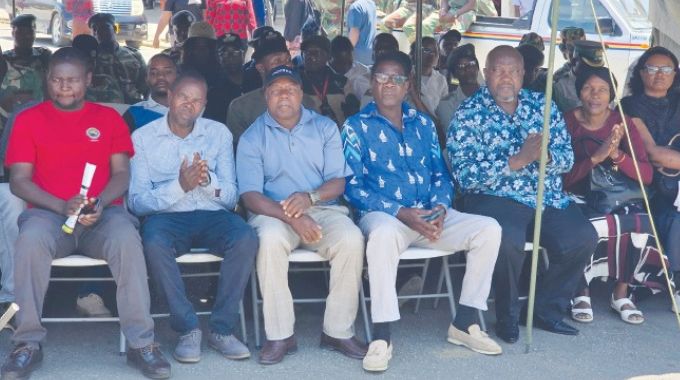
Patrick Chitumba, [email protected]
SCORES of Gweru residents turned out in large numbers yesterday to learn how the Integrated Electronic Case Management System (IECMS) introduced by the Judicial Service Commission (JSC) will transform access to justice upon its roll-out in the Midlands and Mashonaland West provinces on October 1.
The awareness campaign, held as part of the Midlands Provincial IECMS pre-launch programme, brought the justice delivery system closer to ordinary people through music, drama and poetry.
Performers demonstrated how members of the public would be able to register, file documents and track court matters electronically from the comfort of their homes or at designated facilities.
The Air Force of Zimbabwe brass band, Zimbabwe Prisons and Correctional Services brass band, an inmate band from Whawha Medium Prison and the High Voltage Hodzeko drama group took turns to entertain and educate people on the new system.
The performances also provided a lively platform for explaining how members of the public, litigants and legal practitioners would register and use the electronic platform.
In his keynote address, the Minister of State for Midlands Provincial Affairs and Devolution, Cde Owen Ncube said the pre-launch campaign demonstrated Government’s commitment to modernising justice delivery through technology.
The event ran under the theme ‘Modernising Justice through Technology.
“The theme resonates with the Second Republic under the pragmatic leadership of His Excellency, the President of the Republic of Zimbabwe, Cde Dr E. D. Mnangagwa’s call for integration of inclusive specialised data systems that enhance organisational efficiency and service delivery,” said Minister Ncube.
He said the transition from paper-based case management to secure digital platforms aligns with the National Development Strategy 2 pillar on Science, Technology, Digital Innovation and Human Capital Development.
Minister Ncube commended the JSC led by Chief Justice Elizabeth Gwaunza, for embracing the Whole-of-Government and Society Approach in implementing IECMS.
“The electronic system inhibits corruption by reducing human interface and the manual handling of files. Case backlogs will therefore be reduced as this new system brings courts closer to communities in line with the New Dispensation’s Devolution and Decentralisation Agenda,” said Minister Ncube.
He noted that IECMS incorporates electronic filing, case tracking and management, automated case allocation, e-filing support services and virtual hearings, among other applications designed for litigants, legal practitioners, law enforcement agents, judicial officers and court administrators.
The electronic storage of court documents is also expected to help address the long-standing problem of missing or misplaced court records by ensuring that case information is securely stored and can be retrieved electronically.
To support the transition, the JSC has deployed national trainers who are working with court officials, legal practitioners, members of the uniformed forces, traditional leaders and members of the public.
The commission has also established e-filing offices and internet hubs to assist court users with registration and electronic filing.
In the longer term, the JSC plans to establish additional e-filing facilities at selected police stations and chiefs’ homesteads to improve access to justice, particularly for people in rural areas.
Speaking at the same event, JSC deputy secretary Rosalie Katsande said the Midlands rollout is part of Phase 4.4 of the national courts digitisation programme, which is also targeting Mashonaland West.
“This IECMS Day is to ensure that court users are familiar with the system before it goes live in the Midlands Province and in Mashonaland West Province,” she said.
Katsande said the JSC was equipping courts ahead of the October 1 rollout, with court recording and transcription machines being installed while laptops and computers were being issued to judicial officers and other members of staff.
She said IECMS would enable litigants, legal practitioners and other court users to file documents electronically, monitor cases and access court services without relying solely on paper-based processes.
“The digitisation programme began in 2022 when President Mnangagwa commissioned the country’s first paperless court during the opening of the Commercial Division of the High Court,” said Katsande.
She said the system has since been extended to the Constitutional Court, Supreme Court, Labour Court and all divisions of the High Court, with the JSC now taking the programme to Magistrates’ Courts, which handle the majority of litigation in the country.
“With Midlands and Mashonaland West Provinces coming on board, we will be left with Harare and Bulawayo, for which plans are at an advanced stage to digitalise the two remaining provinces by year-end,” said Katsande.
She said the rollout is expected to change how court users interact with the justice system by making it possible to initiate and follow up cases electronically, reducing reliance on physical files and improving the tracking of matters.
A Gweru resident, Innocent Maphosa said the awareness campaign had helped demystify the electronic court system.
“Coming here has helped us understand that IECMS is not only for lawyers or court officials. Ordinary people will also be able to use the system, including checking the progress of their cases without constantly travelling to court,” he said.
Another resident, Emson Musoni said digital records would make it easier for court users to track their matters.
“We have seen situations where people have to make several trips to court to check progress on their cases. If information can be accessed and tracked electronically, it will save time and reduce the burden on members of the public,” he said.
Midlands provincial JSC head, Beaulity Dube said JSC is using the remaining days to familiarise court users with the technology, train key stakeholders and equip courts, paving the way for a wider transition from paper-based to digital justice delivery.