admin
admin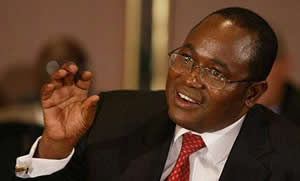
Happiness Zengeni and Martin Kadzere
SPECULATION and secrecy has shrouded the fate of Reserve Bank Governor Dr Gideon Gono’s tenure amid indications that his second term, due to expire at the end of this month, may be extended by one year.
If a new appointment was to be made, it should have been made public by now and his successor should have been preparing for office. But with no announcement to date, speculation has grown that Dr Gono’s term was most likely to be extended.
Dr Gono was first appointed as the central bank governor in November 2003 and was re-appointed in November 2008 for another five-year term. Over the past few months, several names have been linked to the hot seat. These include CBZ Holdings chief executive Dr John Mangudya, former CBZ chief executive Nyasha Makuvise, FBC Holdings chief executive Mr John Mushayavanhu, African Development Bank chief economist Mthuli Ncube and head of debt and aid management in the Ministry of Finance Mr Andrew Bvumbe.
While no comment could be obtained from Finance Minister Patrick Chinamasa, sources said there was a feeling Dr Gono’s term could be extended to give Government enough time to search for a new governor.
Constitutionally, Dr Gono cannot exceed two terms the Reserve Bank of Zimbabwe Act can be made amended to provide for the extension of the governor’s tenure beyond the two terms.
“What is coming out now is that his term could be extended by another year, but that is still under discussion,” one source said. “This is probably being done so as to give those in charge more time (to choose the right successor). Further to that, because of the fragile state of the banking sector, Government would rather delay the appointment of a new governor until the situation improves.”
At the time Dr Gono took over from Dr Leonard Tsimba, the economy was going into a slide. He came up with a number of policies, though widely criticised, in a bid to try and keep the country’s economy afloat.
Dr Gono “presided” over an economy which was going through its worst spell with some observers saying the amount of work he needed to execute was too much for him to halt the decline.
“Whatever I did had authorisation from the Government of the day,” said Dr Gono in an interview with AFP on October 8, 2009.” I prevented this country from descending into chaos like Somalia.”
During his tenure, Zimbabwe experienced cash and fuel shortages, the highest inflation in the world — 231 million percent at the last official count before dollarisation in June 2008 – corruption, high unemployment and the collapse of the health, education and agriculture sectors.
Illegal forex deals were rampant although Dr Gono known for such terms as “failure is not an option” or “irrational exuberance” partially legalised the use of foreign currency in January 2009 by allowing some shops to transact in hard currency after the Zim dollar had become worthless. In February, Government adopted the use of multi-currencies, mostly the US dollar.
He made earth-shattering decisions upon taking the office of governorship by closing a number of banks engaging in non-permissible activities and firing several chief executives in the process. A number of banks and financial institutions that were violating provisions of banking laws had their operating licences cancelled while some were placed under curatorship.
Dr Gono took a hard stance on errant bankers, hounding most of them out of the country over alleged violation of forex laws but later softened his stance and ensured that a blanket amnesty was given to the bankers which saw the return of Mr James Mushore, Mr Nicholas Vingirai and Mr Francis Zimuto.
If he is not remembered for his political-like stature, Gono is more famous for his flip-flopping; first he was the governor who said Zimbabwe was overbanked, announcing there would be no more new licences. But then he instituted Operation Sunrise after realising the bulk of Zimbabweans were actually excluded from the banking sector. In 2008 he came up with a framework for financial inclusion that highlighted the plight of banks.
Dr Gono printed large quantities on money to support production, with the economy reeling under western imposed sanctions, leading to the demise of the local currency and collapse of the banking system.
Dr Gono rebased old bank notes on 1 August 2006 and introduced new ones. Prior to rebasing the currency Z$1 000 was the lowest denomination, which was reduced to Z$1 after three zeros were slashed.
A year later, he authorized a Z$200 000 denomination. This marked the start of a series of new denominations issued in rapid succession, including Z$250 000, Z$500 000, and Z$750 000 by December.
On January 16, 2008, RBZ introduced Z$1 million, Z$5 million and Z$10 million dollars. This was followed by introduction of Z$25 million and Z$50 million dollars in April, Z$100 million and Z$250 million dollars in May, Z$500 million, Z$5 billion, Z$25 billion and Z$50 billion dollars and Z$100 billion in July.
The central bank also raided foreign accounts of most gold mines, paralyzing their operations as a result. Gold miners were then obliged by the laws to sell their yellow metal to the central bank.
But some observers say the governor should be credited for avoiding the collapse of the economy. He introduced several support funding facilities for agriculture and manufacturing sector. But unfortunately most of the facilities succumbed to rampant corruption with a few people benefitting from the programmes.
With the shortages of agriculture inputs, the RBZ came with funding facilities to assist farmers. To support the land reform programme, Dr Gono came up with a programme to mechanize the farms.
During his term, he wrote a book, Zimbabwe’s Casino Economy (probably the only central bank governor to ever write a book during his term). He has single handedly driven positive developments in the banking sector although he is a largely “do as I say, not as I do” kind of leader…this is in particular reference to bank governance. To most, his legacy significantly weakened the banking sector with undercapitalised banks reeling from largely under-reported non performing loans with almost every bank being owed directly by him or businesses-linked to him.
After his re-appointment, there was strong opposition from the coalition-Government partners, particularly, Morgan Tsvangirai’s Movement for Democratic party who accused him of killing the economy.
In defiance, he said: “The immorality and irrationality of the whole argument is that ‘Gono must go because he printed money and he killed this economy.’ That’s a white lie because no single individual can harm or kill an economy.”
More recently Dr Gono went all out to defend the indigenisation of the banking sector in what became more of a personal war with then minister of Indigenisation Saviour Kasukuwere as the two constantly haggled in public.
There was also a strong lobby in certain sectors that he be appointed Finance minister but the President went on to appoint Minister Patrick Chinamasa to oversee the portfolio instead.


 Online Reporter