
Tapiwanashe Mangwiro
ZIMBABWE could soon begin benefitting from lower fuel prices and easing inflationary pressures following the ceasefire between the United States and Iran, and the reopening of the Strait of Hormuz, although economists and industry leaders say the gains are unlikely to be immediate.
The strategic waterway, which handles roughly a fifth of global oil trade, had become a major flashpoint during months of conflict that disrupted shipping routes, heightened geopolitical tensions and sent energy prices soaring across international markets.
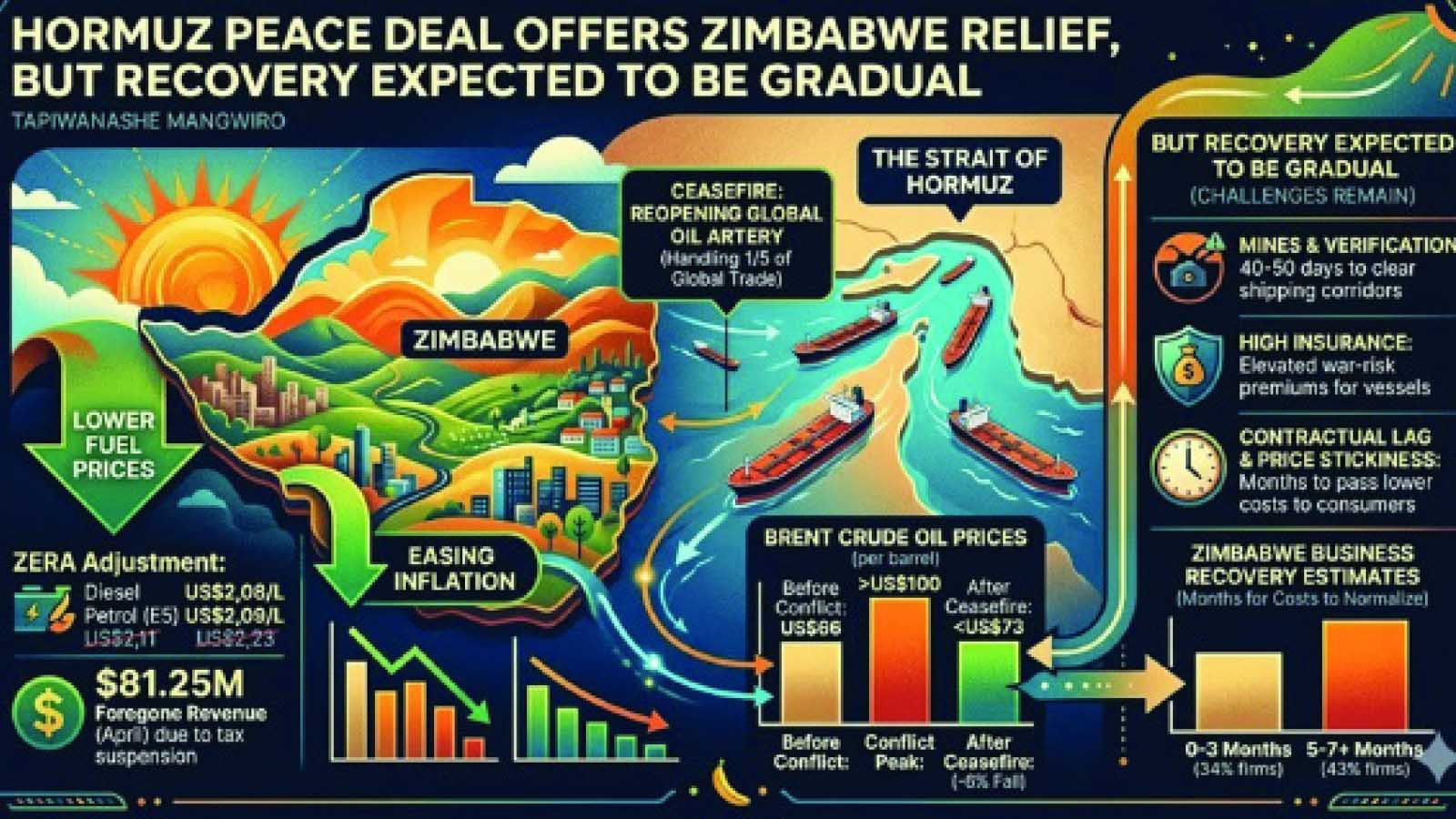
Local fuel prices were sharply adjusted by the Zimbabwe Energy Regulatory Authority (ZERA), with diesel reaching US$2,11 per litre and unleaded petrol (E5) priced at US$2,23 per litre.
For ordinary Zimbabweans, the impact was immediate. Commuters in Harare and Bulawayo report that minibus fares, which used to range between US50 cents and US$1 for short distances before the conflict, now range between US$1,50 and US$2, squeezing household budgets.
Finance, Economic Development and Investment Promotion Minister Professor Mthuli Ncube, on April 2, announced a tax suspension of US54 cents per litre, covering excise duty, the Zimbabwe National Road Administration (ZINARA) road levy, carbon tax and the strategic reserve levy. The total revenue foregone in April alone amounted to US$81,25 million.
As a result, petrol has retailed at US$2,09 per litre and diesel at US$2,08 per litre since then.
But signs of relief emerged almost immediately after the ceasefire announcement.
Brent crude oil, the international benchmark, fell by about 6 percent to below US$73 per barrel, having traded above US$100 at various stages of the conflict. Before hostilities escalated, oil prices averaged about US$66 per barrel.
The decline has fuelled optimism among import-dependent economies such as Zimbabwe, where fuel costs influence transport charges, production expenses and the prices of goods and services across the economy.
Despite the positive developments, global shipping experts caution that normal trading conditions remain some distance away.
Greek maritime risk management agency MARISKS said in a report that the agreement should be viewed as “the beginning of a de-escalation process rather than the immediate restoration of normal trading conditions”.
Security concerns remain a significant obstacle. Maritime experts estimate that clearing naval mines reportedly deployed during the conflict and verifying safe shipping corridors could take between 40 and 50 days.
Mr Jakob Larsen, chief safety and security officer at shipping association BIMCO, described Hormuz transits as “very risky” and called for “mine-free routes” to be established before normal shipping operations resume. Insurance costs present another challenge.
War-risk premiums for vessels transiting the region remain substantially higher than before the conflict, increasing the cost of transporting oil and other commodities. Industry observers believe shipping companies will only gradually return to the route as confidence improves.
Shipping analyst Mr Anoop Singh noted in a report that operators would continue weighing commercial opportunities against security risks. The Japanese, Koreans and Chinese are less open to high risk, while the Greeks have a different appetite, so we may see some people gearing up,” he said.
The Confederation of Zimbabwe Industries (CZI) echoed these concerns in an April report, warning that the effects of the conflict would linger long after shipping routes reopened.
“As a net importer of essential commodities, Zimbabwe remains highly vulnerable to cost-push inflationary pressures arising from the Iran-Israel-US conflict,” said CZI.
“The primary transmission channel has been the energy sector, where rising Brent crude oil prices have increased domestic production and distribution costs.” According to the report, 34 percent of firms expected operational costs to take about one fiscal quarter to return to pre-conflict levels, reflecting what CZI described as a “price stickiness phenomenon” in which energy and logistics costs do not immediately decline when global conditions improve.
Another 43 percent of firms anticipated recovery periods of between five and more than seven months, suggesting that many businesses expect prolonged supply chain disruptions.
Economist Dr Rumbidzai Chirenje said the easing of tensions represented a welcome development for Zimbabwe, particularly because fuel prices have a direct bearing on inflation and business costs.
“The fall in oil prices is undoubtedly positive for Zimbabwe because fuel is embedded in almost every economic activity, from agriculture and mining to manufacturing and retail distribution,” she said.
“Consumers and businesses should not expect immediate price reductions, however. Existing fuel stocks, contractual arrangements and elevated shipping costs mean the transmission of lower international prices into the domestic market typically takes time.”
Dr Chirenje said a sustained period of stability in the Gulf would be required before meaningful reductions in inflationary pressures become evident. “If the ceasefire holds and oil prices remain below the levels witnessed during the conflict, Zimbabwe should gradually experience lower imported inflation,” he said.
“The key issue is consistency. Markets respond more favourably to sustained stability than temporary improvements.”
The reopening of the strait is also expected to unlock a significant backlog of vessels that have remained stranded in the Gulf region. Hundreds of loaded and empty tankers are reportedly waiting for safe passage, a situation that has disrupted supply chains and delayed deliveries across several markets.
Industrialist Dr Nxaba Ndiweni said the conflict had highlighted deeper structural vulnerabilities within Zimbabwe’s economy.
“Lower oil prices are certainly welcome, but the broader lesson is that Zimbabwe remains highly exposed to external shocks because of its dependence on imported fuel, raw materials and industrial inputs,” he said. “Many firms have spent months absorbing higher transport and production costs. Those costs do not disappear overnight simply because a ceasefire has been reached. Supply chains need time to recover and businesses need time to rebuild confidence.”
Dr Ndiweni said the country should use the current respite to accelerate efforts aimed at strengthening domestic production capacity and reducing reliance on imported inputs. “Economic resilience comes from building stronger local value chains, improving energy security and increasing domestic industrial capacity,” he said. “External developments will always affect us, but their impact can be reduced if we address structural weaknesses at home.” Global energy markets are also likely to require time to regain full momentum.
Mr Neil Shearing, group chief economist at Capital Economics, projected that around 80 percent of energy flows through Hormuz would only resume by the end of September.
Natural gas exports could take longer to recover, he said, warning that gas flows “will be slower to return” because of damage to key infrastructure in Qatar.
Zimbabwe’s economic outlook has undoubtedly improved since the ceasefire announcement. The pace at which lower fuel costs and easing inflation reach businesses and households, however, will depend on how quickly normal shipping patterns are restored and whether the fragile peace in the Gulf endures.