Online Reporter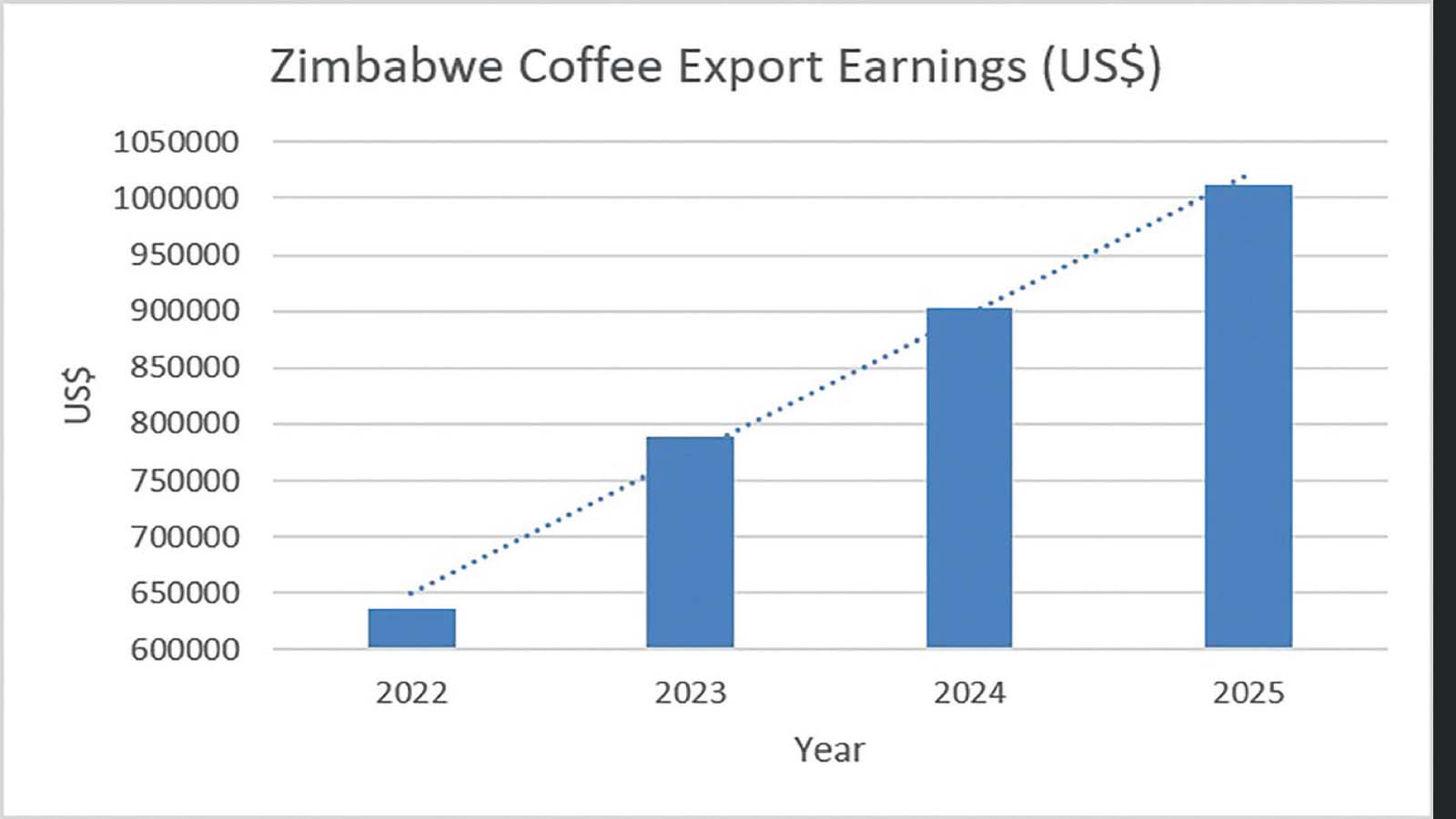
Edgar Vhera
Specialist Writer – Agribusiness
THE European Union has given the Zimbabwean coffee sector a clean bill of health, with more than 99 percent of mapped farms showing zero deforestation, according to an extensive due diligence assessment carried out across coffee farms.
The EU Deforestation Regulation (EUDR), adopted in June 2023 as Regulation EU 2023/1115, represents one of the most significant legislative developments in international trade and forest conservation in recent years.
The regulation prohibits the placing or making available on the EU market of certain commodities and products, including coffee, unless they have been produced on land that has not been subjected to deforestation or forest degradation since December 31, 2020.
Any operator or trader seeking to export coffee to the EU market must demonstrate due diligence by providing geolocation data for all plots of land where the coffee was produced, a country-of-origin risk assessment, and a declaration confirming that the product is free from deforestation and has been produced in compliance with the relevant laws of the country of production.
The EUDR creates a benchmarking system in which countries are classified as low, standard or high risk based on their deforestation profile and the robustness of their governance frameworks.
For many coffee-producing countries, the EUDR introduces substantial new compliance requirements.
Smallholder farmers, who account for the majority of global coffee production, face particular challenges in meeting the geolocation and traceability demands of the regulation, given their limited access to digital infrastructure, technical expertise and institutional support.
National governments, certification bodies and development organisations are increasingly engaged in efforts to build the data systems and capacity necessary to facilitate compliance.
As Zimbabwe aims to expand its coffee production and exports to the EU, compliance with the EUDR is crucial.
The assessment will focus on mapping coffee farms, evaluating environmental sustainability practices, and ensuring that Zimbabwean coffee is free from deforestation-linked activities.
The EU Delegation to Zimbabwe (@euinzim) official X handle disclosed that Zimbabwean coffee was brewing a strong comeback and had earned a sustainability boost.
“As the industry’s recovery continues, this time led by small-scale growers, demand for its rich flavours is growing in premium markets around the world. But great coffee alone is no longer enough; buyers increasingly want proof that it has been grown responsibly, with care for people and the environment,” read the post.
Enveritas, an independent, non-profit organisation that works with many of the world’s leading coffee brands, conducted an extensive EUDR due diligence assessment across coffee farms in Zimbabwe, co-funded by the EU and working alongside the Horticultural Development Council (HDC).
Enveritas conducts on-the-ground assessments of coffee farms in more than 30 countries, measuring environmental, social and economic practices such as forest protection, worker welfare, water management and traceability.
These assessments help give international buyers confidence that the coffee they source meets globally recognised responsible sourcing standards.
Using advanced satellite imagery and ground-level mapping, the assessment verified that over 99 percent of mapped farms showed zero deforestation since the EUDR cut-off date of December 31, 2020.
“This strong compliance with EUDR standards directly strengthens the industry’s reputation in key export markets,” added the EU. “For Zimbabwe’s coffee sector, this is another positive sign that the industry’s comeback is gathering momentum. As the industry continues to grow, strong sustainability performance will help keep Zimbabwean coffee flowing into high-value markets around the world,” noted the EU.
Meanwhile, statistics released by the Zimbabwe National Statistics Agency (ZimStats) show that coffee export earnings rose 16 percent, from US$872,337 in 2024 to US$1,012,618 last year. This rise was mainly attributed to a 41 percent surge in average price, from US$4.53 to US$6.39 per kg.
Zimbabwe exports its coffee as roasted and not decaffeinated, as well as not roasted or decaffeinated. It also exports coffee husks and skins, and coffee substitutes containing coffee.
Since 2022, coffee exports have risen 59 percent, from US$600,000 to US$1 million last year.
The country’s Unique Selling Proposition (USP) is its top-quality coffee, which is balanced with rich flavour, moderate acidity and a good aftertaste. The USP is a marketing statement that differentiates a product or brand from its competitors.
Coffee is a long-term crop requiring capital outlays in the first four years before harvesting begins. It is a complex and labour-intensive, high-value and high-margin crop, which is mostly produced by smallholder farmers.
It aligns well with the HDC’s ‘Hub and Spoke’ model, where smallholder farmers can be aggregated and paired with larger producers (hub or nucleus farms) to achieve tradeable quantities and consistent quality.