Online Reporter
Eman Hillis
A year ago, my dear friend and relative, journalist Amna Homaid, was brutally killed, along with her eldest child, Mahdi, aged 11.
She was targeted following incitement against her by Israeli media.
I still remember the overwhelming flood of grief and condolences that poured in, keeping the family occupied during the first days following her murder.
International media reached out to Amna’s husband with messages of sympathy. Articles detailing her killing and the incitement that preceded it circulated widely.
Social media was awash with tributes to Amna and her achievements, all echoing the same tone of mourning.
Meanwhile, those grieving her staggered between sorrow, pride, and blame.
But the blame was not directed at Israel, which killed her, nor at the world, which allowed it to happen.
Instead, it was directed at Amna’s decision to pursue journalism — a path deemed deadly in a country excluded from the protections of international law.
Eventually, the grief faded. Amna was gradually forgotten. No institution, no Government, ever sought an investigation into her murder.
But what happened to her is not an exception — it is the rule.
This is likely what will happen to journalists Hussam al-Masri, Mohammad Salama, Mariam Abu Daqqa, Ahmed Abu Aziz, and Moaz Abu Taha, who were killed in Nasser Hospital in Khan Younis.
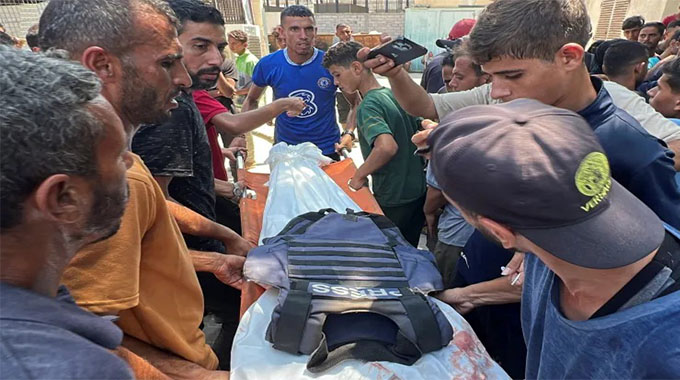
The massacre is briefly making headlines now, but it will soon be forgotten — just as Amna’s murder was.
Although these journalists were protected civilians, sheltering inside a medical facility that enjoys special protection under humanitarian law, no one will hold Israel accountable for what it claims was a “mistake”. No one will investigate.
This is exactly what happened with the assassination of Anas al-Sharif, Mohammed Qreiqeh, Ibrahim Zaher, Mohammed Noufal, Moamen Aliwa, and Mohammed al-Khaldi.
Their deaths were also gradually forgotten. Social media tributes faded.
Their killing, described as “unacceptable” and a “grave breach of international law”, remains uninvestigated. Israel’s claims about Anas have gone unchallenged.
Israel’s burying alive of journalist Marwa Musallam, along with her two brothers in June; its killing of Hussam Shabat in March; its murder of Ismail al-Ghoul and Rami al-Rifi in July 2024; and — most painfully for me — its assassination of my dear professor Refaat Alareer in December 2023, all show how this recurring pattern endures.
The silence that follows each Israeli atrocity paves the way for the next, and for yet another failure by the world to hold Israel to account.
After witnessing this deadly cycle repeat time and again, Palestinians have come to believe that a career in journalism is a death sentence — not only for the journalists themselves, but for their families.
My own family, which once encouraged its young members to pursue media studies, now discourages anyone from following in Amna’s footsteps. “It’s a lonely road where the world turns its back on you,” they say.
Those working as journalists in the family are warned to tone down their work and avoid the spotlight.
My uncle Hamed, Amna’s father-in-law, told me he would never allow any of his other six children to pursue a career even remotely related to journalism.
“No acting, no journalism. I’d never let them appear before the media,” he said.
“I used to encourage anyone to enter the field of journalism. It’s the field of truth, I would say. After Amna, I hated everything related to the field,” he added.
Even Amna’s husband, Saed Hassouna, himself a journalist who once mentored aspiring youth, has gradually reduced his work since her killing.
This silence and withdrawal leave journalists’ families with nothing but unhealing trauma. In Amna’s case, a year after her death, her son Mohammed, aged 10 — who witnessed his mother and brother die and personally reported to journalist Ismail al-Ghoul that his family was trapped under the rubble — still suffers from trauma attacks.
Whenever he is sad, he shouts at people to let him go to the Israelis who killed his mother, so they can kill him too.
Amna’s young daughter, Ghina, aged five, still waits for her mother to return. She often cries, “Where did you take my mum?”
Nearly 23 months into this brutal war, the world still only goes as far as offering condolences for dead Palestinians. It does everything it can to avoid even the slightest sense of responsibility for what is happening in Gaza.
To date, 244 Palestinian journalists have been killed in Gaza.
All have received the same treatment — even those whose deaths were documented in detail have not been prosecuted as war crimes.
The case of Shireen Abu Akleh, killed in 2022 in Jenin by an Israeli sniper, was a harbinger of what was to come.
Even her United States citizenship and investigations by American media could not secure justice.
If mourning Palestinian journalists helps you feel less guilty — if it makes you feel as though you’ve fulfilled your duty towards them — then don’t mourn them.
We do not need more eulogies.
We need justice. It is the least the world can do for the orphaned children of Mariam, Amna, Anas, and the other 244 slain journalists in Gaza. — Aljazeera