

 admin
admin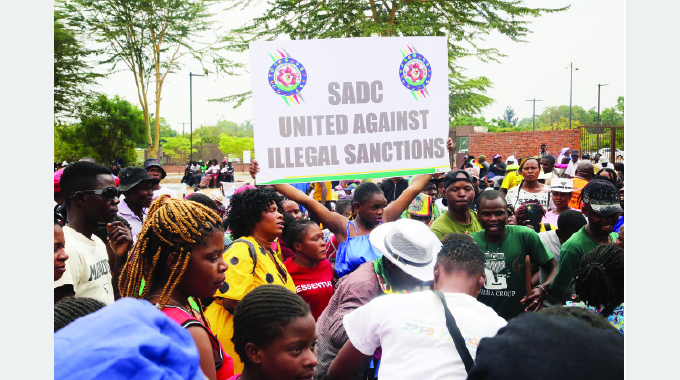
Paidamoyo Mutsvairo-Correspondent
Following the land redistribution programme of 2001, Western countries imposed illegal sanctions against Zimbabwe.
The European Union (EU), the United States (US) and United Kingdom (UK) claimed that the Government’s decision to remove the white minority and empower the black majority through land was a violation of human rights.
According to the EU and US, the sanctions were restrictive measures on late former President, Robert Mugabe, and some of the officials who were behind him.
Contrary to the assertion that sanctions in Zimbabwe are targeted at a small number of people, the truth is that the stiff grip of these economic embargoes is being felt all over the country’s economy, including critical sectors such as agriculture, mining and the manufacturing sector.
Given that the country’s economy is anchored on agriculture, failure by farmers to import some farming inputs such as fertilisers, farm machinery, as well as failing to export their produce negatively impact on their operations.
Such a development has ripple effects, as it also affects the agro-manufacturing industry.
Imposing economic sanctions on a developing nation is as good as crippling its economy.
Considering that lines of credit were also cut, and local companies were unable to access such service and this affected the viability of the local industry.
Access to cheaper and long term lines of credit is key to sustainable economic growth of any developing nation.
Unfortunately, in their blind reasoning and ignorance, the western community has been arguing that sanctions were designed as a penalty meant to ensure compliance with the law.
As first world countries, the West should by now have acknowledged that sanctions affect the whole nation and all economic sectors.
In actual fact, US, EU and UK should also admit that economic sanctions are the real human rights violators.
Instead of continuously reviewing and adding Government officials on the list, the West should be motivated to remove the economic sanctions imposed on the country, as they have proved that they are affecting all economic pillars.
Since he assumed office in 2017, President Mnangagwa has been preaching the gospel of engagement and re-engagement with the international community.
Thus, the President has been accommodative to some retrogressive nations in an effort to achieve success with the re-engagement drive.
He has also been emphasising that Zimbabwe is a friend to all and an enemy to none.
With such a positive development under the Second Republic, there is really need by the West to appreciate that and consider lifting the illegal sanctions.
Moreover, the illegal sanctions imposed on the country, like those imposed on Iraq, will continue to harm institutions which are vital for the survival, sustenance and continuity of the well-being of the majority.
Failure by the West to unconditionally lift the economic sanctions could be their strategy designed to isolate the country from the rest of the world and to keep the economy under-performing so that citizens would revolt against their Government.
In simpler terms, the move is calculated at effecting regime change.
The opposition party, Citizens for Coalition Change (CCC), then Movement for Democratic Change (MDC), in their naivety had been used by the West to front their agenda.
One wonders why the MDC lobbied for sanctions, in a bid to manipulate Zimbabweans for the furtherance of their objective of regime change.
Fortunately, the illegal sanctions failed to unseat a duly elected government for two decades now, as anticipated.
It is time those who imposed sanctions on Zimbabwe remove them.
It is, however, pleasing that the Southern African Development Community (SADC) set 25 October of every year as a day to strongly denounce the sanctions imposed on the country.
Like what most African leaders did at the United Nations General Assembly (UNGA), in September 2022, they stood in solidarity with Zimbabwe in calling for the unconditional removal of the economic sanctions.
Delivering his address at the UNGA 77th session, African Union (AU) chairperson and Senegalese President, Macky Sall, said the sanctions should be removed immediately to enable Zimbabwe to realise its full potential.
He further said these harsh measures continued to inflict a sense of injustice against an entire people and aggravate their suffering in these times of deep crisis.
It is heart-warming that progressive Zimbabweans and outsiders who want to see Zimbabwe prosper, on 25 October 2022 rallied behind the country to call for the lifting of the illegal economic sanctions against our beloved nation.



 Online Reporter