Online Reporter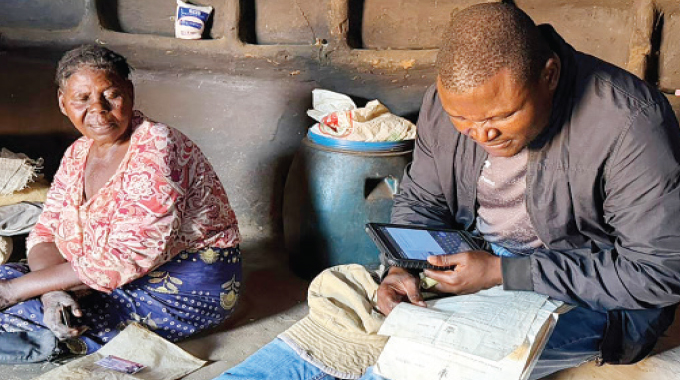
Andile Tshuma recently in Nkayi
In scattered homesteads across Nkayi District, Matabeleland North province, enumerators are quietly moving from one household to another, documenting lives that have long existed beyond the reach of formal data systems.
There are no public gatherings, no community meetings. Instead, there are private, one-on-one engagements between trained enumerators and families, designed to capture an accurate and confidential picture of how people are living.
At the centre of each interaction is household data; detailed, disaggregated information that is increasingly becoming the backbone of effective social protection systems.
Enumerators are collecting demographic and socio-economic data, including household size, age distribution, sources of income, employment status, access to water and sanitation, food security, disability status and other vulnerability indicators.
These are not just statistics. They are a reflection of lived realities, and, increasingly, a tool for shaping national policy.
This is the Zimbabwe Social Registry Survey (ZISO), a nationwide exercise aimed at building a comprehensive database of households to guide Government and development partners in designing targeted social protection programmes.
Its roll-out comes at a critical time.
Zimbabwe, like many countries, is grappling with the combined effects of climate change, economic pressures and global instability, factors that have deepened vulnerability, particularly in rural communities.
Erratic rainfall patterns, prolonged dry spells and recurring droughts have disrupted livelihoods, while broader economic challenges have placed additional strain on household incomes.
In such a context, experts say guesswork is no longer an option.
Effective social protection now depends on clear, reliable and up-to-date statistical data.
The ZISO survey, being spearheaded by the Ministry of Public Service, Labour and Social Welfare in collaboration with the Zimbabwe National Statistics Agency, seeks to provide exactly that.
By collecting granular household-level data, the initiative is expected to strengthen social protection systems, improve the targeting of vulnerable populations and support evidence-based policy making.
Globally, institutions such as the United Nations have underscored the importance of robust data systems in delivering effective social protection. The UN has repeatedly highlighted that social registries built on household-level data are essential in ensuring that assistance reaches the most vulnerable, particularly in contexts affected by inequality and climate shocks.
In Nkayi, that global principle is being translated into local practice.
Traditional leaders have welcomed the programme, describing it as a necessary step towards ensuring that development interventions are informed by realities on the ground.
Chief Tshugulu said accurate data would help bridge longstanding gaps in assistance programmes.
“This programme is important for our people because it will help Government understand the challenges faced by households and respond appropriately,” he said.
Village Head Ephraim Mathuthu highlighted the role of local leadership in supporting enumerators as they navigate communities, including hard-to-reach areas.
“We are working with enumerators to ensure every household is reached. This is important so that no one is left behind,” he said.
Authorities say enumerators have been carefully selected and trained not only in data collection, but also in ethical standards and community engagement.
Their work is guided by structured questionnaires and mapping systems similar to those used in national censuses, ensuring that even the most remote households are included.
Central to the exercise is the assurance of confidentiality.
Each interview is conducted privately, and all information collected is protected under the Census and Statistics Act, with strict guarantees that personal data will not be shared with unauthorised parties.
This approach, officials say, is critical in building trust and encouraging honest responses from households.
For villagers, the process is as much about being heard as it is about being counted.
Ms Sandisiwe Ncube, a villager, said the household-based interviews allowed families to openly share their realities without fear or pressure.
“We are glad that Government is taking time to understand our situation. We hope this will bring development that speaks to our needs,” she said.
Another villager, Mr Nkosiyapha Nkomo, said accurate data would help ensure fairness in how assistance is distributed.
“If the information is used properly, it can help improve our lives and ensure that support goes to the right people,” he said.
While the exercise in Nkayi is unfolding quietly at the household level, it forms part of a broader national shift towards data-driven governance.
Speaking during a field tour in Nkayi District, Matabeleland North Provincial Director in the ministry, Mr Sicelo Nyathi said the registry would improve targeting of vulnerable groups and enable quicker responses in times of distress. “This exercise ensures that no one is left behind. With accurate and up-to-date data, Government will be better positioned to design and implement programmes that uplift livelihoods and build resilience in communities,” he said
Zimbabwe is intensifying efforts to modernise its statistical systems under the National Development Strategy 2 (NDS2), with a strong focus on strengthening the production and use of data in policy-making.
ZimStat Director General Ms Tafadzwa Bandama said the initiative comes at a critical time as the country grapples with economic pressures and climate-induced shocks.
“The Zimbabwe Social Registry Survey is a critical tool that will allow us to collect detailed household-level data across the country. This will strengthen our social protection systems and ensure that assistance reaches those who need it most,” she said
According to ZimStat, the country is working towards building an integrated national statistical system that brings together household surveys, administrative data and emerging data sources to improve the scope, accuracy and timeliness of official statistics.
The shift reflects a growing recognition that development outcomes are closely tied to the quality of data that informs decisions.
However, challenges remain.
Fragmented data systems, institutional silos and inconsistencies in definitions and methodologies continue to affect the efficiency of the national statistical system.
In some cases, data is produced too late to inform policy, while in others, gaps in coverage leave vulnerable populations unaccounted for.
There are also concerns around the limited use of available data, with experts noting that weak coordination between data production and policy cycles can undermine the effectiveness of otherwise robust datasets.
These gaps highlight the importance of initiatives such as the social registry, which seeks to create a unified and reliable source of household-level information.
Once complete, the registry will serve as a centralised database that can be used by Government and development partners to coordinate interventions, reduce duplication and ensure that limited resources are directed to households that need them most.
At a time when climate shocks and economic uncertainties are becoming more frequent and complex, such coordination is increasingly critical.
Without reliable household and demographic data, social protection programmes risk missing their targets, leaving vulnerable households exposed.
But with a robust, evidence-based system in place, Zimbabwe stands to significantly improve its ability to respond, not only to current challenges, but also to future shocks.
The initiative also aligns with the country’s Vision 2030, which places emphasis on inclusive development, improved service delivery and data-driven decision making.
From Nkayi, where the survey is currently underway after its completion in Mangwe District, the exercise is expected to expand to other parts of the country, including Mudzi District, as the nationwide rollout gathers pace.
Authorities are urging households to cooperate with enumerators, verify their identification and provide accurate information, emphasising that the success of the programme depends on full participation.
As enumerators continue their quiet, methodical work across Zimbabwe’s communities, each household interview is contributing to a larger national goal, building a clear statistical picture that can guide meaningful, targeted and effective social protection.
In an era defined by uncertainty, that data may prove to be one of the country’s most valuable tools in safeguarding livelihoods and driving inclusive development.