admin
admin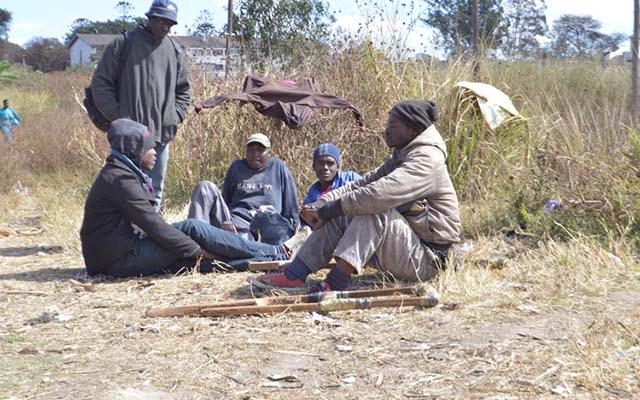
Leroy Dzenga : Features Correspondent
The cold breeze from Mukuvisi River, which runs through a number of Harare suburbs, keeps 38-year-old Nicholas Gatawa literally awake every night. He is one of several destitute people who have found a home along the infamous water bodies in the country’s capital. However, his story is different from the multitude of homeless people found along the river channel.His ordeal is compounded by the tag of being an ex-convict.
Gatawa, a beneficiary of the recent Presidential Amnesty, is one of several ex-prisoners who have found a “home” along the river bank.
He has been in and out of jail on three occasions blaming it on an unreceptive society to ex-prisoners.
In 2001, Gatawa was convicted of rape and served four years but was back in jail between 2009 and 2011 for theft.
He was serving time for theft before the presidential pardon.
“I found myself back in prison because each time I got out, I was broke and had no one to turn to. My family disowned me at a time I needed them most.
“People rejected me. They said that since I had been convicted of rape, I was a danger to their daughters. My relatives said painful words to me,” he said.
His ordeal is shared by many ex-prisoners.
Mathew Chiweshe (39), has also served three prison terms after being sentenced to 11 years for housebreaking and unlawful entry in 1998.
He was also convicted twice between 2010 and 2015 on theft charges.
What made his situation worse is that his parents had died when he was eventually released in 2009 and had no one to turn to.
“My parents died while I was in prison and I became homeless when I was released. I had no choice but to resort to my old ways for survival,” he said.
Chiweshe found himself along the Mukuvisi River bank after people in Mbare directed him there.
Here, he found many other homeless people.
Another ex-convict, Tendai Ali (38), was sent to the Chikurubi Female Section for shoplifting in January this year.
Although her stay was cut short by the amnesty, she returned home to find her lodgings empty after thieves ransacked her house.
“I was happy to be released just a few months into my sentence.
“The joy was, however, short-lived as I went to an empty house,” she said.
Former jail colleagues told her how Mukuvisi provided ex-prisoners with a place to stay after being released from prison.
“I came to stay here with my daughter and these people are the only family I have for they accommodated me when I arrived,” Ali said.
Ties with her family were weak before her arrest and she never bothered to approach her relatives after being released.
“I knew no one would accept me so I had to seek alternative accommodation hence I found myself here,” she said.
Ex-convicts who have benefited from the ZPCS rehabilitation programmes have, in some instances, found the going tough due to economic hardships.
Thomas Mpofu (43) studied mechanics during his time at Chikurubi Maximum Prison.
“I have failed to find work because of my criminal record and people treat me with suspicion,” he said.
President Mugabe pardoned more than 2 000 inmates across Zimbabwe to decongest national prisons and promote better living conditions.
The amnesty was extended in terms of Section 112 (1) (a) and (d) of the Constitution of Zimbabwe.
The amnesty freed all convicted female prisoners except those on death row or serving life sentences, leaving Chikurubi Female Prison literally empty.
It was also extended to all juveniles and other male prisoners with life sentences convicted on or before December 25, 1995.
However, of all the people released, at least 68 have already found themselves behind bars in less than two months after the amnesty.
Zimbabwe Prison and Correctional Services (ZPCS) acting public relations officer Priscilla Mthembo said family hostility towards the ex-inmates compounds the challenges they faced.
“Rejection by family members, mainly due to the fact that the ex-offender would have committed the initial offence within the family set-up thus upon release family members refuse to forgive and accept them back,” she said.
The family set-up is expected to act as a support system for the ex-inmates.
Mthembo however said prisoners who exhibit a negative attitude towards prison rehabilitation programmes find themselves back in prison.
“Negative attitudes towards rehabilitation programmes offered by ZPCS to inmate can also have adverse effects upon release as rehabilitation programmes are meant to correct, empower and prepare the inmate for life after imprisonment.”
Prodigal Sons and Daughters, an organization that deals with the rehabilitation of ex-prisoners, blamed society for ex-prisoners relapsing into criminal activities.
The organisation’s founder Masauso Kaware (40), an ex-convict who has experienced better fortunes, said the worst stigma came from society especially in a rural set-up.
“When someone commits a crime, is tried and convicted in the courts and serve their time, they usually go back to their rural areas where some are also tried at the chief`s court.
“They may be facing possible banishment,” he said.
Kaware said these ex-convicts find themselves with nowhere to go after banishment.
“At this point it is easy for an ex-prisoner to be tempted back to crime” he said.
Kaware turned his life around after serving 10 years at Chikurubi Maximum Prison for armed robbery.
He has since recorded two gospel albums since his release.
Kaware has also dedicated time to assist ex-prisoners through the Prodigal Sons and Daughters programme.
“When I left prison, my aunt welcomed me and I started doing menial jobs as I saved money to record music.
“If it was not for her hospitality things would have turned out badly as she was my only hope out of prison.”
He was homeless temporarily before registering Prodigal Sons and Daughters, an organization which rehabilitates ex-inmates.
His next album is due for release next month.
Feedback: [email protected]



 Online Reporter