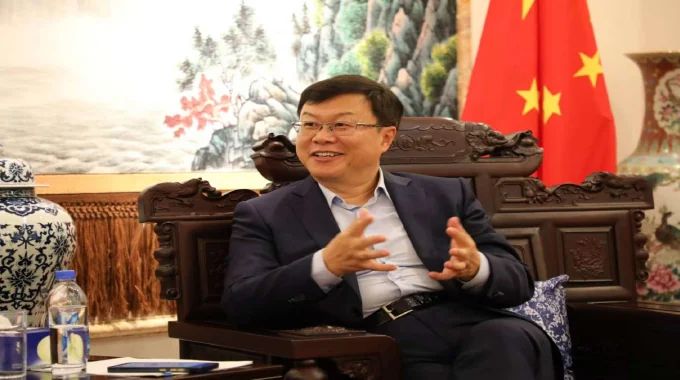
Q1: Your Excellency, the Fifth Plenary Session of the 20th Central Commit-tee of the Communist Party of China wrapped up in Beijing on 29 October. What is the core focus of this session?
Ambassador: The Fifth Plenary Session of the 20th CPC Central Committee centres on building a CPC that is stronger, cleaner, and more effective in deliv-ering its mandate. The CPC holds a fundamental conviction: sound national governance starts with strong party governance, and a strong Party underpins a strong nation. A well-governed Party enables steady national development and faithful delivery of China’s international commitments.
Held at the milestone of the CPC’s 105th anniversary and the launch of the 15th Five-Year Plan, the session signals the Party’s top priority on strengthening its own institutional health. Amid complex domestic and global challenges, it advances systematic self-improvement to support Chinese modernisation and im-prove people’s wellbeing. Its core task is to sustain full and rigorous Party self-governance to address governance challenges at home and abroad.
The landmark outcome of the Plenary session is the adoption of the Resolution of the Central Committee of the Communist Party of China on Certain Major Issues concerning Persevering with
Full and Rigorous Party Self-Governance. This actionable blueprint draws on more than eight months of drafting, wide-ranging inputs from across the Party and extensive research, embodying collective wisdom and evidence-informed decision-making rather than closed-door decision-making.
To help Zimbabwean readers grasp what “full and rigorous Party self-governance” actually means, let me break the concept down into three simple pillars.
Full: Discipline applies to all Party members and all areas of the Party’s work; everyone is equal before the rules..
Rigorous: Regulations and standards are strictly enforced. We prioritise early warning and preventive education to stop minor misconduct from worsening.
Self-governance: The Party exercises internal supervision, rectifies its own flaws and reforms itself via dedicated disciplinary and oversight systems.
The plenary session underscores the critical importance of “sustained effort”. Corruption risks persist, modernisation is a long-term endeavour, and public trust cannot be secured through short-term campaigns. Full and rigorous self-governance of the Party is an ongoing journey with no final finishing line.
President Xi Jinping uses a well-known, vivid analogy: “To forge iron, one must be strong yourself.”
To build a strong nation, the governing party must first for-tify its own foundations. This plenary session is precisely about tempering that foundation.
Q2: Under CPC leadership, China has recorded extraordinary development gains. Why does the Party keep undertaking this rigorous process of internal reform? What does this plenary session mean for China’s future path?
Ambassador: That is a very pertinent question. Founded 105 years ago with just over 50 members, the CPC has grown into the world’s largest governing politi-cal party, boasting more than 100 million members and steering a country home to over 1.4 billion people. It has guided the
Chinese people to national inde-pendence, lifted hundreds of millions out of poverty, and is driving the country forward on its modernisation journey. Even amid these major achievements, we remain sober-minded and clear-eyed.
Looking back across our century-long history, the CPC has identified two solutions to break free from the historical cycle of rise and fall that troubled many past regimes. The first solution emerged in Yan’an in the 1940s, on the eve of national liberation: letting the people hold the Party and government to account. The second solution, forged in the new era starting from 2012, is the Party’s self-reform through full and rigorous self-governance. These two solutions are unique innovations born from decades of real-world practice.
It speaks volumes about our governance philosophy that a century-old political party never grows complacent over its successes. Instead, it squarely faces its own weaknesses and renews itself from within. External oversight by the people plus internal self-purification keeps the Party vibrant and accountable. This clarity and courage carry valuable practical governance lessons.
The plenary session sets out seven guiding principles for sustaining full and rigorous self-governance of the Party: staying true to the Party’s core mission; prioritising political-ideological building; enforcing comprehensive rigorous discipline; keeping a problem-focused mindset; preserving core values while pursuing innovation; leading by example from senior leadership downwards; and running the Party according to formal rules and regulations. These princi-ples are not abstract theoretical ideas. They are hard-won lessons accumulated from more than a decade of party-building practice in the new era. This mature governance system ensures the CPC remains the firm core steering China’s modernisation drive.
For China’s future, the logic is straightforward: a strengthened party delivers consistent policies. Consistent policies underpin national stability. National stability enables long-term national plans to be implemented and delivered, so that the lives of China’s 1.4 billion people keep improving year after year.
Q3: Even though this plenary session centres on the CPC’s internal institu-tional strengthening, what global significance does it hold? What insights can countries across the Global South draw from it?
Ambassador: While this plenary session is an internal CPC meeting, its ripple effects stretch well beyond China’s borders.
First, it sends the world a powerful signal of predictability. When the CPC strengthens its own institutions, national governance stays stable, policies re-main consistent, and international commitments are honoured reliably. By get-ting its own domestic house in order, China is not turning inwards. On the contrary, it offers Africa and the wider world a dependable, consistent partner. For developing nations, a partner with steady policies and a proven track record of keeping its word is far more valuable than one whose positions shift unpredictably.
Second, I wish to emphasise a key point: China never exports its governance model. Our party-building experience grew directly out of China’s unique national realities. We never urge other countries to copy our systems wholesale.
As we often put it: “Only the person wearing the shoes knows where they pinch.” Every country has its own distinct history, culture and social context. No outsider understands a nation better than its own citizens. Each country ought to choose and shape a governance path suited to its own circumstances. This is also a core tenet of the Global Civilisation Initiative that China advocates.
At the same time, we welcome equal-standing exchanges on party-governance experience with political parties worldwide. China’s practices are offered purely for reference. We attach no political preconditions and do not lecture other na-tions.
Today’s global landscape is fraught with challenges. Unilateral sanctions, foreign interference and hegemonic posturing are on the rise, placing heavy pressure on many developing countries.
China stands firmly alongside the Global South. I note Zimbabwe will take its seat as a non-permanent member of the United Nations Security Council in January 2027. This is well-deserved international recognition for Zimbabwe, and a vital platform for Global South nations to speak with a collective voice. China is ready to work closely with Zimbabwe and other like-minded countries in multilateral forums to push back against illegal unilateral sanctions, advance reforms to global governance architecture, and safeguard the shared interests of developing nations.
Q4: Both Zanu-PF and the CPC are revolutionary political parties born from national liberation struggles. What direction will inter-party exchanges take following this Fifth Plenary Session? Is
China prepared to share experi-ence on integrity-building and anti-corruption work with Zimbabwe?
Ambassador: The bond between our two parties was forged in the crucible of national liberation struggles. On the 105th anniversary of the CPC’s founding, H. E. President Mnangagwa sent a congratulatory message to President Xi Jinping. When the Fifth Plenary Session was convened in
Beijing, Hon. Advo-cate J.F.N. Mudenda, Parliament Speaker and Zanu-PF Secretary-General, and Hon. Mabel Chinomona, President of the Senate, also extended congratulatory messages. These gestures embody the strong, long-standing solidarity and ca-maraderie between our two parties.
Our parties share fundamental common ground. Both emerged from liberation movements and carry forward a revolutionary legacy.
After securing national independence, both have prioritised economic empowerment and improving or-dinary people’s livelihoods as core governing goals. This creates solid ground for us to learn from one another on an equal footing.
Going forward,our Party-to-Party dialogue and cooperation can deepen along three main tracks.
First, mutual learning on party-building. We can exchange views and ideas on party organisation, member education and cadre capacity building. Zanu-PF recently concluded its 23rd National People’s Conference, where it set out plans to strengthen the party.
This priority aligns closely with the core themes of the Fifth Plenary Session of the CPC Central Committee. Both parties place high importance on internal institutional strengthening, creating plenty of room for two-way, comradely conversations, not one-sided lecturing.
Second, sharing practical grassroots governance experience. We can exchange real-world lessons on rolling out national policies at local level, reducing pov-erty, raising household incomes and advancing rural revitalisation.
Third, leveraging existing cooperation channels. We will continue delivering specialised training programmes, organising cross-party delegations and cadre exchange visits, so we can learn side-by-side and make progress together.
Turning to your question on anti-corruption and public-sector integrity: corruption is a governance headache in every country, and the zero-tolerance stance taken by the Government and people of Zimbabwe is one China fully shares. Since the 18th National Congress of the CPC in 2012, China has waged sustained, consistent anti-corruption efforts, and our resolve and results are widely recognised.
Drawing on accumulated experience, the Fifth Plenary Session sets out a coordinated strategy to advance three objectives in tandem: ensuring that officials dare not, cannot, and do not want to commit corruption. This goes well beyond prosecuting individual wrongdoers; it combines deterrent measures, in-stitutional safeguards and values-based education into a single system.
The Session also called for deeper international anti-corruption cooperation, including tracking fugitives and recovering illicit assets. This framework is now underpinned by the newly adopted
“Anti-Cross-Border Corruption Law”, China’s first dedicated law in this area, passed by the National People’s Congress Standing Committee on 6 November.
I would like to clarify the key points of the new law for Zimbabwean readers:
First, the law primarily regulates Chinese citizens and Chinese enterprises operating overseas, including those active across Africa. It turns integrity compliance from a policy expectation into a legal duty: outbound firms must put in place proper compliance systems, conduct due diligence on partners and agents, keep reliable accounts and avoid improper indirect dealings. Stronger compliance makes Chinese businesses more trustworthy partners for Zimbabwe.
Second, the law is not a tool for long-arm jurisdiction. It operates strictly under international law and respects the primacy of host-country laws. Cross-border cooperation proceeds only through treaties and agreements, on the basis of equality, mutual benefit and consent. It does not seek to override the host-country’s law enforcement authority.
Third, the law itself sets clear procedural safeguards. It requires lawful imple-mentation, equal protection for all market players and avoids disrupting normal business activities. The state must hold itself to the standard it sets for others.
Q5: The Fifth Plenary Session stresses stable national governance and policy continuity. What fresh opportunities will this create for building a China-Zimbabwe all-weather community with a shared future?
Ambassador: In September 2025, China-Zimbabwe relations entered a new chapter focused on building an all-weather community with a shared future. “All-weather” means our friendship does not shift with global geopolitical swings, nor rise and fall over isolated points of disagreement.
What does the Fifth Plenary Session mean for China-Zimbabwe cooperation? I would highlight four key dimensions.
First, greater certainty for our partnership. Full and rigorous self-governance of the Party consolidates China’s domestic governance foundations. China’s commitment to opening its doors to the world will not waver. Agreements struck be-tween China and Zimbabwe can be implemented steadily, free from disruptions caused by domestic shifts inside China. For Zimbabwe, this translates into a highly reliable partnership environment.
Second, higher-impact cooperation that delivers tangible improvements to peo-ple’s lives. We will keep deepening joint work in agriculture, food security, irri-gation infrastructure, rural development and healthcare. We will work to ensure China’s zero-tariff policy for African countries benefits ordinary Zimbabwean citizens, enabling Zimbabwe to lay solid groundwork for long-term development.
Third, opening new frontiers for cooperation. Alongside our traditional areas of collaboration, we stand ready to jointly explore opportunities in emerging sec-tors such as renewable energy and artificial intelligence. This can help Zimba-bwe capitalise on new technological revolutions and foster home-grown sources of economic dynamism.
Fourth, deepening capacity-building support. We will scale up vocational skills training and youth-focused people-to-people exchanges, to nurture skilled pro-fessionals that Zimbabwe needs. As a well-known proverb puts it: give someone a fish and you feed them for a day; teach them how to fish and you feed them for a lifetime. Our aim is to help Zimbabwe build up its own self-sustaining de-velopment capacity.
To sum up: a stable, strong and self-confident China is Zimbabwe’s trusted, all-weather long-term partner.