Chronicle Editor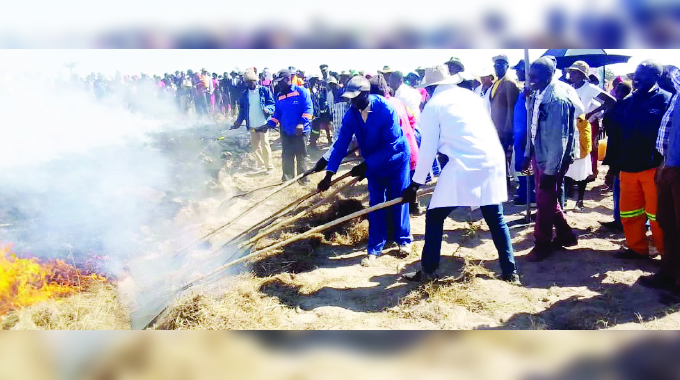
Patrick Chitumba, [email protected]
Almost two years have passed since Mr John Makhaya Masuku (39), a farmer from Somabhula, lost three brand new tractors and an array of hay baling equipment to a veld fire that ravaged through his farm and surrounding areas. The pain and suffering brought by the incident is still fresh in his mind.
Mr Masuku recalls the sad Wednesday morning back in September 2022, when he heard the news about his equipment being destroyed in a veld fire.
He was one of the farmers who converged at Dawson Farm in the Somabhula area outside Gweru recently for a launch of the Midlands provincial fire week and gave a testimony of how veld fires can hinder progress if farmers fail to put proper fire guards on their properties.
With the intention of expanding his hay bailing business, he said he found himself losing three tractors with a combined cost of US$57 000 and a baler at US$9 000.
Also lost in the veld fire were 14 000 hay bales valued at US$21 000, which he was selling at US$1,50 each.
“I am still haunted by the experience we faced back in 2022. It’s like it happened yesterday because the wounds are still fresh.
“My employees left the farm unattended as they went to the shops. Unfortunately, we had not done proper fireguards at the farm and it so happened that a veld fire that ravaged the area also left a trail of destruction at the farm and I lost the tractors, a baler and hay bales all to the tune of about US$80 000 and that’s no joke for a young farmer like myself,” he recalled.
Mr Masuku commended the Environmental Management Agency (EMA) for launching the fire week which he said should be used to sensitise farmers on the need of putting fireguards on their properties.
“As we are slowly approaching the fire restriction period, farmers as well as members of the public are encouraged to put in place measures to prevent veld fires. By now farmers should be hard at work constructing fireguards and reducing biomass through hay baling,” he said.
Veld fires do not only destroy property but they also disturb ecosystems by destroying critical plant and animal species.
In addition, these blazes also burn important plants that community members consume to supplement their diets in times of need.
Fires also cause air pollution through the release of carbon dioxide, nitrogen oxides and oxygenated organic compounds.
Vegetation regulates carbon dioxide in the atmosphere through carbon sequestration. Removal of vegetation in the form of veld fires means that there is reduction in carbon sequestration from the atmosphere, and the smoke produced in those fires produces massive carbon dioxide which is a greenhouse gas causing global warming.
Addressing the farmers, Minister of State for Midlands Provincial Affairs and Devolution Owen Ncube said there was a decrease in veld fire incidences across the province in 2023 as compared to 2022.
In a speech read on his behalf by the permanent secretary Dr Edgar Seenza, Minister Ncube said the province lost a total of 84 915 hectares in 2023 as compared to 128 000 hectares in 2022.
Minister Ncube said the province must guard against such losses which have a negative impact on the economy, and result in biodiversity loss, land degradation, pollution and food insecurity.
“In 2022 one farmer in the area lost three tractors and bailing equipment worth thousands of dollars, while in 2023 seven and five huts were gutted by fire in Shurugwi and Zvishavane respectively losing household property in the process.
“Veld fires have become an issue of national concern given their destructive nature to the environment, life and property,” he said.
“They have become one of the major challenges that the country is facing and are also undoubtedly among the major drivers of land degradation and biodiversity loss in the country.”
Minister Ncube said EMA’s fire risk modelling revealed that the country is generally in the medium to high risk between 18,6 percent and 55,7 percent.
In the Midlands Province, Gweru, Chirumhanzu, Kwekwe, Shurugwi and Gokwe are high risk areas, while Zvishavane and Mberengwa are low risk.
He said the launch of the fire week at Dawson Farm, which is in Ward 15 was important as Gweru District was affected the most by veld fires in 2023 before imploring Chiefs to diligently remain as guardians of the environment, natural resources and cultural values.
“The economic and environmental consequences of veld fires are far-reaching and severe. The fires not only destroy crops, forests, grazing land, livestock and property, but also endanger biodiversity, water sources and air quality,” said Minister Ncube.
Forestry Commission Gweru District officer, Mr Polite Foto said they had trained 12 firefighting teams in Somabhula, which is a model fire village ready to fight any fires that might start in the area.
“Other districts in the province must emulate what is happening in Somabhula as villagers are equipped in terms of knowledge and firefighting techniques,” he said.
Mr Foto said Gweru District had a bigger hectarage destroyed because the fires were sporadic and started from neighbouring districts.
He said hay bailing is encouraged to reduce biomass so that if fires start, they will not spread fast as fuel load would have been reduced.
EMA spokesperson for Midlands province Mr Oswald Ndlovu said the launch was a way of upscaling awareness activities on veld fire management.
“Farmers will know what to do as we have trained firefighters here who will know how to assist other communities when fire breaks out.
“The most common cause of veld fires includes field preparation for the farming season, pedestrians or motorists starting fires next to highways and littering of burning cigarette stubs,” he said.
Mr Ndlovu said farmers who have not started constructing fireguards should upscale their preparedness and make sure that all properties have fireguards in order to protect them.
Chief Bunina Chisadza of Lower Gwelo said he was elated that his area hosted the provincial fire week launch.
He said people in rural areas were aware that it is unlawful to start fires but some were stubborn.
Meanwhile, 40 fruit trees donated by the Forestry Commission were planted at the farm as an encouragement to the community to preserve their surroundings through setting up fireguards.


 Online Reporter