Online Reporter
Sukulwenkosi Dube-Matutu , Matabeleland South Bureau
WHAT was once an ancestral homestead in Wanezi, Insiza District, has been transformed into a bustling centre of agricultural innovation and rural enterprise.
Mr Nkosibona Dube, a former South Africa-based project manager, has turned his family land into a thriving agro-tourism hub that is fast becoming a model of rural industrialisation in Matabeleland South Province.
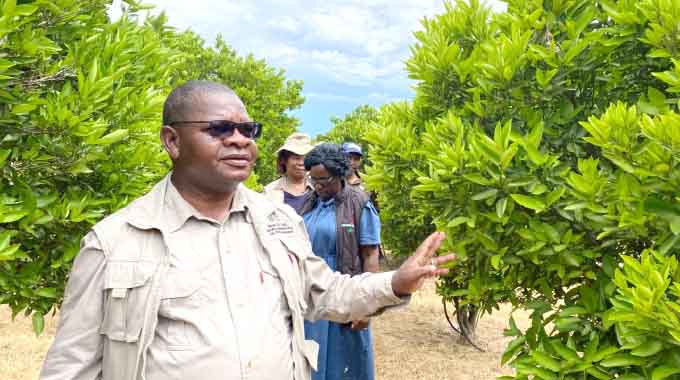
Set on just four hectares, the enterprise integrates livestock and crop production under a climate-smart agriculture model, complete with a modern milk parlour, a citrus orchard, a piggery and a 34kV solar system that powers operations.
The project directly aligns with the National Development Strategy 2 (NDS2), which prioritises rural industrialisation, value addition and the mobilisation of diaspora resources to drive economic growth and food security.
Mr Dube, who spent nearly two decades working on farms in Johannesburg, returned home in 2016 determined to invest his skills and savings into productive agriculture.
“The shift from subsistence to intensive mixed farming is part of my contribution towards national food security. I felt it was important to channel my resources back home in response to the Government’s call for citizens to drive economic transformation,” he said.
Working on land passed down through generations, Mr Dube has built a diversified farming operation that supplies fresh produce to local markets, including Wanezi Mission, while also servicing hotels and outlets in Bulawayo.
“I’m doing all these projects on our ancestral land, which belonged to my forefathers. We can do a lot on our land if we are dedicated and focused. The starting point is having reliable water. I drilled my first borehole in 2016 and now I have eight,” he said.
Water security has been central to his success, enabling year-round production in an ecological region often characterised by erratic rainfall. He now employs more than 30 workers, including specialised personnel such as a crop expert, animal health technician and a farm manager thus contributing to local livelihoods.
Beyond production, Mr Dube has embraced sustainable farming practices, relying on organic fertilisers to maintain soil health and boost yields in the area’s predominantly sandy soils.
“Our area has sandy soils and many people think they are not fertile, but we feed our soil. We use organic materials from the farm such as cattle and chicken manure, to improve soil quality. This has helped our crops perform well,” he said.
His integrated system includes recycling nutrients within the farm, where chicken manure is processed and fed to cattle, with the resulting manure then used to enrich crop fields, a closed-loop approach that reduces input costs and enhances sustainability.
Despite having no formal agricultural qualifications, Mr Dube said the decision to leave a well-paying job in the diaspora required courage and conviction.
“It took a lot of guts to leave my job, but the desire to develop my own country pushed me. I wanted to build something meaningful at home,” he said.
The farm is now drawing attention not only for its productivity but also as an emerging agro-tourism destination, attracting visitors keen to learn about intensive farming on small landholdings.
During a recent visit, Permanent Secretary in the Ministry of Agriculture, Mechanisation and Water Resources, Professor Obert Jiri, described the project as a practical example of how communal land could be transformed into viable agro-industrial enterprises.
“What we are seeing here shows that it is possible to develop your communal land into an agro-industry. What we are seeing here is an example of intensive farming and now the area has become an agro-tourist attraction. So, you do not need vast tracks of land to be productive,” he said.
Prof Jiri said such initiatives are critical to the Government’s rural industrialisation agenda, which seeks to stimulate economic activity, create jobs and improve livelihoods in rural communities.
“Farming isn’t always about having a portion of land. It depends on how you utilise the land that you have to maximise production. Here, the farmer has four hectares of land but has managed to operate a dairy project, beef production, horticulture, small livestock production and an orchard,” he said.
Prof Jiri said the country needs such farmers who will fully utilise the land they have been allocated.