admin
admin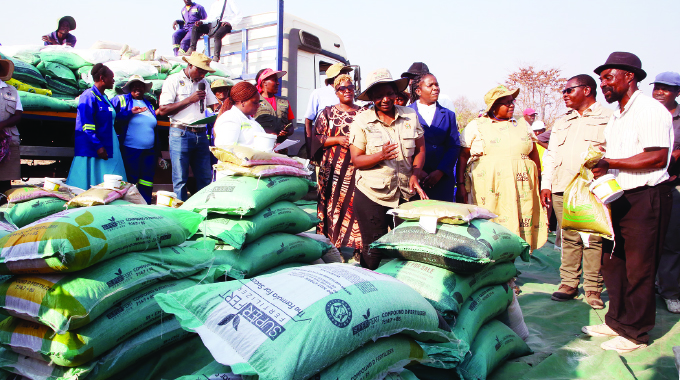
Obert Chifamba Agri-Insight
RECENTLY, the Government announced plans to avail more inputs for farmers intending to expand their hectarages under the Pfumvudza/Intwasa programme.
Essentially, the move was inspired by the desire to ensure all citizens have enough food and even surplus to sell and generate some income.
This makes a lot of sense given that the Pfumvudza model is an actualisation of the dogma to treat agriculture like any other business in which one invests and harvests profits.
The Pfumvudza tenets of producing more using very little clearly hints at its business nature where investments should generate more in return. Under Pfumvudza, the farmer must know the number of planting stations (holes) he has on his plot and the plant population as well as the cobs per plant.
This goes down to the point of also establishing the number of kernels per cob and the kernels needed to fill a bucket versus the number of buckets he needs per year. Armed with such knowledge, the farmer can then calculate own requirements from the yields before selling surplus.
To me this is a business approach that can easily make one food secure, and is economically sound if done properly.
And to make sure farmers do everything to book, Government has also deployed extension workers that are equipped with motor bikes and tablets for easy communication and movement so there should be no excuse for farmers to perform below par if the season is a good one.
Farmers have also been trained on the basics of the concept and how to make it more viable than conventional farming.
It is therefore not folly to expect farmers who benefitted from the programme at its inception to have been weaned from Government support by now to make way for new beneficiaries.
It, however, seems some farmers are comfortable being beneficiaries every season and do not take the initiative to graduate from relying on the Government for them to have a successful season.
The sober truth is that Government has a lot on its plate and cannot perennially help the same people for the same problem.
It is not surprising that Lands, Agriculture, Fisheries, Water and Rural Development permanent secretary Professor Obert Jiri recently hinted that Government’s focus was to make sure everyone had enough food on the table but quickly added that the idea was not to give them fish but to teach them to fish and be self-reliant later.
In less idiomatic terms, Prof Jiri was saying all the efforts Government is making in coming up with a cocktail of resilience building measures and climate smart technologies are designed to make everyone, everywhere food secure every day instead of waiting for free food handouts.
He did not end there but commented that humanitarian assistance would now be a thing of the past, with Government recently announcing plans to provide more inputs for vulnerable groups that needed to increase their number of plots under Pfumvudza.
Logically, such a move should also increase their incomes besides boosting food security.
The ball is now in the farmers’ court. The brutal truth is that most of them have land that can accommodate more plots, which is not being used so there is no reason for them not to take up Government’s offer and broaden their production levels.
This will leave them more secure in terms of both food security and incomes. It will not make sense for the farmers to be perennial dependants on Government programmes because that will also curtail their growths as individuals while stalling the expansion of the national economy as well.
Suffice it to say therefore that Government can always extend a helping hand to vulnerable groups that include the elderly, child headed families, orphans and the chronically ill who cannot adequately provide for themselves, thanks to their disadvantaged positions.
The idea of having farmers going it alone may at first sound less-caring but it builds the much-needed sense of business and ownership of farming programmes or projects.
Where the farmer injects own capital, the zeal to recoup that money will drive him /her to go the extra mile and produce more. Naturally, this burning desire to succeed may easily die if they know that Government will just come in and support them for the next season.
If the country is to seriously take agriculture as a business in which farmers participate in market-oriented agriculture that can improve their livelihoods through diversified nutrition, employment and enhanced incomes, it is imperative that they also bear the cost of production even if Government may step in to assist.
As producers and consumers, smallholder farmers are key actors in the agriculture sector and must readily play the part.
It is refreshing to note that Government is alive to farmers’ needs and growing challenges and has since moved in to promote innovative approaches in extension and general development of the agriculture sector, pluralism of service provision, and demand-driven extension services along the agricultural enterprises value chains.
The current agricultural extension services have gone beyond production technology transfer to facilitation, training to learning, dealing with post-harvest handling, food safety, nutrition, value addition and marketing issues.
It is also taking into account the conservation of natural resources, financial and other resource mobilisation, agribusiness, and gender issues in the agriculture sector and more specifically at household level.
This is what the independent farmer needs to grow as a business person.
Our farmers are also lucky to have service providers that are up to date with topical issues in agriculture in as far as changes in the global food and agricultural systems, changes in consumer demands, off-farm rural employment opportunities and mitigating constraints imposed by pandemics such as Covid-19 and HIV/AIDS are concerned.
Most importantly, the country’s extension services are also being mainstreamed to come in handy for farmers when they tackle climate change challenges that are frustrating agricultural productivity and production.
This leaves farmers without a reason to keep on expecting Government to fund them every season, which clips their wings or delays individual growth.
Government’s programmes are meant to provide a threshold for farmers to re-charge and go back into business on their own once again and not expect to be eternal dependants on aid.
Of course, there are times when Government has to chip in, for instance, when the weather turns hostile to production and causes poor yields that leave farmers unable to generate meaningful incomes to support their activities.
Government has always done that and has even intervened when there are man-made challenges threatening to ruin agricultural production. The crux of the matter is that farmers must move away from expecting Government to be supporting them every year.



 Online Reporter