admin
admin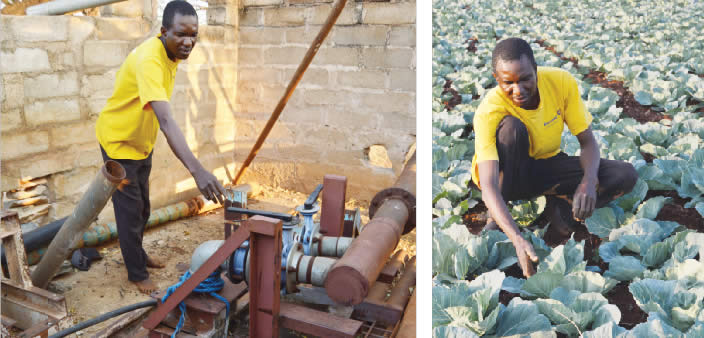
Dumisani Nsingo Senior Farming Reporter
DISUSED mines are despised in many communities and often serve as scars of the exploitation that miners would have done leaving a trail of destruction. But a group of nine enterprising farmers in Bubi District, Matabeleland North has managed to take advantage of the water trapped at one of the various disused mines in the area to run a flourishing agricultural enterprise in the drought prone area.
The 25-hectare Diglis Park Irrigation Scheme is home to nine farmers who were allocated land under Government’s land reform programme in 2001.
The farmers have been cropping cereals and horticultural produce at the irrigation scheme since 2008.
“We started irrigating our crops using water from the disused mine shaft in 2008 following successful tests that were conducted by experts from the Department of Irrigation,” said one of the farmers, Justin Moyo.
The group of farmers is considering extending their cropping fields owing to an abundant underground water source. “There are two more wells which we intend to utilise and extend our farming project but due to lack of equipment we are being confined to the 25 hectares that we are cultivating at the moment,” said the irrigation scheme’s vice-chairman, Moment Malandu.
He said the irrigation scheme was one of the beneficiaries of Brazil’s More Food for Africa funding programme.
“I’m glad that we have been identified as one of the beneficiaries to receive farming equipment under the Brazilian facility. We are reliably informed that we are going to receive a tractor, a disc harrow, disc plough, a hose reel and snap snack sprayers.
“This will go a long way in ensuring that we till more land and assure food security in our community and even sell surplus produce to Bulawayo. Through timely support by Government and other stakeholders we can contribute immensely to the country’s food reserves,” Malandu said.
The irrigation scheme’s chairperson, Councillor Panny Irene Khupe, said with water being a scarce resource especially in the smallholder sector, the need for irrigation development was apparent hence the need for Government to channel more resources towards irrigation farming.
“It is high time farmers and Government invest more in irrigation equipment because relying on rain has impacted negatively on anticipated yields,” she said.
Clr Khupe said there was also a need for Government to ensure timely payment of farmers for maize deliveries at the Grain Marketing Board.
“GMB doesn’t pay us on time and this has prompted most farmers to engage in side marketing instead of contributing to the country’s food reserves,” she said.
Matabeleland North’s Department of Agricultural Technical and Extension Services (Agritex) provincial officer Dumisani Nyoni said the use of water from the disused mine shaft by Diglis Park farmers was commendable and important towards encouraging sustainable utilisation of water bodies.
“The use of water from a disused mine shaft is commendable. We have always encouraged farmers to use various water bodies within their vicinities for irrigation purposes. However, it is worth noting that just like most farmers in the province these farmers are faced with challenges of farming equipment,” Nyoni said.
Matabeleland North province, Department of Irrigation’s Chief Engineer Charles Makhula said the irrigation scheme has the capacity to become a lucrative agricultural enterprise if all its members were productive.
“Generally cooperative models in irrigation schemes have failed due to the inter-dependence syndrome and this has seen a lot of schemes dragged into bankruptcy.
“Diglis Park is also facing the same problem whereby about three or so farmers are active while the rest are rather unproductive. If need be those that are sitting on their laurels should be pushed out,” Eng Makhula said.
He said in an effort to weed out the unproductive lot, the Department of Irrigation once attempted to introduce drip irrigation at the scheme whereby each farmer would have been liable for the payment of the electricity they might have consumed.
“We are going to introduce hose reel method in place of the sprinkler method. This method is less extensive and we hope this time around they would be active participation by all members,” Eng Makhula said.
Smallholder irrigation has a role to play in agricultural and economic development of Zimbabwe.
The high yields obtained in irrigation, coupled with other benefits such as increased incomes, food security, employment creation, drought relief savings and so on, are an indication that irrigation can be a vehicle for the long term agricultural and macro-economic development.
The farmers are, however, faced with challenges of acquiring adequate farming inputs and sourcing a viable market for their crop produce.
“We are faced with a challenge of getting funds to purchase sufficient farming implements and this has proved to be detrimental to our farming project. We are also faced with a situation whereby we find it difficult to access a viable market for some of our horticultural produce and this impacts negatively to our business,” Moyo said.


 Online Reporter