Chronicle Editor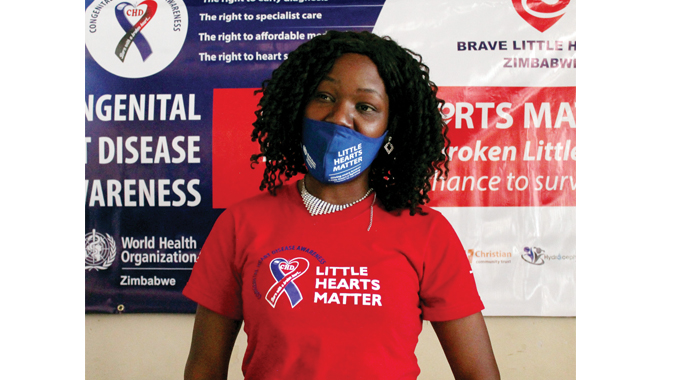
Lumbidzani Dima, Chronicle Reporter
A BULAWAYO based community organisation is advocating for Government to consider initiating a national registry for those suffering from congenital heart disease and place it under the National Health strategy like any other serious illnesses.
Congenital heart disease is a general term for a range of birth defects that affect the normal way the heart works. The term “congenital” means the condition is present from birth.
The advocacy is part of the awareness strategies by Brave Little Hearts, when the world is commemorating International congenital heart disease awareness week running from February 7 to February 14.
February 14 was chosen to be the Congenital Heart Defect Awareness Day, an annual campaign to honour and remember everyone born with a heart defect and all families and friends touched by children with heart defects.
Ms Tendai Moyo who lost her child to congenital heart disease after facing so many challenges in 2019, formed Brave little hearts to help other families raise funds to fight the disease.
“I started this organisation in 2019 after I lost my daughter who had the disease. I gave birth to her at United Bulawayo Hospitals (UBH), unfortunately she was diagnosed late and we had to try and raise resources to go to India, but we did not manage to raise them.
During the course of trying to get the resources we faced so many challenges. She was wrongly diagnosed, she was given the wrong medication at times and eventually one of the nurses in a hospital forgot to put back her oxygen and she died.
“Through the challenges I went through, I realised that it was not my plight alone, but many families in the country are affected but no one is speaking out for them. I reached out to find out which organisations are standing for us, and I got to know that we don’t even have a national registry for our children, we are not even included in the national health strategy,” she said.
Ms Moyo said they engaged Government because the disease is not treated as seriously as it should.
“Congenital heart disease is sixty times more prevalent than cancer but very few resources are attributed to it in this country. Most of our children do not live beyond the age of five because they need critical intervention.
They need lifesaving surgeries but they are unable to access these resources because these surgeries are found in South Africa or India. They cost approximately US$15 000 to 20 000 which an ordinary Zimbabwean is unable to meet,” she said.
Besides the cost of surgeries, she said children with congenital heart disease need medication which is not accessible from local clinics and government hospitals. They have to outsource from private pharmacies the medication that ranges from about US$50 per month.
She said the medication has to be taken daily for children to survive, but there are situations when some children are forced to default as their parents cannot afford.
“We have a challenge of specialists. So far, we have only one pediatric cardiologist in the government hospitals, here at Mpilo and she is very much overwhelmed. If possible, may our government train more pediatric cardiologists, and have at least one or two in each province.
This will go a long way in diagnosing our children, because they are diagnosed late, forcing parents to look for resources that they do not have within a short time,” said Ms Moyo.
She said pregnant mothers must be scanned at five weeks when the heart develops to avoid late diagnosis when a child has the condition.
“The government should implement a compulsory oximeter reading in baby health cards so that when the child goes for monthly checkups, they are not only checked for weight and temperature, but the heart rate reading as well. This measure can help quickly detect such diseases,” said Ms Moyo.


 Online Reporter