peter
peter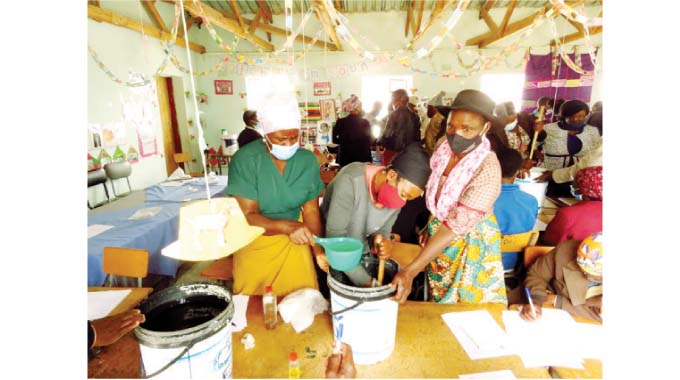
Kamangeni Phiri
THERE was a momentary silence as community leader, Ms Thandekile Nyathi narrated the devastating effects of the coronavirus in her village.
“My relatives and friends, Covid-19 is real,” she says in a somber voice as fellow community leaders listened attentively.
“In my village, Gqalaza, there was a serious wave around June this year and many families suffered the effects. Some members fell ill, others were not so lucky … they died. This was our wake-up call.”
Ms Nyathi and her colleagues were sharing notes on dealing with the Covid-19 pandemic in a rural setup as a prelude to a one-day training workshop of the ‘champions’ on making liquid soap and face masks.
The workshop is one of many such Covid-19 response capacity building programmes rolled out in various parts of Gwanda district by Uluntu Community Foundation, working closely with the Government.
Villagers say the local non-governmental organisation’s programmes are giving them a fighting chance against the deadly pandemic.
Ms Nyathi, who works with many people in her capacity as a clerk to the senior village head, said Uluntu interventions kept her safe at a time when most villagers were reluctant to follow WHO Covid-19 preventive guidelines.
In an enthralling, conversational but audible voice, Ms Nyathi spoke about the metamorphosis that the villagers underwent within a short time after the pandemic hit them.
“Before the devastating third wave, most villagers were not wearing face masks or sanitising their hands at public places and gatherings.
“It was a challenge for people to appreciate the existence of Covid-19. Many told themselves the pandemic was a city problem which did not concern them,” she said.

It all ended when some villagers were infected by the virus forcing most people to embrace WHO guidelines on Covid-19.
Gqalaza is in Ward Seven under Chief Mathema in Gwanda rural but the champions were meeting as a cluster at the neighbouring village’s Simbumbumbu Primary School in the same ward.
Three more clusters also met at Magedleni, Matshiya and Stanmore Primary Schools respectively for replica training sessions.
Nkazhe village head, Mr Job Ndlovu, 69, of Chief Masuku’s area said Uluntu’s Covid-19 interventions were informative and making a huge contribution to the social fabric of rural communities.
“Their programmes are very educative and empowering,” he says.
“They help us manoeuvre from point A to point B during these Covid-19 times. Uluntu provides most of the Personal Protective Equipment (PPE) that we use at our community meetings and in schools. The organisation provided water buckets and liquid soap that we use for hand washing at gatherings like funerals.”
Champions are volunteers who are trained to be leaders and help develop communities through information sharing and consultations. They enjoy decision-making power in the planning, designing, implementation and evaluation of services and projects working in partnership with organisations.
Mr Ndlovu said Uluntu inspired more like-minded organisations to visit rural communities creating awareness on the dangers posed by the pandemic.
“We now have more health workers coming to our areas to scale up the fight against the pandemic. In the first days we used to think Covid-19 was a joke meant to just restrict our movements,” he said.

But for the rural parent, the struggle to keep children safe from the deadly virus is real.
“At times my son in (Early Childhood Development) ECD B comes back without his mask. On other days the elder sibling in Grade Six keeps the mask on his behalf,” lamented Mrs Witness Ngulube, a parent and champion from Magedleni area under Chief Masuku.
Water availability remains a challenge in most parts of the semi-arid district of Gwanda. On certain occasions, Magedleni Primary school teachers have to walk a distance of about two kilometres to fetch water from the shops.
“There are days when teachers ask us to bring water to school for washing hands. It is difficult to always comply as there are times when we get really busy with other duties at our homes,” said Mrs Ngulube.
The mother of three school-going kids is grateful to Uluntu for introducing the liquid soap and face mask making project at a time when the Omicron coronavirus variant was causing havoc globally.
A professional tailor, Mr Roland Nyathi, trained participants in mask making while a primary school teacher, Mrs Promotion
Hlatshwayo handled the liquid soap training sessions. Mrs Hlatshwayo is a trained detergents and soap manufacturer.
Mr Kennedy Moyo, 58, a village head for Mapane Village under Chief Mathema, said the Uluntu project was a game changer in the Covid-19 fighting matrix.
“We are taking what we learnt back to the community. The NGO is bringing the needed resources in fighting Covid-19 like masks and soap closer to rural people. If everyone is involved in this fight we will win,” he said.
For the rural-based early childhood education teacher, each passing day brings with it the realisation that teaching ECD classes in Covid-19 times is no child’s play.
“The kids can just remove their masks during lessons and put them in their pockets while you are delivering a lesson,” says Ms Keresia Chuma, an ECD teacher at Magedleni Primary School.
At times some of the ECD children forget their masks at home and are often sent back.
This, however, disturbs the kids’ lessons as some of them have to cover a distance of about 12km to and from school. A child can end up travelling a total distance of 24km in a day for forgetting his or her mask.
“I often ask the elder siblings of such kids to accompany the ECD kids back home. Most such kids end up not coming back to school that day,” said Ms Chuma.
But there is a positive spin. “The kids enjoy washing hands and they know there is Covid-19, a deadly disease,” she said.
They have gotten used to the habit at their homes where they have ‘isgubhu’ gear. ‘Isgubhu’ gear is a simple concept where a water container is hung between two poles and has a string attached to a stick that acts as a foot pedal. It discharges water once one steps on the stick pedal.
The NGO took a more aggressive stance in the fight against Covid-19 by distributing PPEs, water buckets and containers, soap, thermometers and sanitisers to communities.
“We are working with 15 communities and their schools under this Covid-19 response programme sponsored by Global Fund for Community Foundations. The communities are grouped into clusters and we hold regular workshops where we give them skills and resources to combat coronavirus,” says Ms Sibusisiwe Sithole, the Executive Director of Uluntu Community Foundation.
The participating communities and schools were selected based on their being located in areas that have water challenges. Ms Sithole said from the Covid-19 lessons shared by champions during the workshops it emerged that lockdowns affected people’s way of life and business.
“Covid-19 is real and it affected almost everyone. Some lost their jobs and are now back in the rural areas. We are giving communities all the requisite ingredients for liquid soap making and fabrics for face masks including needles, elastics, scissors and tap measures.
Those who lost their jobs due to Covid-19 can survive through making and selling soap. We are training the champions and they will in turn train other members of the community when they go back to their respective homes,” she said.
Three primary schools, Simbumbumbu, Gqalaza and Zhukwe with acute water challenges, were each given 1 000 litre water tanks. Some of the schools were harvesting rain water for the children and staff to wash their hands.
Uluntu has been creating awareness of the pandemic in rural communities ever since the country reported its first case in March last year.
At every meeting or public gathering, participants observe WHO guidelines on Covid-19 like social distancing and washing hands.
Heads of benefiting schools have also responded accordingly by decongesting all classes with more than 50 pupils through dividing them into two. Every class has a piece of soap or liquid soap and a bucket for hand washing.
“All sporting activities remain suspended as a precaution because of Covid-19 except PE and the ECD play centre,” said Magedleni Primary School head, Ms Utility Sibanda.
Her school has an enrolment of 355 children among them 62 ECD A and B pupils.
As the Omicron variant of the coronavirus spreads, Zimbabwe is recording new cases daily and is increasing its testing.
On December 15 the country recorded one of its highest figures in new cases, 4 367, (all local) and 14 deaths. As at December 21 the country had a total 195 079 Covid-19 cases and 140 812 recoveries while 4 805 people had succumbed to the pandemic.
Government continues to urge the nation to remain vigilant and adhere to Covid-19 prevention and mitigation measures to contain the fourth wave of the pandemic.



 Online Reporter