
Business Reporter
Zimbabwean businesses have reported a broadly positive first half of 2026, with nearly half of firms recording increased trading volumes and two-thirds posting higher turnover, according to a new survey by the Confederation of Zimbabwe Industries (CZI).
The CZI 2026 Half-Year Business and Economic Environment Insights, drawn from a survey of 541 businesses across key sectors, paints a picture of cautious optimism, with firms expanding output, hiring modestly and expressing strong confidence in the remainder of the year.
Average turnover growth stood at 4,4 percent, with 66 percent of firms registering an increase over the same period in 2025.
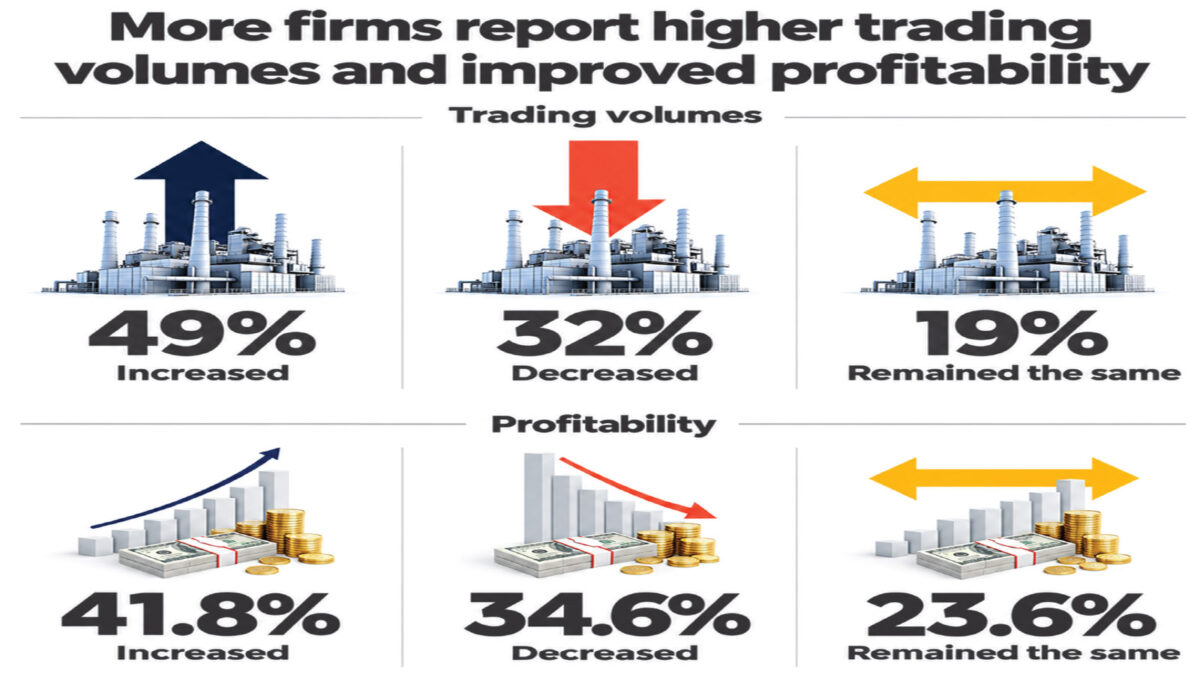
The survey found that 49 percent of firms saw trading volumes rise, against 32 percent reporting a decline and 19 percent recording no change.
The findings suggest real growth rather than purely price-driven gains. With ZiG inflation generally below 5 percent in 2026, CZI attributed the increase in turnover to genuine expansion in business activity, supported by higher trading volumes. Annual ZiG inflation rate rose to 3,7 percent in September 2026 (up from 2,9 percent in August), while the official USD/ZiG exchange rate traded at approximately 26,58 ZiG per US dollar as of late October 2026.
Stability and low inflation in Zimbabwe in recent months have been anchored by several key policy and economic factors, including prudent monetary policy, tight liquidity and a stable exchange rate, which have allowed predictability in business planning.
Profitability also improved, with 41,8 percent of firms reporting higher margins, although 34,6 percent recorded a decline and 23,6 percent saw no change.
The positive firm-level results are mirrored at the macro level. Government revenue collected in the first half of 2026 was 36 percent higher than in the same period of 2025, while corporate income tax collections rose 83 percent to ZiG18,9 billion, which the CZI said was consistent with improved business profitability.
Total Government expenditure increased by 25 percent year-on-year, a development the CZI said is likely to support business performance given that much of State spending goes on goods and services provided by firms.
Medium-sized and large firms outperformed their smaller counterparts.
Firms with turnover above US$500 000 and up to US$1 million recorded average turnover growth of 10,5 percent, while those with turnover above US$1 million grew by 11,8 percent on average. Small firms, by contrast, recorded a marginal decline of 0,2 percent.
Service-oriented sectors led the way, with healthcare and wellness posting 16,5 percent turnover growth, catering 15,8 percent and professional and technical services 11,9 percent. Agriculture (11,5 percent), advertising and marketing (10,3 percent) and ICT services (9,3 percent) also recorded strong gains, pointing to broad-based growth across services and parts of the real economy.
Employment outcomes were positive but uneven. On average, firms created three permanent jobs and retrenched one employee each, producing a net gain of two jobs per firm. New permanent jobs were equivalent to 9 percent of the existing permanent workforce, against a 4 percent retrenchment rate, yielding net employment growth of 5 percent.
Large firms were the primary drivers, creating six permanent jobs on average and recording net employment growth of 7 percent.
Transport recorded the strongest sectoral net employment growth at 16 percent, followed by hospitality and catering at 14 percent and construction at 10 percent.
About a third of firms invested in machinery or other assets during the period, with a combined outlay of US$143,7 million. Manufacturing accounted for 46,7 percent of total reported investment value, equivalent to approximately US$67, 15 million, while agriculture and horticulture contributed 41,9 percent, or about US$60,21 million.
Firm-level sentiment for the remainder of 2026 was strongly positive, with 77 percent of respondents expecting their businesses to improve, against 18 percent anticipating no change and only 5 percent expecting deterioration. Firms that invested were even more optimistic, with 85 percent expecting improved performance.
At the macroeconomic level, sentiment was more measured but still positive: 49,5 percent of respondents expected Zimbabwe’s economic environment to improve over the remainder of 2026, while 41 percent anticipated no significant change and 9,5 percent expected conditions to worsen.
The CZI attributed the improvement in business performance in part to relative price and exchange rate stability, which it said had
Firms register volume, turnover growth, as stability holds improved firms’ ability to plan, budget and make investment decisions with greater confidence.
The report also highlighted the resilience strategies firms are adopting, with digitalisation and technology adoption, alongside strengthened customer service and relationships, each cited by 13 percent of respondents.
Product diversification and innovation (12 percent) and marketing (10 percent) were also common responses, indicating that firms are actively seeking new revenue streams rather than merely cutting costs.
Demand and sectoral growth were the strongest system-level enablers of resilience, cited by 48 percent of firms, followed by inflation and currency stability at 14,4 percent.
The survey found that 40 percent of businesses now incorporate sustainability considerations into their operations, with waste management, recycling and reuse the most widely reported approaches, followed by energy efficiency and renewable energy.
Sustainability integration rises sharply with firm size, reaching 68,4 percent among firms with turnover above US$10 million.
AI adoption remains at an early stage, with 22.6 percent of firms reporting uptake, concentrated on general-purpose generative tools such as ChatGPT.
Adoption rises with firm size, from 20 percent among the smallest firms to 35 percent among the largest.
The CZI concluded that the first half of 2026 demonstrates that Zimbabwean firms are resilient and innovative, with businesses positioning themselves for longer-term competitiveness.
“Overall, the first half of 2026 demonstrates that while Zimbabwean firms are resilient and innovative, their growth trajectory will depend heavily on targeted reforms that strengthen stability, competitiveness and inclusiveness across the industrial landscape,” the report stated.