

 admin
admin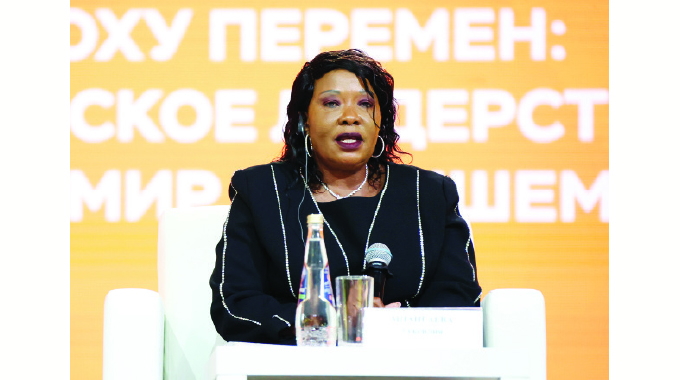
Tendai Rupapa recently in MOSCOW, Russia
First Lady Dr Auxillia Mnangagwa was among high profile panellists in a plenary session in Moscow themed, “Facing new challenges: International humanitarian cooperation of women”, an event which united women humanitarian champions from across the world.
The session sought to understand how women’s view of volunteer initiatives, a new soft power, change the vectors of development focusing on experiences in the field of charity and social initiatives.
The event saw leaders of various charity organisations addressing hundreds of young women, youths and deliberating on advancing women empowerment and elimination of violence against women and children.
Moderated by Ms Galli Monastyreva, the Humanitarian Adviser to the Association for Economic Cooperation with African countries, speakers included Dr Mnangagwa, Galina Karelova, the Deputy Chairman of the Federation Council of the Federal Assembly of the Russian Federation, Ms Chi Fang, the Deputy Executive Director of the Secretariat of the Conference on Interaction and Confidence-building Measures in China and Maria Prokofieva, Director of Centre for International Interaction and Cooperation.
Dr Mnangagwa gave a detailed account of how she is actively spearheading the women empowerment drive through the Angel of Hope Foundation.
Hon Galina Karelova said each year women participation in the forum was becoming broader.
“We are glad this forum involves a number of international participants. Allow me to welcome and congratulate Dr Auxillia Mnangagwa, the First Lady of Zimbabwe, who is among the panellists, for winning an international award. The example you are setting in charity work in Zimbabwe is important and inspiring.
“Your foundation, Angel of Hope, is very unique and doing a lot in empowering women and youths in Zimbabwe. Since this forum is attended by young women, I would love to emphasise that as Eurasian women’s forum we have projects for young women and they also involve international young women. Among them is related to entrepreneurship and women leadership.
“We want you all young women to participate in these projects so that you are better engaged in society and be leaders. Our women should take leadership positions. We believe that women will keep doing their best to make the world a better place by being kinder and cooperating.”
In her remarks, Dr Mnangagwa expressed her appreciation to the organisers for inviting her and recognising the work that drives her passion for philanthropy through the Angel of Hope Foundation.
“It is indeed a great honour and privilege to be present at this forum in the company of representatives from all across the world as we discuss and encourage volunteering and charity activity among women.
“More than two years into the Covid-19 pandemic, the global financial crisis and the energy and climate change crisis, I believe that global recovery is still too shaky and uncertain to navigate with traditional power, and even after these crisis subside, we will still face grave challenges to rebuild as we experience the culmination of a “new normal” as populations age, and as economic disparities increase,” she said.
Given these challenges, the First Lady said there was need for all the economic growth, dynamism and compassion the world can get in the years ahead.
“Thankfully, a key part of the solution is staring at us right now in the face, the economic power of women, also called “soft power”, and it brings the world’s largest excluded group into the fold,” she said. “For many years, women have fought to be included and it’s only recently that women were even allowed access to the spheres of education, commerce and politics.
“So it’s no surprise that much of these inclusive platforms have a culture that is built on ‘masculine’ foundations, appropriating competition, individualism, achievement.
“Women have adopted these masculine traits. Ladies and gentleman, I believe there is a different way. A way that adds value without contestation and identity that is exclusive to that of a man, a way that proves our weaknesses to actually be strengths.
“The 2030 Agenda has pledged to leave no one behind. This means that in our development efforts, girls must be a priority. The world should ensure girls are granted all the opportunities they deserve as they mature into adulthood.”
Amai Mnangagwa said women leadership was restricted by the various social, cultural and political norms which needed to be understood and addressed.
“First of all we need to address all the social inequalities hindering women’s advancement in order to change women situation in the society as well as in our nations,” she said. “The Angel of Hope Foundation has been providing economic interventions to vulnerable women in both rural and urban communities in Zimbabwe to improve their well-being.
“Working through the Traditional Leadership structures under Chiefs’ wives have been targeted by the Foundation as icons to use their “soft power” to impact positive changes, adaptation, uptake and participation in income generating projects which include small livestock production, nutrition gardening, caster bean production and traditional grain farming.”
The First Lady said there were such projects going on in all provinces of the country aimed at enhancing the standard of living of women.
“I am also the Ambassador of Health for Zimbabwe, and as patron of Angel of Hope Foundation, I have used these portfolios to spearhead awareness campaigns on cancer, HIV, TB and Covid-19 and the recently launched National Human Papilloma Virus (HPV) vaccination campaign among other diseases,” she said.
“There is a flagship intervention wherein Angel of Hope Foundation has partnered with the Ministry of Health and Child Care to providing awareness and free cervical and breast cancer screening through mobile outreach programmes.
“This partnership has resulted in effectively tripling the number of women screened, treated and referred for further treatment.”
Ms Chi Fang said celebrating the volunteer international day was important and from her organisation they were happy for the success of the forum.
“It corresponds with the name of our organisation-building a common space and involving women in the decision-making process. Today we can give many examples of how women are involved in all facets of life,” she said.
“Time has proved that gender issues are key to building sustainable solutions to equitable development. We must also note that women are not divided by colour or creed but women find it much easier to find common ground through similar experiences.”
Giving brief comments after presentations by the panellist, Ms Ngo Mang Epse Epesse Anne Gisele from Cameroon, a member of the Association of Women involved in Environmental and Sustainable Development Issues, said they involved women because they were experts of environmental issues.
“Women are the same all over the world, hence it’s important to put our heads together and work together. Women empowerment is important. Volunteerism is what women do naturally. Everyday, women are hard workers.
“On GBV, this issue needs to be properly addressed and to curb this, women must be financially empowered so that they do not rely 100 percent on their husbands. Women should also be decision makers. There is no way GBV can stop unless if we involve men. Violence is the strength of weak men, GBV should not be tolerated in any society,” she said.
Dr Mnangagwa has already initiated the Male Engagement Forum where she is touring all provinces of the country, seeking their views and finding solutions on how to end gender-based violence as well as encourage them to undergo regular health checks.
She is of the view that to end GBV, men too should be involved.
Dr Nana Kadidia Diawara from Mali cited illiteracy and low purchasing power as reasons why there were development gaps between rural and urban areas.
“Women who have received a short education are exclusively represented in the informal sector. Only a small percentage has been able to move into more advanced production methods on the basis of higher education. Women in rural areas have formed associations to increase their production and thus generate new resources,” she said.
In almost all households, Dr Diawara said, women had to help supplement the family income and this was why many women were involved in food processing and marketing.
This is why in her interventions, Dr Mnangagwa is offering women access to education through the partnership between her Angel of Hope Foundation and Zimbabwe Open University and helping them generate income through sewing, cooking, farming and detergent making projects.
She is also promoting a poultry rearing project which is leaving no place and no one behind and aimed at empowering women.
Others who gave brief presentations included Ms Daoui Wafaa, President of the 3E-bridge Association, Ms Ndeye Seinabou Pouye, president of the NGO Active African Women for Development from Senegal, Ms Ranivunianarisua Vululuarimanga from Madagascar, who is Member of the Committee of the Social and Charitable Foundation “MAITSO TSARA” and Ms Orabiyi Christie Abiodun Ayo, owner of the Joy for Peace Charity Foundation in Nigeria.



 Online Reporter