admin
admin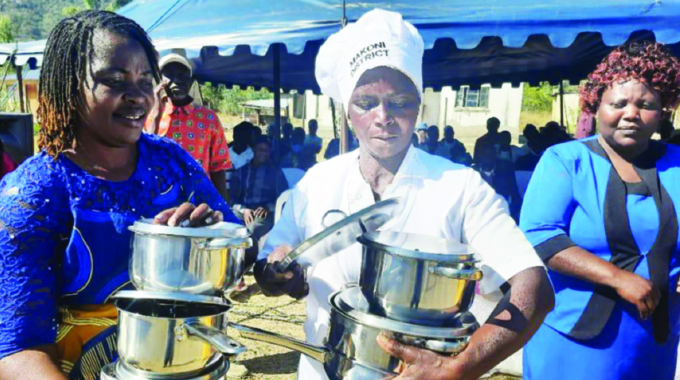
Samuel Kadungure
Manicaland Bureau
FIRST Lady Dr Auxillia Mnangagwa’s traditional cook-out competition has cascaded to the grassroots, with those in Makoni District hailing and embracing the initiative that has turned out to be a solution to nutrition-related diseases, well-being and physical fitness.
Chiefs wives, who are the First Lady’s ambassadors in their communities, are carrying forward the programme.
Chief Makoni’s wife, Mrs Redempter Gwasira, recently held Amai’s cook-out competition in villages across Makoni District on behalf of the First Lady.
Villagers hailed the First Lady for spearheading the programme that seeks to preserve the Zimbabwean tradition.
They said traditional food holds immense nutritional, cultural and spiritual value.
The cook-out competition was held at Ringanayi Primary School, with participants showcasing their cooking skills using traditional ingredients.
All the 20 participants, including the elderly, who participated at the event received food hampers courtesy of Dr Mnangagwa.
Three contestants, Mrs Grace Kuipa, Mrs Beauty Gowe and Mrs Esnath Mujajati, also walked away with the top three prizes that were up for grabs.
Some of the prepared dishes included wheat, millet and sorghum sadza, cassava, spinach, garlic, beans, sweet potatoes, yams, traditional chicken and duck, ndororo, dried vegetables, zondo, traditional seven-days beer and madora — all famous for their nutritional value.
Mrs Makoni applauded the First Lady for her desire to see families eating healthy diets, adding that she will continue implementing the programme in every corner of the district.
“We have been given a rare opportunity by the First Lady as traditional leaders’ wives to spearhead the programme, promoting the consumption of traditional foods,” she said. “There has been a movement from traditional to modern eating, and we want to thank the First Lady for taking us back to our traditional culture.
“We do not want any village in Makoni District to miss out and this is why we are taking this programme to every village in the district. The traditional foods had been eclipsed by modern foods, but Amai Mnangagwa has put it back on our menu.
“Our culture has been diluted and Westernised, but through the First Lady’s programme, the grassroots have embraced it. We want our families to revert to our tradition of eating mutsine, nhopi, madora and ndororo which are good for our health, well-being and physical fitness. These are foods that our ancestors ate, and they managed to lead healthy and long lives.
“I want to salute the First Lady as our visionary, and together with my team we stand firm as we implement this initiative and ensure that our communities in Makoni revert to the consumption of traditional foods.
“It is Amai Mnangagwa’s desire that we go back to those golden old days of eating healthy foods, spiced with modern ways of doing things, think of munyemba pie, madora pizza and fried madhumbe.
“Here in Makoni, we have traditional foods like Makoni tea, nhopi, mutakura. We are privileged to be part of Amai Mnangagwa’s programme and we are forging ahead with it.”
The cook-out drive provides a comprehensive insight into what constitutes a traditional menu.
Mrs Makoni said traditional foods were wholly unaltered and organic, and nutrient-dense.
Chief Makoni, who attended the programme, also hailed the First Lady’s programme.
He said traditional foods were nutritious as they were produced without chemicals and other dangerous substances which diminish the nutritional value in food.
“To achieve wellness, the body needs nutrients from real food,” he said. “Eating traditional foods helps to avoid many health problems, including allergies, asthma, digestive and cardiovascular health issues, obesity, auto-immune disorders and even diabetes and hypertension.
“Traditional foods are tastier than processed foods. Eating traditional foods also supports community food producing systems.”
Chief Makoni said although the nation always had traditional foods, it has taken the efforts of the First Lady for many to realise their nutritional benefits.
“My subjects are beginning to consume more traditional meals,” he said. “Our people have awakened and are beginning to realise the benefits of eating their own traditional foods and wild fruits.
“We thank the First Lady for running this programme. She is moving across the country conducting these competitions for our own benefit.”
In line with the First Lady’s campaign for people to embrace traditional meals, supermarkets are now selling various types of mealie meal, including millet, sorghum and finger millet mealie meal.
Relish like mopani worms, blackjack, pumpkin leaves and African spinach have also found their way into big shops as the demand has grown.
Cassava and sweet potatoes are also proving to be popular.
Eighty-two-year-old Gogo Dorothy Tapotsoka and 78-year-old Gogo Susan Nyamhowe revealed that traditional foods were the secret to long life.
“Long back, we would hunt for terminates at the anthills. Traditional meals would guarantee us strong immune systems, instead of the highly processed foods that are now being consumed by the younger generations,” said Gogo Tapotsoka.
Gogo Nyamhowe chipped in: “Our traditional diet is the reason behind our longevity.”
Mrs Kuipa, who was the overall winner of the competition, said communities used to believe that eating white refined mealie meal is a symbol of wealth.
“We thank the First Lady for opening our eyes,” she said. “She has put us firmly on our tradition lane, and lessons drawn from her programme have helped me improve my cooking skills.
“We have embraced her programme as a community. The hygiene levels in our homes have improved, and we are living happily. I am now able to serve my family healthy meals. My children actually prefer traditional food, which they are now proudly taking to school.”
Second best contestant, Mrs Gowe, said the First Lady’s programme should be cascaded to schools, where the younger generation should be taught the nutritional benefits of traditional meals and how to prepare them innovatively.
Mrs Gowe said traditional meals have created positive economic effects for the rural communities’ food systems.


 Online Reporter