

 Chronicle Editor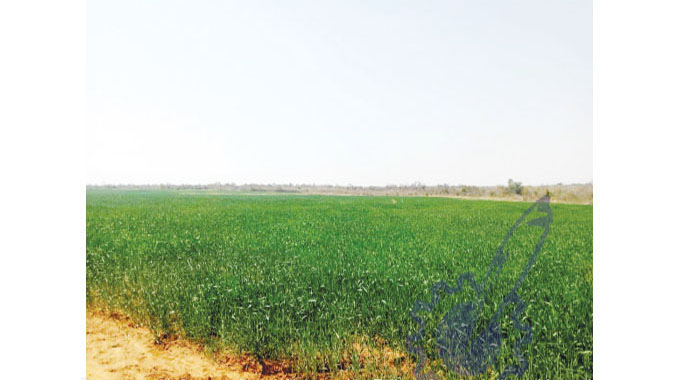
Michael Magoronga, Midlands Correspondent
MUTANGE Irrigation Scheme has given hope to the Gokwe community in the wake of climate change-induced erratic rainfall patterns, with the first wheat growing project in the district now taking shape.
Gokwe is located in Region 5 and farmers mostly grow cotton, which is more drought resistant.
The area has water challenges, but Government stepped in and constructed Mutange Dam which was completed in 2017.
It has become a huge source of water for both the community and livestock, with Mutange Irrigation Scheme receiving a facelift that has resulted in planting of wheat this year.
Benefitting 170 people, Mutange Irrigation Scheme is the second biggest in Midlands Province after Exchange Irrigation Scheme in Silobela.
State-of-the-art centre pivots which became idle as a result of non-availability of a transformer, went back to work when last year Government ensured that a transformer was installed and production began at the 134-hectare irrigation scheme.
Seventy hectares have since been put under winter wheat, a first in the area.
“We have managed to clear more land and we have now planted wheat.
This is the first time that we have planted wheat in Gokwe and the farmers are really excited,” he said.
Midlands Provincial Irrigation Engineer, Shingirirai Zano said this was the first phase of the mega project.
“We completed Phase 1 by 2017 and we installed the 134 hectares with state-of-the-art centre pivots. As you might be aware, the transformer was vandalised and this stalled progress.
We however, finished the installation last year and part of the area was not available for planting and we had only 70 hectares available which we planted our first wheat crop,” he said.
Eng Zano said they have since engaged contractors to clear more land for farming.
“By September this year, we will be having all the 134 hectares ready for farming under Phase 1 of Mutange Irrigation Scheme.
We are only left with clearing 12 hectares of land so that we can have maximum capacity utilisation by the end of year,” he said.
Eng Zano said the state-of-the-art irrigation equipment made work easy for the elderly.
“We are grateful to Government for enabling us to install state-of-the-art centre pivots at the schemes which makes it easy for the elderly beneficiaries to operate. The irrigation scheme is also fully mechanised with tractors and planters all in place,” he said.
Going forward, Eng Zano said Government will embark on Phase 2 of the irrigation schemes as well as another scheme near Sengwa Dam.
“We want to make use of the water bodies available in the district as it is a dry region.
We are therefore, constructing another 50-hectare Irrigation Scheme in Sengwa making use of Sengwa 2 Dam.
We are also looking at clearing more land under Phase 2 for Mutange Irrigation Scheme so that we capitalise on the water available in Mutange Dam,” he said.
Mutange Dam has the capacity to irrigate 200 hectares and given its location, the scheme can produce a cocktail of crops to ensure food security and for export.
The scheme is very key as it plays a key role in attaining the country’s wheat self-sufficient and filling the gap of the 300 000 tones for our local production versus the production.
The development comes at a time when Zimbabwe is likely to be self-sufficient in wheat.
Buoyed by the irrigation revitalisation programme, which saw a number of schemes being revitalised, Zimbabwe is targeting a winter target of 380 000 tonnes out of a national annual requirement of 360 000 tones.



 Online Reporter
 Blessing Chizhande