Chronicle Editor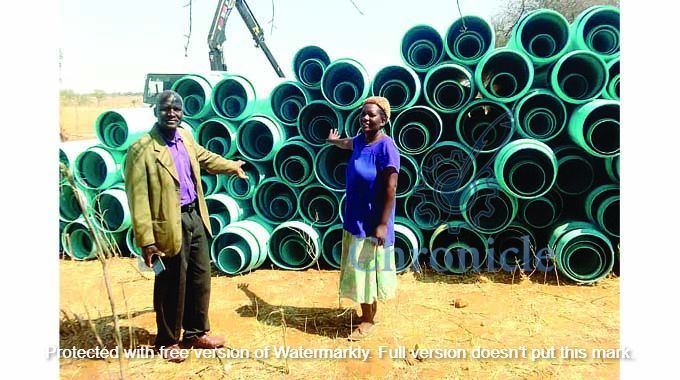
Sukulwenkosi Dube-Matutu, Matabeleland South Bureau Chief
GOVERNMENT has, through the Smallholder Irrigation Revitalisation Programme (SIRP), started rehabilitating the 200-hectare Makwe Irrigation Scheme in Gwanda District, Matabeleland South province.
The SIRP is a seven-year programme funded by International Fund for Agricultural Development (IFAD), OPEC Fund for International Development (OFID) and the Government of Zimbabwe, which contributes to the resilience of smallholder farming communities.
Its goal is to reduce vulnerability of smallholder farmers to: food and nutrition insecurity, climate change effects and economic shocks.
The rehabilitation of the Makwe Irrigation Scheme, which has been lying idle for five years, will contribute significantly to food and nutrition security in the drought prone province.
Matabeleland South lies in low rainfall agro-ecological regions four and five.
Pipes have since been delivered on the site while villagers have managed to mobilise resources to erect a perimeter fence.
The irrigation scheme, which is the largest communal irrigation scheme in Gwanda District, has not been fully functional following the disruption of power supply due to theft of copper cables.
Established in the 1960s Makwe Irrigation Scheme was once a major source of income for the local communities.
Power has since been restored at the irrigation scheme. A tender to upgrade the irrigation scheme’s water system was awarded to a Bulawayo company, Forster Irrigation (Pvt) Ltd.
In an interview yesterday, the village head, Mr Gwanda Mlilo, who is also a farmer, said the rehabilitation of the scheme comes as a relief to villagers.
“We are relieved now that there is some work taking place at the irrigation scheme. When we were told last year that plans were underway to rehabilitate the irrigation scheme, we assumed it’s an empty promise,” he said. “Pipes have been delivered on site and we are happy with progress. We are looking forward to seeing the irrigation scheme being rehabilitated timeously.”
Mr Mlilo said villagers are being assisted by their children in the diaspora.
Makwe Irrigation Scheme secretary, Ms Nomathemba Mbano said they are looking forward to resuming production.
“We hope to irrigate the entire scheme as many families are looking forward to benefitting from the Makwe Irrigation Scheme,” she said.
Another farmer, Mr Grayen Mhlanga said they are looking forward to turning their operations into a viable business enterprise. “When we start our operations this time around, we want it to be strategic and business oriented. We will be targeting cash crops and we hope with the assistance of Agritex extension workers, there will be improvement in our operations,” he said.
“We have abundant land and if we can utilise it properly, we have a potential to become the bread basket of the province and realise significant income that can improve our livelihoods.”
Matabeleland South provincial irrigation engineer, Mr Shepherd Mpotegwa said the Makwe Irrigation Scheme site will be officially handed over to the contractor on Thursday.
He said part of the rehabilitative works include installing new pumps, repairing and servicing old ones, repairing the conveyance canal, replacing damaged pipes and installing a centre pivot.
Infill canals with underground pipes and electric motors will also be replaced while the pump house will be revived. Mr Mpotegwa said the irrigation scheme will be watered through a centre pivot and underground pipes that are connected to valves.
“Makwe Irrigation Scheme is the biggest communal irrigation scheme in the district. If it is fully operational, it will significantly contribute towards ensuring food and nutrition security,” he said.
“We have a reliable source of water hence the irrigation will operate at full capacity. Once the irrigation scheme is operational, we will engage partners to come on board so that villagers maximise their production and commercialise their activities.”
Government is prioritising the revival of the agricultural sector through the development of irrigation schemes to alleviate food insecurity and poverty particularly in rural communities.
The Second Republic has made food security a top priority and is working towards a US$8,2 billion agriculture industry economy by 2023, underpinned by the country’s National Development Strategy 1 (NDS1) — the driver towards Vision 2030 to make Zimbabwe an upper middle-class economy.
National food self-sufficiency is key to the Government’s economic blueprint, the National Development Strategy 1, which identifies food security and nutrition as key drivers of economic revival.–@DubeMatutu



 Online Reporter