admin
admin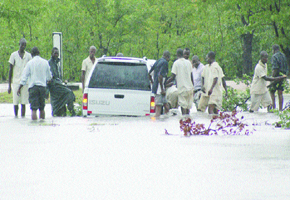
“I lost my hut and I do not even know where I am going to sleep because this other hut might also fall any time. This is happening to me every year. I lost another hut to floods some time ago.
“These floods are devastating and have destroyed our crops. When these floods are over we will face hunger again because crops cannot grow well under such conditions,” she said.
She explained that the situation was bad, as most houses in her area were likely to be destroyed if the rains persisted.
“I am afraid to sleep because the house might collapse while I am inside. I do not have a house or other proper shelter. Our houses are built from mortar bricks and when the rains fall continuously they become muddy resulting in them collapsing,” said Gogo Hlatswayo, looking dejected.
The country has over the past three weeks, received heavy rains, causing flooding in many areas. Many people have been swept away by flood waters, while others have died after their houses collapsed on them. In Beitbridge for example, eight people died on Monday this week and 40 homesteads were destroyed as the heavy rains take their toll. Floods have been a common feature in low lying areas like Muzarabani in Mashonaland Central as well as Tsholotsho, and Limpopo and Save Valleys.
Floods are caused by many factors such as heavy rainfall, highly accelerated snowmelt, severe winds over water, unusual high tides, tsunamis, or failure of dams, levees, retention ponds, or other structures that retained the water. Flooding can be exacerbated by increased amounts of impervious surface or by other natural hazards such as wildfires, which reduce the supply of vegetation that can absorb rainfall.
The worrying situation in Tsholotsho raises the question whether villagers are well informed and taught about preventive measures they can use to handle floods. Environmentalists have always urged relevant authorities to educate villagers on how to handle floods so that damage can be reduced but in Tsholotsho, awareness is apparently poor.
The worst affected areas are villages in Chefunye, Sipepa such as Jimila and Sawudweni under Chief Mathuphula Khumalo, and parts surrounding Tsholotsho Business Centre. In these affected areas, pools of water were seen almost everywhere. Some of the crops that are about 40cm high were not visible, as they were covered by water.
Mrs Margret Hadebe (65) of Ward 12 lost all her property after her hut collapsed. She said she almost collapsed herself when she woke up in the morning to find the hut reduced to foundation level. Fortunately, she said, there was no one in the hut.
“I never thought that this house was going to be like this,” she said.
“My property was destroyed and there is a ‘dam’ in the house. Even if the Government is to put up tents where are they going to pitch them because there is water all over the place?”
Many villagers said they were unable to deal with floods. They said the rescue teams mostly arrive late. They said they were not aware of who they should report to. Their ignorance forces them to just wait for whoever passes through the area to monitor the situation.
“We do not know who we are supposed to report to when things are like this. We tried to support each other by opening some ways so that water might pass through but nothing is changing,” said Mrs Hadebe.
As the news crew drove along Sipepa Road pools of water could be seen everywhere. At some homesteads, water was in their doorsteps.
Mr Sidumo Moyo (35) from Jimila area said villagers should properly build their houses. He said many villagers construct houses that are not strong enough to withstand floods.
“Normally they should build a slab around the house so that water cannot seep through into the house easily. This rain is too much and this is the reason why some houses are being destroyed.
“We do not have any means to deal with this disaster. People have lost their property and this is a sad thing because some of their property they got from their relatives in South Africa who were home for the holiday,” he said.
In Mapalusi area, Mr Middlelot Ndlovu (83) said:
“I saw this heavy rain and I knew that some people were going to have their houses destroyed. This rainfall is too much and for us in Tsholotsho we normally cry foul after experiencing such rains.”
Mr Thompson Ndlovu (43) from Ward 8 said villagers should learn from past experiences. He said mud houses were not ideal for low lying areas like Tsholotsho which are prone to flooding.
“People should realise that their mud houses are a death trap. Their houses should be built by brick and failure to do that people will die.
“These mud houses can be easily washed away by floods and this is the reason why everyone should start building proper houses. We need to come up with measures that will enable us to fight floods,” said Mr Ndlovu.
Councillor for Ward 17 in Tsholotsho North, Jipule Moyo said the dam wall that burst in Thabani Village has resulted in water flowing into houses.
“Most people are homeless. Most people in the area do not know where to report and some of them live in too remote areas where communication is bad.
“We need to be informed on how we can handle floods on our own. The Government can come and help us when the situation is out of control.
“Injiva donated some money to build the dam wall so we hope that these affected villagers (Thabani village) will not be affected by floods,” he said.
Clr Moyo said no livestock was swept away by the floods.
While many victims of the flooding are hopeless, hungry, living in the open and had their property damaged, Tsholotsho District Administrator, Ms Nosizi Dube said everything was in control. She said they sent the team around the district to monitor the situation.
“There are three people who are in critical situation. Their house was completely destroyed and they lost their property and they have no food. We will be monitoring everything but we can assure villagers that the situation is under control,” she said.
A number of flood control methods have been practised since ancient times. They include planting vegetation to retain extra water, terracing hillsides to slow flow downhill, and the construction of floodways to divert floodwater.
Other techniques that may be used are the construction of levees, dams, reservoirs or retention ponds to hold extra water during times of flooding.
Some of the methods that villagers can also use to fight floods are building barrier embankments and control land use around the river. Also, villagers should not build houses near rivers as they are more easily prone to floods.
District Development Fund Matabeleland North provincial water engineer Mr Stephen Ndwalazi said flooding often occurs in Tsholotsho due to its general landscape.
“There are no rivers in Tsholotsho and the drainage is poor. The area has Kalahari soils and due to lack of rivers, water drains and soils quickly get saturated. When soils are saturated they become weak and this leads to the collapse of buildings because their foundations will also be weak,” explained Mr Ndwalazi.


 Online Reporter