
Anashe Mpamombe
THE warning from the Meteorological Services Department and the Department of Civil Protection Unit could not be clearer, avoid crossing flooded rivers and bridges to prevent loss of life.
Yet, despite repeated alerts and painful lessons from the past, tragedies continue to unfold, often in the same, preventable way.
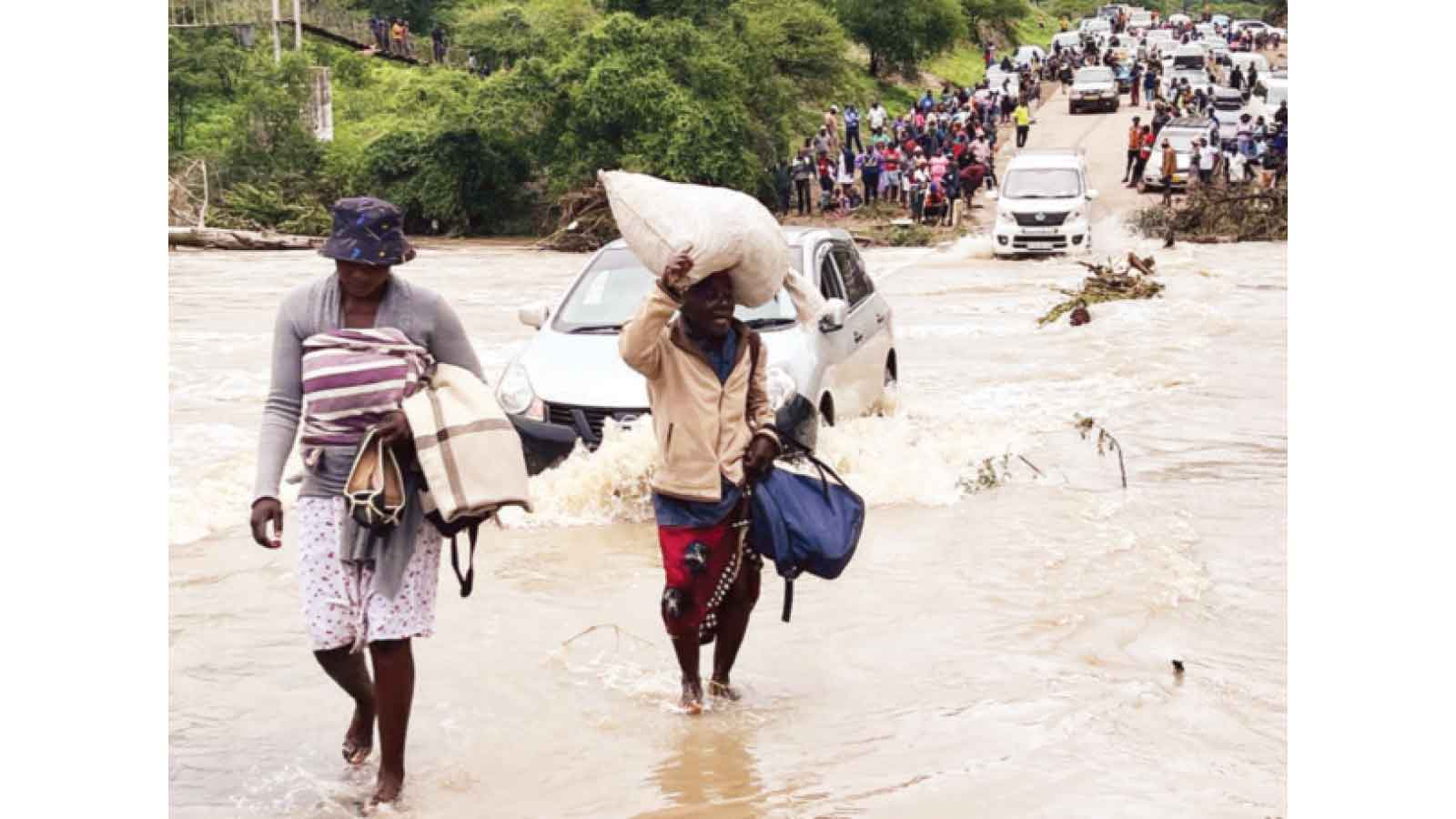
Over the past few weeks, Zimbabwe has experienced increased rainfall across most parts of the country. Rivers that were once calm have transformed into deep, fast‑moving torrents; low‑lying bridges have disappeared beneath churning water; roads that were familiar have become dangerous and unpredictable. For many Zimbabweans, what might have seemed like a short, routine journey has become a critical, life‑altering decision.
Floods rarely strike when people are idle. They strike when someone is trying to get home after work, take children to school, attend a funeral, transport goods to the market, or reach essential services. Life does not pause for weather, and neither do responsibilities. When a river cuts across a road, the choice to wait or attempt to cross becomes urgent, personal and, sometimes, fatal.
This rainy season has already provided stark reminders of how quickly ordinary moments can turn into emergencies. In Mwenezi, six women were trapped overnight after floodwaters rose rapidly where they had attempted to cross a river. What began as a seemingly familiar crossing turned into hours of fear as water levels rose around them. Their survival owed much to a helicopter rescue, a dramatic ending that could easily have been a tragic one.
In Mt Darwin, a mother with her one‑year‑old and nine‑year‑old children found themselves marooned on an island in the Ruya River when floodwaters cut off every escape route. Rescue teams, including the Zimbabwe National Army and the Zimbabwe Republic Police, coordinated a risky operation to bring the family home safely. Their relief at being saved was palpable — but so too was the sense that they had narrowly escaped disaster.
These rescues ended well. Many do not. In Chimanimani a few seasons ago, two young children, aged five and six drowned while trying to cross a rapidly rising river after intense rainfall overwhelmed local waterways. In Gokwe, a young couple and their newborn perished in a flood‑ridden river when their canoe was overtaken by strong currents as they tried to reach medical care a journey meant to save a life, tragically ending in loss.
These are not distant headlines. These are Zimbabweans just like you or me, mothers, brothers, cousins, friends, trying to go about their lives when nature’s unpredictability intervened.
Floodwater is dangerous because it is deceptive. A river does not need to be wide to be deadly. Water that appears shallow can conceal deep eroded channels and strong undercurrents. What looks calm on the surface can be moving fast enough to sweep away a person or lift a vehicle. Bridges that once stood firm can vanish beneath the waterline, turning familiar routes into unseen traps.
Meteorologists and disaster response authorities have explained, repeatedly and in scientific detail, how weather systems this season are producing heavier downpours over shorter periods. Rain falling far upstream can turn a familiar crossing into an impassable barrier in a matter of minutes. Rivers respond quickly; ground already saturated by previous rains cannot absorb more; water levels rise with shocking speed. This is the reality of contemporary flood behaviour but scientific warnings often collide with the realities on the ground.
Why do people attempt these crossings? Because they crossed yesterday and it was fine, because others are waiting behind them; because turning back means a long detour, a missed appointment, or spending the night away from home, because funerals do not wait for better weather; because employers and obligations do not always understand delays. These are human reasons, not reckless ones; and yet, water does not care about reasons.
Across Matabeleland South, the Mtshabezi Bridge in Gwanda — a lifeline for commuters, traders, mine workers, students and parents — was submerged for days after persistent rains. Motorists and pedestrians found themselves stranded, face to face with a dark, wide sheet of flooding that had washed away familiar roads. Some considered unsafe alternatives; others waited for hours as the river slowly subsided. In Tsholotsho, the Pumula River overflowed its banks and stranded villagers and vehicles miles from home, cutting off access to markets, clinics and other basic services. In these situations, waiting became more than inconvenience; it became a test of patience and prioritisation of life over schedules.
Emergency services work tirelessly to rescue those trapped by floodwaters. Helicopters hover overhead, boats navigate unpredictable currents, and teams on the ground wade into dangerous water to reach people who find themselves in peril. These operations save lives that would otherwise be lost. But they are not the first line of defence; they are responses to danger that already exists.
Every rescue is a reminder that floods are unpredictable and unforgiving, and that waiting is often wiser than crossing.
Responsibility for prevention is shared. Government departments must ensure that early warnings reach even the most remote corners of the country. Roads and river crossings known to flood should have visible signage, barricades where necessary, and timely alerts. Local leaders, from councillors to traditional chiefs — play a critical role in reinforcing safety messages at community level. When trusted voices repeat the same caution, it increases the chances that people will pause, rethink and choose safety over haste.
But citizens also bear responsibility. Sometimes survival requires patience. Sitting by a riverbank, watching water levels creep up and down, waiting for the currents to ease this may be uncomfortable or inconvenient, but inconvenience passes. Death does not.
Crossings that “worked yesterday” may not work today. The water is not obligated to behave the same way twice.
Crossing a flooded river is often described, mistakenly, as bravery. It is not. Bravery implies choice, control and preparation. Floodwater offers none of these. It is silent, powerful and indifferent. Cars float, feet slip, currents pull. Once control is lost, there is no negotiation.
The human cost of ignoring these risks is immense. Families grieve quietly in their homes. Communities gather for funerals that could have been avoided. Rescue teams, having given their all, return exhausted, carrying the burden of lives saved and lives lost. Each near‑miss adds to a collective warning that should not be ignored.
Floods will continue to come with the seasons. Rivers will rise, and bridges will disappear beneath the waterline. The question Zimbabwe faces each year is this: will we learn from each tragedy and rescue, or will we allow history to repeat itself?
The lesson is simple, and it is urgent: do not cross a flooded rivers. Life is not worth testing against the current, no matter how familiar the crossing, how urgent the journey, or how small the water looks. Turning back, waiting, or finding an alternative route is not weakness. It is wisdom.
The road home can wait. Life cannot. When the water rises, judgment must rise higher. In the face of floods, the strongest decision is the simplest: stay on dry ground and survive.