admin
admin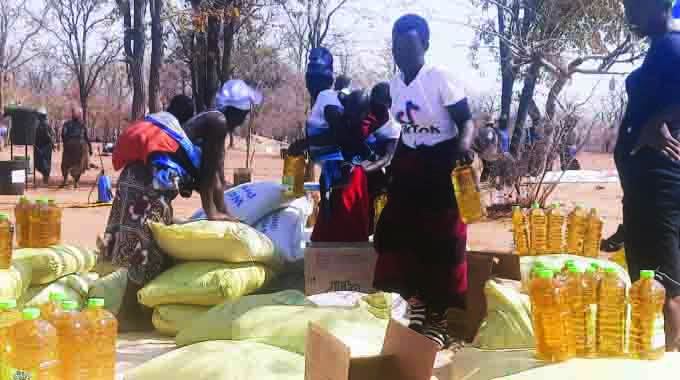
Elita Chikwati, Features Editor
Women, as primary care givers and food providers are mostly affected by climate change as they struggle to put food on the table for their families.
Climate-related shocks such as the recent El Nino-induced drought, which led to crop failure in most parts of the country, fall heavily on women’s shoulders as they are usually the first to be vulnerable to food insecurity and malnutrition.
This threatens the well-being and survival of families.
Mwenezi District is among areas that were severely affected by drought, leaving more than 270 000 people in need of food.
The area is in Region 4 and 5 and receives very low rainfall around 400mm.
Most farmers in the area produce traditional grains such as millet, sorghum and cowpeas, among other things.
In some instances, the rains are scarce that even the traditional grains do not give much yields, leaving many households food insecure.
Women in the district said the recent drought presented challenges as they were stressed on how they would provide for their families.
Development partners such as the World Food Programme (WFP), working closely with the Government, came up with different initiatives to assist vulnerable communities facing food insecurity.
Interventions include food distributions, establishment of nutritional gardens and resilience building through improving smallholder farmers’ production, management of community resources and access to finance and markets to reduce vulnerabilities to recurrent crises.
The interventions have made life easier for women benefiting from the projects being spearheaded by the WFP and its partners including the local non-governmental organisation Mwenezi Development Training Centre, Africa Risk Capacity and Zambuko, among others.
This has seen communities receiving food assistance while others have ventured into nutritional gardening and others are into income generating projects which has improved food security within households.
After receiving the Africa Risk Capacity (ARC) insurance payout of US$6.1 million, WFP is providing food assistance to communities affected by the El Nino-induced drought in support of the Government of Zimbabwe’s Food Deficit Mitigation Strategy.
The Africa Risk Capacity (ARC) Replica Programme is an innovative disaster risk management initiative that helps the country respond to climate shocks like droughts, which impact food security.
Through this programme, WFP purchases climate insurance on behalf of the Government, enabling rapid access to funds when droughts occur based on rainfall deficits.
With the funds from the insurance payout, WFP is conducting food distributions in three districts; Buhera, Mangwe and Mwenezi) supporting over 272 000 people with cereals, pulses and vegetable oil for a period of two months.
Beneficiaries in Mwenezi District last week received food to last them for the next two months.
This saw an individual getting 17 kgs of grains, 3,4 kg of pulses and 1,2 litres of vegetable oil.
Beneficiaries in Nyuni, Mwenezi East applauded Government and development partners for their efforts to ensure the nation was food secure.
Mrs Tariro Chichetu of Tagwireyi Village said while the interventions catered for all vulnerable people, life had been made easier for most women as they no longer worry about securing food for their families.
“Food insecurity affects everyone but women and child headed families suffer most. Food insecurity stresses women more as children always look up to the mother for food.
“This also causes domestic violence and also increases child marriages. Food distributions have really helped us. We have been given double portion for two months and this will help us to be stable. We hope WFP will continue to provide food until we are food secure,” she said.
Seventy-five-year-old Mrs Else Gondo of Mudzudzi Village, Chingwizi said she was relying on the food assistance as she was too old to engage in menial jobs.
“Food insecurity affects us as women. I’m a widow and I have a family that looks up to me for food. I look after my five grandchildren who also orphaned. It is painful to just sit and watch as children suffer from hunger.
“This drought stressed me as I could not figure out how I could feed the family.
“Those who are still able-bodied weave baskets for sale while others have income generating projects. I can no longer walk to Runde River to collect reeds for basket weaving. This food has helped me a lot. I thank Government for working with these partners who are giving us food. We get grains for sadza, cooking oil and pulses for relish, we get a full package,” she said.
In Chingami, the farmers have been empowered under the Integrated Climate Risk Management which is targeted at enhancing resilience to food insecure and vulnerable farmers and allow them to achieve sustainable food production.
The farmers were empowered through the drilling of two solarised boreholes which they use to irrigate their nutritional gardens. They also have a greenhouse and are growing different crops.
A beneficiary, Ms Furidzayi Chigara of Chingami said the garden was helping the 47 members with nutritional food as well as income.
“Instead of buying food, we are growing our own. We also sell locally and get money we use to pay school fees and buy mealie meal.
“We have been taught to run this garden as a business. With the help of Agritex officers, we first establish a lucrative market before we produce our crops,” she said.
In Murove Village, Mrs Nciniso Dongo said she benefited from the Zambuko project and has ventured into poultry production.
She now sells chickens and eggs.
“I had four birds but received 20 more from the Zambuko project. I started with four cocks and 16 hens. I hatched the eggs and got more chickens. I use traditional herbs to treat my chickens. I use aloe vera, and donkey droppings for different ailments that affect the chickens. These are locally available and I do not have to fork out money. I sold eggs and chickens and used the proceeds to a decent house,” she said.
Mrs Dongo currently has 47 chickens and sells at S$5 or 100 Rand per bird.
“I am able to help look after my five children and do not have to ask for food from my husband. I have several hens that may hatch anytime.
“I do not have to worry about feeds because I grow traditional grains under the Pfumvudza. Last season there was drought but because I used Pfumvudza concept I harvested enough to last me until the next season. I got more than a tonne of millet and 100kgs of cowpeas. I planted early and got better yields,” she said.
Mwenezi District Agronomist, Mr Jametius Denhere, said through the WFP and MDTC projects, farmers were now able to grow high value crops for sale.
“Chingami irrigation scheme is a model of a village business unit. The farmers are trained on financial literacy so they can run the business viably.
“The irrigation and greenhouse are ways of climate proofing agriculture. The scheme uses drip irrigation and this is another way of using water sustainably,” he said.
District Development Coordinator, Mr Isaac Mutambara said the El Nino drought had been declared a national disaster and Government was working with developmental partners to ensure no one dies of hunger.
“With this drought, we have 143 000 people of our people receiving food assistance with 97 000 people being catered for by WFP through Mwenezi Development Training Centre.
“With the interventions of the Government the situation is improving. Government is climate proofing agriculture, drilling boreholes so people and livestock can have water some have has solarised boreholes.
“We are also promoting village business units through the promotion of irrigations schemes using water from Manyuchi Dam and along the river. We are resuscitating all irrigation schemes,” he said.


 Online Reporter