Chronicle Editor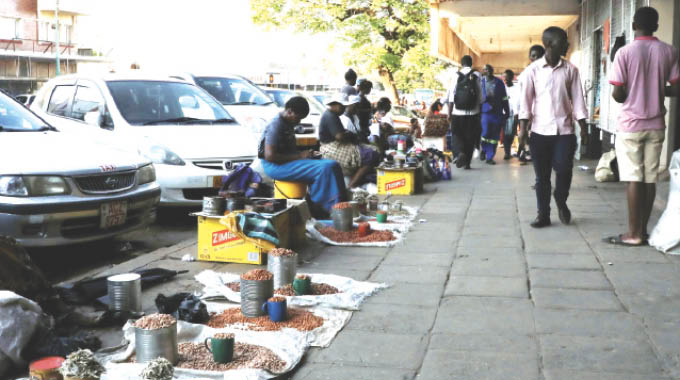
Yoliswa Dube-Moyo
Heaps on heaps of dried kapenta, amacimbi, soya chunks and sugar beans in bags are lined on a pavement about a metre from a dingy alley along Sixth Avenue, between Joshua Mqabuko Nkomo and Herbert Chitepo Streets in Bulawayo.
A strong stench fills the air and puddles of dirty water retain litter after the city has experienced some rains. It is still drizzling and uncovered arms would develop goose bumps from the chilly weather.
Next to these “delicacies” is a woman carefully counting bond notes — without being distracted, assisting a customer interested in buying some kapenta.
“Forty-five dollars for kapenta that fills up this container,” she hurriedly responds, still counting her money. She momentarily tucks the money into a small pocket on the front of her dirty floral apron.
“Should I put some for you,” she says as she scoops some kapenta into an empty 500g container of yoghurt using her hand.
The woman quickly packs the kapenta into a plastic bag that was previously tied onto one of her apron’s strings. She has scored one of many sales for the day.
A quick glance down the same pavement and there are people selling chicken pieces, pork, fish, sugar, cooking oil, bath soap, body lotion, rice and sadza meals, roasted mealies — you name it.
The pavement is crowded. People have to shove past each other. It’s dirty and generally disorderly.
You randomly hear shouts of “$24 sugar!” or “Cheap, cheap pork!” as the illegal vendors sell different wares to eke out a living. Business is brisk with customers constantly looking to save a few bucks considering the harsh economic environment currently prevailing in the country.
But, in the midst of all these savings against a backdrop of debilitating hardship, no one is thinking about the health risks associated with buying and selling food from dirty pavements, under unhygienic conditions.
Health and sanitation regulations are not followed with the risk of spreading and contracting diseases such as food poisoning, gastroenteritis, diarrhoea, salmonella, typhoid and cholera.
Foodborne illnesses are usually infectious or toxic in nature and caused by bacteria, viruses, parasites or chemical substances entering the body through contaminated food or water.
Foodborne pathogens can cause severe diarrhoea or debilitating infections including meningitis.
Chemical contamination can lead to acute poisoning or long-term diseases such as cancer while food-borne diseases may lead to long-lasting disability or death.
Street food vending has become an important public health issue and a great concern to everybody. This is due to widespread food-borne diseases, due to the mushrooming of wayside food vendors who lack an adequate understanding of basic food safety issues. Major sources contributing to microbial contamination are the place of preparation, utensils for cooking and serving, raw materials, time and temperature abuse of cooked foods and the personal hygiene of vendors.
“Do you realise that people who are formally employed can’t afford to buy basic commodities let alone pay their rent? They can’t afford to buy themselves a decent lunch. Meat is now a luxury in many homes. You can’t be telling us about diarrhoea and so forth when there’s an opportunity to make a killing through this business. People are desperate for bargains and we give them just that,” said Mr Mlungisi Dube who was selling fish from a cooler box.
“Meat is expensive these days, you can’t just walk into a butchery and buy meat,” he continued.
Mr Dube buys bream and kapenta from fishermen in Binga for a song and sells it for three times the price.
“At the end of the day, what matters to the customer is that their family has decent relish for dinner. Being out of work has forced us into becoming vendors. If we don’t do this, our children will starve. We also have bills to take care of.”
Thousands of former workers have turned to vending to fend for their families following the closure of many companies in the city. It was estimated in 2012 that 20 000 workers lost their jobs as a result of company closures in Bulawayo and some of them are now on the streets selling different wares to earn a living.
In 2017, the city council indicated that Bulawayo had more than 6 000 vendors in the Central Business District with only a handful having heeded the local authority’s calls to register and legalise their operations. The number of illegal vendors has most likely ballooned in the past few years as more people find themselves out of formal employment.
Law enforcement agents have constant run-ins with illegal vendors but continue to fight a losing battle. Restoring order on the streets now seems like a mammoth task.
Scenes of vendors’ running battles with municipal police officers are an almost daily occurrence and in some instances, the raids turn nasty.
In 2016, six municipal police officers came under fire for allegedly handcuffing a vendor, beating him up and stomping on his head until he became unconscious.
The cops had been carrying out routine raids on unlicensed vendors when they allegedly savagely attacked Mr Mark Chibanda before angry vendors retaliated and chased them away. The vendors later besieged the Large City Hall and pelted the building with stones.
Mr Chibanda of Old Pumula suburb lay on the pavement for almost an hour before he was rushed to the United Bulawayo Hospitals (UBH) in an ambulance.
“Everyone knows that illegal vending is a risk but we all have to take that risk in order to make ends meet. Municipal officers often conduct raids but that doesn’t deter us. Things are tough and we have to come back to the streets so we can earn a few dollars. There’s no way I can sit at home and watch my children starve,” said Ms Lyn Ndlovu, as she re-arranged a stack of bath soap neatly placed on a cardboard box.
Ms Ndlovu was also selling bread, peanut butter, roasted mealies and scones.
“We get our grocery items from South Africa. Some of them are from supermarkets that offer discounted prices for cash purchases. That’s why we only want cash from our customers so that our businesses continue to feed into themselves,” she added.
While economic challenges have forced scores into street vending, the health implications cannot be ignored.
The conditions under which some street vendors operate are unsuitable for the preparation and selling of food.
Preparation surfaces used by some vendors have remains of foods prepared earlier that can promote cross-contamination. Most of the foods are not covered and are exposed to flies and dust, which may harbor food-borne pathogens.
According to the World Health Organisation, access to sufficient amounts of safe and nutritious food is key to sustaining life and promoting good health.
Unsafe food containing harmful bacteria, viruses, parasites or chemical substances, causes more than 200 diseases — ranging from diarrhoea to cancers.
An estimated 600 million — almost one in 10 people in the world — fall ill after eating contaminated food and 420 000 die every year, resulting in the loss of 33 million healthy life years.
Children under five years of age carry 40 percent of the foodborne disease burden, with 125 000 deaths every year.
Statistics show that diarrhoeal diseases are the most common illnesses resulting from the consumption of contaminated food, causing 550 million people to fall ill and 230 000 deaths every year.
Food safety, nutrition and food security are inextricably linked. Unsafe food creates a vicious cycle of disease and malnutrition, particularly affecting infants, young children, the elderly and the sick.
Foodborne diseases impede socio-economic development by straining health care systems, and harming national economies, tourism and trade.
Unsafe food poses global health threats, endangering everyone. Infants, young children, pregnant women, the elderly and those with underlying illnesses are particularly vulnerable. Every year, 220 million children contract diarrhoeal diseases and 96 000 die. — @Yolisswa



 Online Reporter