


 malvernmugadzikwa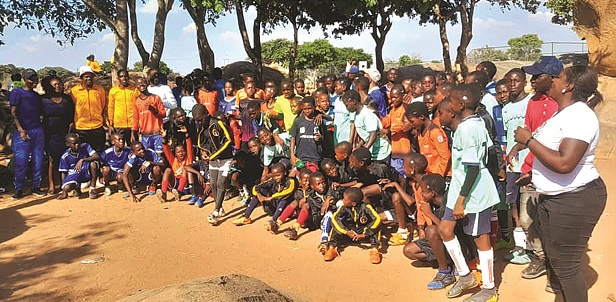
Veronica Gwaze
FOR former Zimbabwe senior women’s football team forward Precious Moyo, there will be nothing extraordinary to celebrate on Christmas Day tomorrow.
She contends since she started her charitable endeavours, every day of her life has resembled Christmas Day.
Moyo is, instead, looking beyond the festive season, thanks to her special circumstances.
Since retiring from the game that gave her some fame, Moyo has had a huge burden to shoulder.
She takes care of more than 50 children in her orphanage.
Hers is a rare tale of breathing life into what seemed a bleak situation.
Moyo’s story dates back to one sunny day in 2013, while going about her business in Chegutu, when she spotted five young boys playing by the street corner.
Being a school day, questions immediately popped up in her mind.
She wondered why the boys were not in class like other learners.
To get answers, she used that same route to her workplace for days. She even befriended the young boys before she could request to meet their parents.
Unbeknown to her, this was to become a mission that would provoke a lot of emotions for the former Mighty Warrior.
Two of the boys were orphaned, while the other three came from poor backgrounds.
And, as a result of poverty, they had all dropped out of school.
To rescue them from societal ills, Moyo went on to set up a junior social football team.
“I would pick them up every day and get them to spend the day playing football for monetary gains,” she said.
“In a few weeks, the numbers had ballooned, so we ended up playing tournaments and everyone would go home with something in their pockets.”
Moyo would ensure some of their needs were met and that some of them were re-enrolled in school.
She would also help them balance school and football.
Ten years later, the former Zimbabwe international set up an orphanage. She took in 53 orphans.
To put smiles on the faces of her underprivileged extended family, Moyo, who is also a farmer, has to depend on her produce.
“I discovered that there were many orphans out there, so I felt compelled to do more.
“I started going into different communities, scouting for orphaned and underprivileged children who were out of school. I provide for them through my farm produce.
“The main idea then was having them off the streets and I had to do everything I could,” she said.
Moyo dug deep into her pockets, ensuring that the teams had refreshments and kits.
Due to limited resources, she would buy the cheapest kits, which went for US$2 per set.
When other parents saw her enthusiasm, they began to financially support her, and on game days, some even brought supplies and meals for the teams.
“They would bring huge pots and cook for the teams, and that made us feel like a family.
“We noted that there was plenty of potential among many underprivileged kids, hence we needed to create something workable and ensure they were safe all the time.
“I feel comfortable with them at the orphanage . . . At first, I had to convert my family home into an orphanage, then with time, I built some structures.”
Apart from the 53 children living at the orphanage, Moyo also provides for 41 others who are underprivileged but stay with their families.
The difficulties she endured — growing up in a poverty-stricken family of seven, whose breadwinner was her mother, a domestic worker — pushed her into developing a soft spot for the underprivileged.
Moyo is currently engaging some schools across the country, where she is securing scholarships for these underprivileged children.
Through this initiative, eight of her beneficiaries have received scholarships at various boarding schools.
“I am happy that starting January, they will be in school. These boarding schools have agreed to assist with basic provisions.
“I now have to raise funds, secure places at some local day schools and pay fees for those who will not be able to get scholarships . . . All I want is for them to get a decent education,” she said.
“Some youngsters are being tempted to engage in drug and substance abuse. The initiative has gone a long way in keeping them away from such ills.
“Sponsorship, however, remains a challenge. I wish we could get help . . . I rescued some of them from criminal activities, drug and substance abuse, so I would be heartbroken to see them go back there,” said Moyo.



 Bongani Ndlovu
 Online Reporter