admin
admin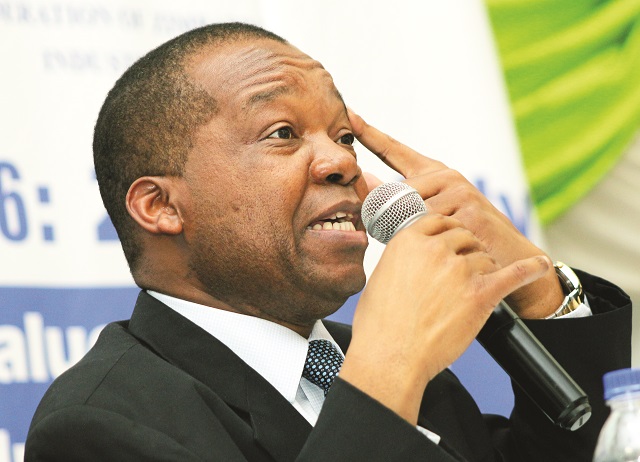
Oliver KazungaSenior Business Reporter
FOREIGN payments processed by the banking sector in the first half of the year dropped by 24 percent to $2,7 billion on the back of limited foreign currency reserves and import restriction measures, the central bank has said.
During the corresponding period last year, total outgoing payments were $3,5 billion.
In the Mid-Term Monetary Policy Statement presented last week, Reserve Bank of Zimbabwe (RBZ) Governor Dr John Mangudya said:
“For the period January to 30 June 2016, banks processed, on a cash flow basis, total outgoing payments amounting to $2,7 billion.
“This is attributable to the limited foreign exchange reserves within the economy and the positive effect of the import compression policies, which promote the importation of critical goods and services not available on the local market.”
He said the current account deficit was projected to narrow down from a deficit of $1,519 million in 2015 to a deficit of $1,069 million this year partly on account of the projected decline in the import bill.
The projected decline in imports in 2016 is mainly a result of the various measures being implemented to compress imports as well as the economic slowdown, which has reduced the country’s import absorptive capacity. Figures from the Zimbabwe National Statistics Agency released last month show that the country’s import bill in the first seven months of the year went down by 21 percent to $2,89 billion from $3,62 billion during the same period last year.
“A sustained current account deficit poses significant challenges as the country relies on export revenues to generate liquidity to support domestic economic activity.
“In this regard, the need to attract both domestic and foreign investment to rejuvenate industry and generate adequate foreign exchange reserves to cushion the economy from external vulnerabilities, remains integral to economic revival efforts.”
The capital and financial account balance is also projected to decline from a surplus of $1,632 million in 2015 to a surplus of $845 million this year.
This was as a result of the projected decline in private sector offshore loans.
“The projected decline in private sector offshore loans reflects the reduced absorptive capacity of the private sector in concomitance with weakening economic activity,” said Dr Mangudya.
Foreign direct investment into the country is also projected to decline this year.
This underscores the need to build investor confidence to attract foreign capital, which is critical for growth.
“The overall balance of payments position is projected to deteriorate from a deficit of $25,8 million in 2015 to a deficit of $224 million in 2016.
“Within the context of the multiple currency system, monetary and liquidity developments in the country remain closely linked to developments on the balance of payments.
“The external sector is a critical source of liquidity in the economy and it is against this backdrop that the bank introduced the export incentive scheme to boost the country’s export earnings, which have been a significant source of liquidity,” he said. — @okazunga



 Online Reporter