admin
admin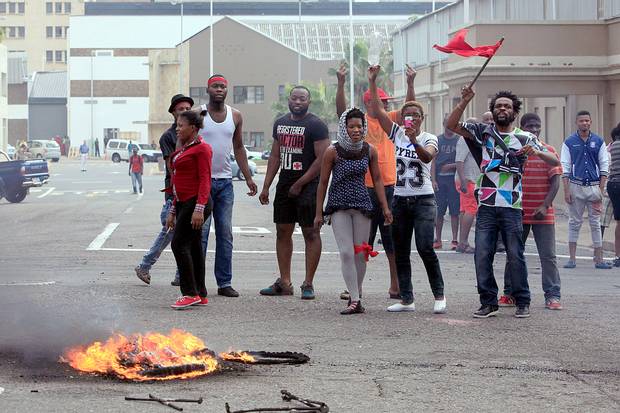

Johannesburg – An Ethiopian street vendor in central Johannesburg said yesterday he received SMSes and WhatsApp messages warning that he and his countrymen faced attack. “It seems that there are attacks planned for Johannesburg on Wednesdays: CBD, Hillbrow, Berea and Yeoville. [On] Wednesday, Zulu people are coming to town starting from Market [street] their mission is to kill every foreigner on the road please pass this to all your contacts in case they come people should be on alert [sic],” it reads.
He said shop owners had opened their businesses in the morning, but after seeing people running up and down the streets they began closing again.
Seeing police and metro police cars driving around did not make him feel any safer, he said, packing away his T-shirts. “Everybody is worried,” he said. He did not want to give his name.
A Nigerian street vendor pleaded for the government to do something. “The president isn’t saying anything. This xenophobia thing is coming back again because the government didn’t do what it was supposed to do in 2008. There’s no security here. If anything were to happen, what will they do?”
Ntombifuthi, 27, from the Eastern Cape, who lives in the CBD, said if government did not want foreigners in the country it should tell them, instead of watching them being killed.
“I’m pleading with the government. If our government doesn’t want foreigners then stop giving them visas. How do they expect foreigners to be treated in other countries if we behave like this?” she asked.
“Young South Africans, we’ve to be open-minded, we’ve to be accommodating to everyone.”
A Nigerian man said: “A lot of people from South Africa are working in Nigeria. Let them come back here as well.”
Samuel Andreas, an Ethiopian who had been in South Africa for five years, said he could not go back to his home country.
“If the South African government doesn’t want us to stay here, please can they help us find refuge in other countries because back in Ethiopia there is war. So we can’t go back there. We’re helping the economy here.”
A more alarming message was circulating in the Durban area following attacks in which five people were killed.
It warns people to stay away from the city centre, Tongaat, Verulam, Umlazi, Isipingo, and Kennedy Road. It made claims of a “massive riot going on”, “three people dead” and shops being set on fire with people still inside.
Hundreds of migrants mostly from other African countries had been forced out of their homes, authorities said on Tuesday.
Khadija Patel, a South African journalist, said there have been previous instances of violence against foreigners. “Hundreds of foreign nationals were displaced in Isipingo (20km south of Durban) late last month, when a group of South Africans attacked foreigners living and working in the area. The victims of that continue to reside in a makeshift camp at a sports ground in Isipingo,” Patel said.
“The Isipingo attacks was blamed on a labour dispute at a local wholesaler, and government refused to categorise the violence as xenophobic violence,” Khadija added.
Most of the recent unrest occurred in and around the coastal city of Durban, where police said two foreigners and three South Africans were killed.
The dead included a 14-year-old boy who was allegedly shot during looting on Monday night and died at a hospital, police official, Jay Naicker, police spokesperson, said.
About 34 people have been arrested for possession of unlicensed firearms and other crimes in the last two days, he said.
“Police are deployed and in high alert in most of the areas where there are foreign nationals,” Naicker said.
Despite the increased police presence, authorities are hard pressed to stop unrest that recalls similar violence in South Africa in 2008 in which about 60 people died.
In January this year, four people died during a week of looting of foreign-owned shops and other violence in Soweto and other areas of Johannesburg, stores owned by foreigners in Johannesburg are closing for fear of the violence spreading.
Some South Africans have accused immigrants of taking jobs and opportunities away from them.
The latest violence followed reported comments by Zulu King Goodwill Zwelithini, an influential figure among the Zulu ethnic group, that foreigners should “pack their bags” and leave.
Zwelithini has since appealed for an end to the unrest, and says he has been misquoted, but many of those rioting were heard chanting “the King has spoken,” Patel said.
Malawi plans to repatriate at least 400 of its citizens following the attacks in South Africa, said Kondwani Nankhumwa, Malawi’s information minister.
Malawi is currently in discussions with South Africa to arrange temporary travel papers for stranded Malawians because most lost their passports in the chaos, Nankhumwa said.
“Most of them fled with literally nothing to safe camps,” Nankhumwa said. “The numbers will swell since some Malawians are in hiding.”
South Africa President Jacob Zuma condemned the violence and assigned several cabinet ministers to work on the problem with officials in KwaZulu-Natal province, which includes Durban.
The government is addressing South African citizens’ “complaints about illegal and undocumented migrants, the takeover of local shops and other businesses by foreign nationals as well as perceptions that foreign nationals perpetrate crime”, Zuma’s office said in a statement. The violence against immigrants is “an expression of a terrible failure of memory by South Africans” who endured racial intolerance under apartheid, two South African foundations said.
The foundations are named after anti-apartheid leader Nelson Mandela, who died in 2013, and Ahmed Kathrada, another campaigner against the white racist rule that ended in 1994.
In a statement, the foundations welcomed efforts by Zuma and other senior leaders to stop the unrest, but said: “For too long, South Africans in leadership positions have either ignored the crisis or stoked the fires of hatred.” – Al Jazeera/AP



 Online Reporter