Online Reporter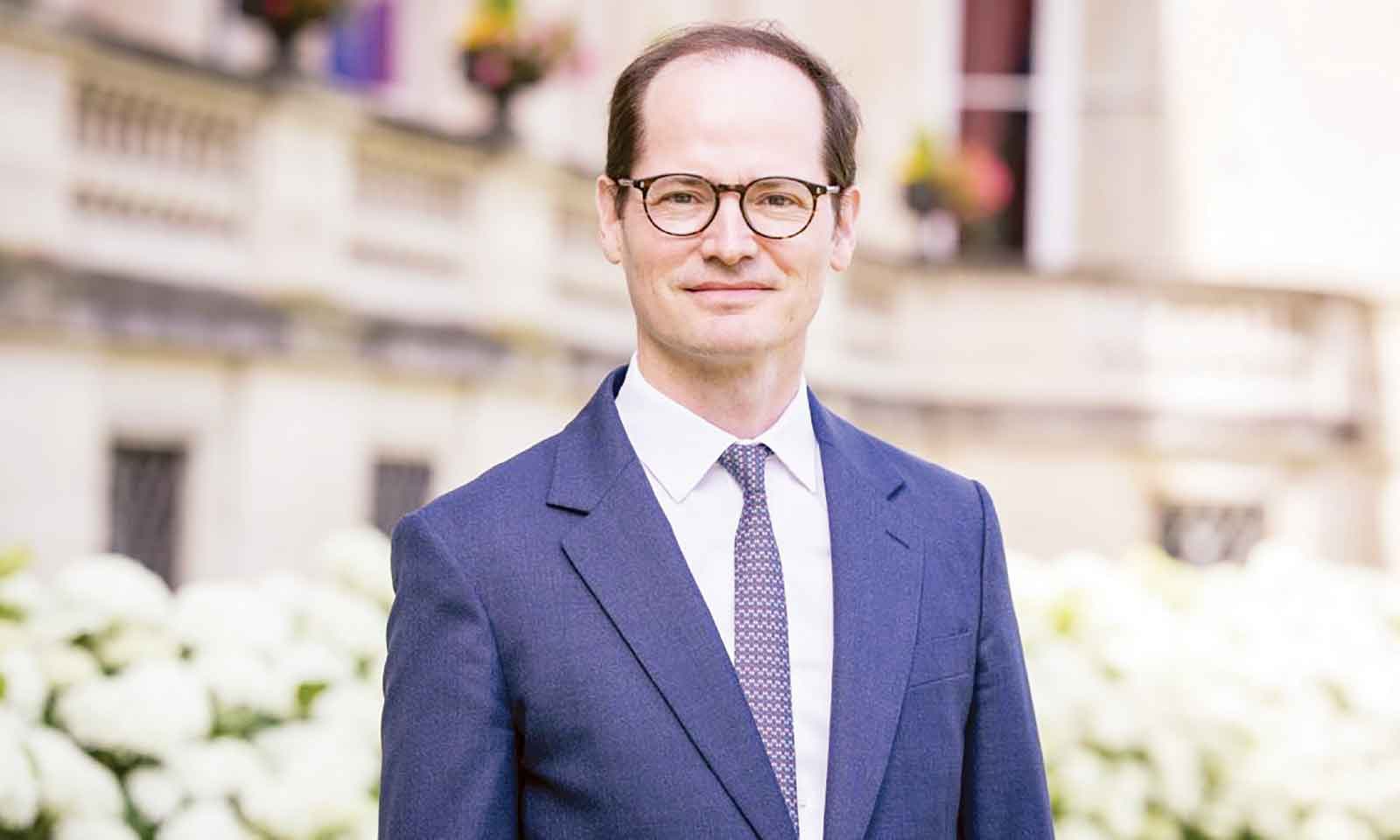
Zimbabwe and France, along with the European Union (EU), are realigning their formerly acrimonious positions towards each other, to one focused on mutual cooperation. French Ambassador to Zimbabwe Mr Paul-Bertrand Barets (PB) told Zimpapers Politics Hub’s Gibson Nyikadzino (GN) that his country and the EU are taking the ‘Zimbabwe is Open for Business’ seriously. Below are the excerpts:
GN: You have been in Zimbabwe for almost 18 months. What is your assessment of Zimbabwe-France relations?
PB: It has been a very rich year for both countries, on the economic and the political sides. It was rather exceptional that for the first time we had political visits, governmental visits from the Zimbabwean side to France. We had the First Lady who went to France on the occasion of the cultural week of UNESCO, and met with the French First Lady. Overall, there is a very positive momentum between our countries, and my intention is to amplify this. Our priorities in terms of cooperation are still the same.
GN: What are some of these priorities that you share?
PB: It is fostering approved climate-resilient agriculture in Zimbabwe. It is fostering women empowerment in the economy. It is about food security. So these priorities will still be there. We are also going to enlarge our cooperation to new avenues like green financing where I think there is a huge potential. Zimbabwe is a very rich country in terms of biodiversity, and you are doing a lot of efforts to preserve and to protect your biodiversity. On the other side, France has a very advanced culture of green finance, with carbon credits, biodiversity credits. Our countries have created the French-Zimbabwean working group to deal with green finance. And so now we are trying to develop this conversation between our two countries.
GN: As a member of the European Union, how do you read the bloc’s importance in your cooperation with Zimbabwe?
PB: France is a founding and active member of the EU, and it is very important to collectively coordinate with our EU colleagues on our actions in Zimbabwe. The EU is a major donor and a major development partner of Zimbabwe, in the framework of the NDS1 and NDS2. And so, yes, France is placing its priorities, the ones I just recalled, in the larger context of the EU action in Zimbabwe. And there is a major project about Zimbabwe’s heritage site, the Great Zimbabwe.
GN: How much progress has been made so far in the Great Zimbabwe project?
PB: The Great Zimbabwe project will be the flagship of our cooperation in 2026. You have this incredibly important world heritage site that is of high archaeological value, world famous, unfortunately not visited enough because infrastructure has to be upgraded and to be more attractive for the international and also the domestic visitors. We thought that it would be a great idea to finance the rehabilitation of the site by creating a brand new visitor centre up to the international standards. We are now finishing the work and hopefully before July, we will be able to inaugurate it at high political level.
GN: Can you tell us about the upcoming Africa Forward summit you will be co-hosting with Kenya, for the first time in a non-French-speaking African country?
PB: France has a very keen and old interest in Africa. This new approach of our president and authorities is now to try to enlarge our relationship towards non-French-speaking Africa. For the first time, this Africa-France summit, called Africa Forward, will be hosted in an English-speaking African country, that is Kenya. So it will be co-hosted by Presidents William Ruto and Emmanuel Macron on the 11th and 12th of May. The very focus of it will be on the economic relationship between the continent and France.
GN: How is this likely to enhance the economic relationship between Zimbabwe and France?
PB: It is taking place in a broader context where everyone can observe that the Zimbabwean economy is really doing better; with a one digit inflation, with macroeconomic fundamentals that are dramatically improving, GDP growth in 2026 is well above seven percent according to the IMF. So we have a very favourable context. We salute the authorities very much. We have agreed upon a special staff monitoring programme with the IMF, which is a first phase of dialogue being reconnected with the international financial institutions. So all these elements are very encouraging. And in this context, there are opportunities for French companies to seize.
GN: Which areas are of interest to the French companies?
PB: I think that transportation, for example, is very interesting. Transportation, logistics, and you have new actors. Think, for example, of the TV sector, where Canal+, the French Canal+, purchased DSTV. And now it is going to develop more and more of its programmes in Zimbabwe as well, not only in South Africa. I cannot say everything about that because some prospects are still confidential. But frankly speaking, it is encouraging that we take very seriously the mantra of the authorities that “Zimbabwe is Open for Business. We take it seriously. Our companies take it seriously, are ready for that.
GN: With regards to the issue of the lifting of freeze on assets and travel bans on Zimbabwe, is there any role that France played as an EU member state?
PB: Indeed, my country and my authorities here in Harare and in Brussels as well, were very active in the conversation we had at EU level about the necessary evolution of the sanctions against Zimbabwe. This regime of sanctions had already evolved these last years. But still had some provisions in the Zimbabwean sanctions regime related to the possibility to freeze assets or to ban trips. I am very glad to confirm that last February 2026, the EU Council has decided on a proposal from the EU ambassadors in Harare. With a strong role of France in this conversation, the EU Council has decided to totally lift these provisions so that now there is only the arms embargo, but there is no more Zimbabwean sanctions as such now.
GN: Does it mean that officials can travel to the EU?
PB: Well, there were no more real bans of any trip. But there was still the legal possibility to decide to apply such a provision. Now this provision has been totally cancelled, withdrawn.
GN: Culturally, what are some flagship projects that are in place to illustrate the vitality of this cooperation between the two states?
PB: Culture and education are at the very heart of our very lively relationship. On the education side, we are very active through the French International School. We are very active through our French Alliances. For example, currently we have cultural activities on the Francophonie with partners and different embassies that are part of the Francophonie. The DR Congo is very much represented in this programme as being the country in the world where the number of French speakers is the biggest. So it’s in Africa that we have the biggest number of French speaking people. The French school is organising on this occasion to enable more than 600 students in more than 40 schools to participate in a French song contest. That seems quite a remarkable exchange.
GN: Zimbabwe needs technology and research to modernise its economy. What are levels of cooperation in this area?
PB: We are very fortunate to have here in Zimbabwe, French scientific teams that have been working in the field for decades. They are focusing very much on all the problems related to the cohabitation of human beings and wildlife. They are focusing on biodiversity conservation and working very much with Zim-Parks, and the University of Zimbabwe. We inaugurated a brand new laboratory for biological analysis at the UZ a few months ago that enabled ZimParks and French researchers to anticipate the risk of transmission of diseases from the wildlife to the human beings or to the cattle as well.