Online Reporter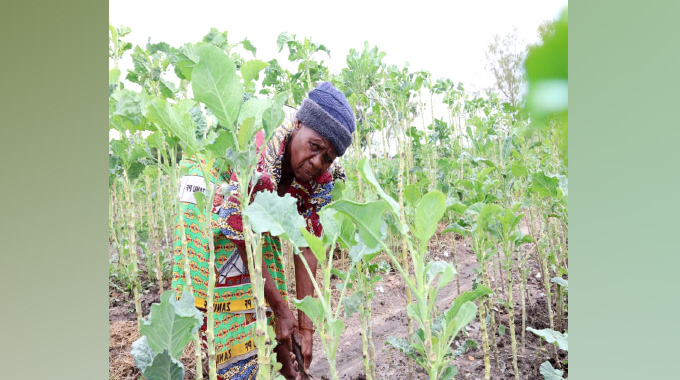
Theseus Shambare, Features Writer
THE names are stitched into Bulawayo’s memory.
MaKhumalo, MaDlodlo, MaMkhwananzi, MaHadebe and MaNdlovu.
These popular beer gardens were the heartbeat of township life — banter was shared, people danced, laughed and wore off the day’s struggles. The beer gardens held families together through hardship and joy. Today, at Old Lobengula’s MaMkhwananzi Garden, the same lineage of women — grandmothers, widows, aunties — work the soil under solar panels.
MaMkhwananzi Garden stands as a testament to that continuity, where culture meets survival and heritage is planted in every seedling.
They do not brew beer here; they plant tomatoes, onions and leafy vegetables.
Where the beer garden once signalled culture and care, the vegetable beds now signal survival, dignity and a very modern answer to an old problem: how to feed a city when rains and city tap water fail.
A newly installed solarised borehole by the World Food Programme (WFP) has breathed life into the dusty plots, allowing 91 families to grow vegetables all year-round and earn a small but reliable income.
Each household manages three beds, each 30 metres long and 1,5 metres wide, planted with tomatoes, onions and leafy greens that are sold to local vendors.
A well-managed bed brings in roughly US$30 per harvest, translating to US$150 every fortnight, or about US$3 900 a year, money that goes straight to feeding families, paying school fees and buying essentials in a city where urban food insecurity is a growing threat.
The urgency of such community-led initiatives is underscored by recent ZimLAC assessments, which estimate that 1,7 million urban Zimbabweans were food insecure during the lean season, a number driven by erratic rainfall, high food prices and limited social protection.
That translates to millions of lives where access to fresh vegetables can mean the difference between going hungry and putting a plate on the table and in that reality, gardens like MaMkhwananzi are quietly revolutionary.
Beyond individual gardens, broader urban solutions are reshaping food security in Bulawayo, as the WFP works to protect, build and prepare cities for shocks, combining cash assistance for vulnerable households, livelihoods and entrepreneurship training for women and youth, and urban preparedness initiatives with local authorities.
These complementary streams ensure that families can meet immediate food needs, strengthen incomes through diversified urban livelihoods and build resilience so that cities are ready for climate or economic shocks.
Initiatives such as MaMkhwananzi Garden are a living example of the “Build” pillar in action, showing how targeted support, tools and mentorship can turn small plots into thriving urban enterprises.
At MaMkhwananzi, the national numbers take human form. Just after 8AM, on a hot weekday, the garden feels like a living mural — rows of green threading into the burnt earth, women bending slowly at the waist, the clink of buckets, the soft splash of water and from the shade of a jacaranda stump, the low hum of memories from the beer garden days.
Mrs Marry Ndlovu (89) — small, wiry, with hands that tremble slightly yet hold seedlings with tender precision — leans on her hoe and lets out a breath heavy with both loss and pride.
She buried two of her four children — a loss that heavily weighs down her spirit — and now she stands as provider for her grandchildren.
“At my age, I never imagined I could still work and provide,” she said.
The garden, she said, is the difference between sleeping hungry and putting a plate on the table.
Nearby, Mrs Winnie Ndlovu (82) and Mrs Sibonginkosi Sipepa (78) share the same rhythms: early mornings, careful pruning, the bartering of seedlings and the friendly bargaining with vendors who buy their harvests at wholesale.
On this day, the ladies had an opportunity to sell to visitors from Harare who were impressed by the garden’s produce.
These women are not victims in the headlines.
They are the architects of their small resilience — the people who convert water into food and food into dignity.
Climate change does not strike evenly.
In Bulawayo — a city that has seen erratic rainfall, dwindling dam levels and frequent water cuts — the burden of scarcity falls disproportionately on women. They collect water, feed children, and stretch meagre incomes.
When urban safety nets are thin, elderly women emerge as de facto heads of household. They labour in backyard and community gardens not as hobbies but as social protection by other means.
That gendered reality makes MaMkhwananzi’s simple technology — a solar pump and reliable water — a transformative adaptation.
It reduces the time women spend fetching water, enables steady planting cycles and allows older growers to plan harvests that meet both consumption and market needs.
In short, climate-resilient infrastructure becomes gender-responsive infrastructure.
The borehole’s ripple effects are already visible beyond leafy greens.
Young people — including Hillary Moyo (22) and Thandekile Jubane (32) — are sketching out fish ponds at the garden’s edge.
Where elders tend soil, youths see enterprise: fish for local markets, value chains that could absorb excess produce and new jobs in processing and sales. Hillary traces rectangles with a shovel.
“Here, we are building a fish pond,” he said, eyes bright. If we combine vegetables with fish farming, we can supply supermarkets, create jobs and expand the garden into a business. This is not just about food; it is about opportunity.”
His colleague, Thandekile, nods in agreement.
“The gogos teach us to work hard. We want to learn from them, but also to grow bigger, to make this a sustainable venture for youth.”
Their ambition aligns directly with Zimbabwe’s national strategies, where Village-Based Units (VBUs) are being rolled out countrywide to stimulate youth agripreneurship, strengthen climate-smart agriculture and diversify urban livelihoods, creating networks of interconnected enterprises that share resources, link production to markets and build competitiveness and resilience across communities.
MaMkhwananzi Garden already illustrates this model, as youth innovators and elderly mentors combine knowledge, water infrastructure and market access to turn small plots into productive, interlinked agribusinesses.
During the recent World Food Day commemorations at the Matopos Research Institute, key officials and development partners gathered to highlight Zimbabwe’s commitment to building resilient food systems.
“We cannot achieve zero hunger without collective action. What we see in communities — gardens, irrigation, climate-smart innovation — these are the real pillars of resilience,” said United Nations Food and Agriculture Organisation (FAO) Subregional Co-ordinator, Dr Patrice Talla.
WFP Country Director Ms Barbara Clemens praised community-led initiatives like MaMkhwananzi, saying, “When people are given the tools to produce food sustainably, dignity is restored. Women lead, youth innovate and households strengthen. This is the future of food security.” Minister of Public Service, Labour and Social Welfare Edgar Moyo said a food-secure community is an empowered society.
“We are committed to ensuring no Zimbabwean goes hungry. Projects like MaMkhwananzi align with our vision — locally driven, water-secure, market-linked agricultural systems that provide both food and income. We need to empower our people. This is a right,” he said.
Lands, Agriculture, Fisheries, Water and Rural Development Permanent Secretary Professor Obert Jiri reinforced the message, noting that Zimbabwe’s pathway to zero hunger is visible at places like MaMkhwananzi. “When water, skills and organisation come together, even a small plot of land can transform livelihoods,” he said.
It is in such small, almost tender scenes that the story of urban food security becomes tangible: elderly women who refuse to surrender to hunger, youth who imagine new enterprises, families that survive because of a solar pump and the stubborn will to work a patch of land.
The lesson is as old as the beer garden that once stood here — community sustains.
MaMkhwananzi Garden has become a quiet but powerful response to Zimbabwe’s urban food insecurity, a reminder that solutions do not always arrive with fanfare; sometimes they arrive in the hands of an 89-year-old woman planting seedlings at dawn.
As the afternoon breeze lifts dust across the beds, Mrs Ndlovu wipes sweat from her brow, looks out over the green rows and smiles.
“This place saved us,” she said simply. “And as long as the water flows, siyaphila — we will live.”